

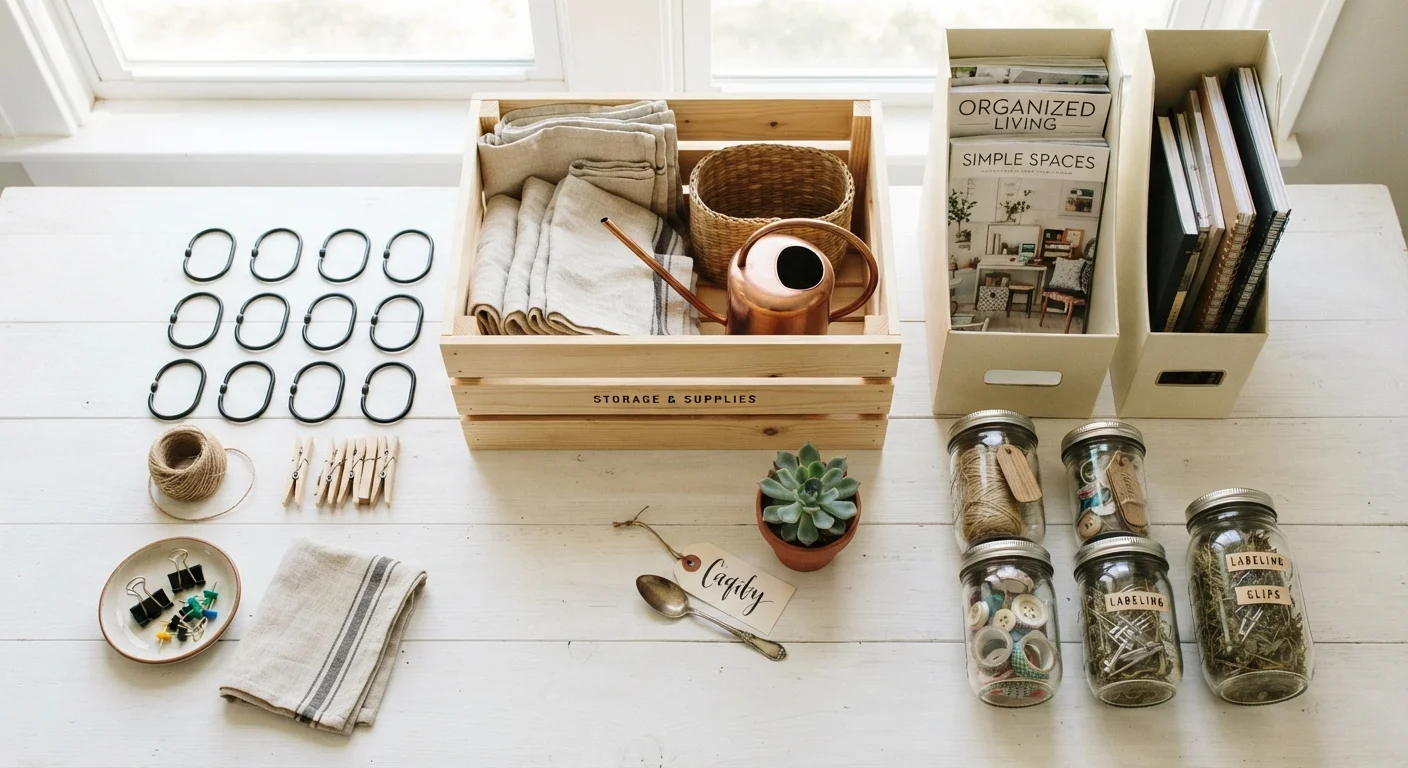
Why Household Items Make Better Organizers Than You'd Expect
Purpose-built organizers are designed for average spaces and average needs - which often means they fit neither your drawer dimensions nor your actual habits. Repurposing household items sidesteps that mismatch entirely. You're working with materials you can hold, measure against your real shelves, and modify without worrying about wasting money on something that doesn't fit.
The items featured here aren't novelty hacks. Each one addresses a specific organizational gap - hanging, sorting, stacking, or corralling - and can be adapted across multiple rooms. Whether you're building out a room-by-room storage strategy or solving one stubborn problem in a single drawer, these materials give you flexible building blocks to work with.
Start With One Problem Area
Rather than overhauling an entire room at once, pick the single spot causing the most daily friction - a cluttered drawer, a chaotic cabinet - and apply one repurposed material to it. Once that system holds for a few weeks, expand from there. Incremental changes are easier to maintain than a full overhaul done in one afternoon.
Before buying anything new, do a quick sweep of your home for candidates. Storage potential often hides in kitchen cabinets, linen closets, and the recycling bin.
Items That Pull More Weight Than Expected
Shower Curtain Rings
A standard set of shower curtain rings costs very little and serves far beyond the bathroom. Clipped onto a tension rod or a closet dowel, they become individual hangers for scarves, belts, tank tops, or cleaning cloths - items that typically pile up because standard hangers don't accommodate them well.
In the kitchen, a row of rings clipped to a cabinet rod keeps reusable bags separated and visible. In a bathroom storage context, rings clipped along a tension rod under the sink can hold small spray bottles by their triggers, freeing up floor space in the cabinet.
Shower curtain rings keep scarves, belts, and spray bottles visible and individually accessible.
Magazine Files
Cardboard or metal magazine files are designed to hold documents upright, but that same structure works for cutting boards, pot lids, baking sheets, and even cleaning cloths folded vertically. Mounted on their sides inside a cabinet with a strip of hook-and-loop tape or a small bracket, they become contained slots that stop flat items from toppling.
In a home office, a row of files on a desktop or shelf organizes notebooks, folders, and mail into distinct lanes. Label each one to maintain the system without thinking about it.
Magazine files keep pot lids, baking sheets, and folders upright and easy to retrieve.
Wooden Crates
Wooden crates are structurally sound, stackable, and easy to modify. Laid on their sides, they function as open-face cubbies for shoes near an entryway - a practical complement to the hooks and shelves covered in our guide to hallway and entryway storage. Stacked vertically with a few screws connecting them, they become a small shelving unit.
A light sanding and a coat of paint or wood stain makes them presentable in living spaces. If you want to go further with wood-based organizers, see our guide on building a wall-mounted entryway organizer from scrap wood.
Wooden crates become stackable cubbies or open shelves with minimal modification.
Tension Rods
A tension rod requires no drilling and can be installed or removed in seconds, making it ideal for renters or anyone who wants to test a layout before committing. Installed vertically inside a deep cabinet, it divides the space into columns. Installed horizontally under a sink, it creates a hanging rail for spray bottles or a second tier for shorter items. Inside a drawer, a pair of rods running parallel act as dividers - a no-cut alternative to the cardboard or foam board dividers approach.
Tension rods divide cabinets, drawers, and under-sink spaces without a single screw.
Mason Jars and Glass Jars
Glass jars with wide mouths are stable, transparent, and available in graduated sizes. On a kitchen counter, they sort utensils by type. On a bathroom shelf, they hold cotton rounds, swabs, and hair ties in a way that makes quantities visible at a glance - which prevents both over-buying and running out. In a small home office, they can hold pens, scissors, and binder clips separated by function.
Jars can also be mounted - attached with metal clamps to a strip of wood or a board, lids screwed under a shelf so the jar threads on below - to get items off the counter entirely. This approach pairs well with the ideas in our guide to organizing a small kitchen without new cabinets.
Glass jars make quantities visible at a glance, preventing over-buying and clutter on any surface.
Pegboards and Scrap Plywood Offcuts
A pegboard section - even a small one - transforms a blank wall section into a configurable storage grid. Hooks, baskets, and shelves can be repositioned as needs change, which is what separates it from fixed shelving. In a garage, laundry room, or craft space, tools and supplies hang in place of piling up on surfaces.
Plywood offcuts serve a similar adaptive role. Cut to fit a specific drawer or cabinet, they become custom dividers or shelf risers. If you're new to cutting wood to size, this reference on tools for basic DIY organizer builds covers exactly what you need to do it accurately.
Pegboards and plywood offcuts create configurable, room-specific storage that fixed shelving can't match.
Putting It All Together
The real power of these materials shows up when you combine them. A wooden crate on a shelf with a tension rod installed inside it - and shower curtain rings hanging from that rod - creates a compact, multi-layer system for scarves, belts, or cleaning cloths. Magazine files lined up inside a crate handle vertical storage while the crate itself manages the horizontal footprint.
If you want to take this further, our full DIY organizer guide covers planning, joinery basics, and room-specific ideas in detail. And if you're uncertain whether your homemade setup will actually stick, it's worth reading about why DIY organizers often fail - spoiler: it's rarely a craftsmanship problem.
The goal isn't to fill your home with clever projects. It's to build systems that match how you actually live, using materials that are already available to you.
The content on this site is for informational purposes only and is not a substitute for professional advice. Always consult a qualified professional for guidance specific to your situation.