

Start here
Why Decluttering Feels So Hard to Start
Next
Choosing a Framework That Fits Your Life
Then do this
Your First 30-Minute Declutter Session
Wrap up
Building Momentum After Day One
Why Decluttering Feels So Hard to Start
Most people don't struggle with decluttering because they lack time or motivation - they struggle because every single item seems to require a decision, and the sheer volume of decisions is exhausting before you even begin. This is sometimes called decision fatigue, and it's the primary reason well-intentioned decluttering sessions stall at the planning stage.
There's also a tendency to think the whole home needs to be tackled at once. It doesn't. Framing decluttering as a single massive project is one of the most common reasons people never start. Instead, think of it as a series of small, repeatable actions - each one complete in itself.
Emotional attachment adds another layer. Objects carry memories, and discarding them can feel like discarding part of a relationship or a period of life. That's a legitimate feeling, not a character flaw. Acknowledging it - rather than pushing through it impatiently - tends to produce better, more durable results.
Start with low-stakes items first
Save sentimental objects - photos, gifts, inherited items - for later sessions when your decision-making stamina has built up. Beginning with neutral, practical objects like duplicate kitchen tools or expired pantry items lets you practice the sorting habit without emotional weight. Most experienced declutterers recommend working through at least two or three spaces before touching anything with sentimental value.
Choosing a Framework That Fits Your Life
Decluttering frameworks are essentially decision-making tools. They give you a repeatable question to ask about each object so you don't have to reinvent your criteria every time you pick something up. Two of the most widely recognized approaches are:
- The room-by-room method: You work through the home one space at a time, finishing each before moving on. It produces fast, visible results and is well-suited to busy schedules because progress is easy to track. Our room-by-room walkthrough covers this approach in full detail.
- The category method: You gather all items in a given category - say, all clothing or all kitchen gadgets - from every room at once, then sort through the entire collection together. This gives a more accurate picture of what you actually own but requires a larger block of time upfront.
Neither is objectively superior. The right choice depends on your available time, your household size, and whether seeing immediate room-level results matters to you. For a detailed comparison, see decluttering by category vs. by room.
You can also draw from minimalist principles - such as those covered in the 20/20 rule and related ideas - to sharpen your decision-making criteria without committing to a full minimalist lifestyle.
Decision fatigue
The mental exhaustion that comes from making many choices in a row, which causes later decisions to feel harder or get avoided entirely.
Category method
A decluttering approach where you collect every item in a given category from across the whole home and sort through them all at once.
Room-by-room method
A decluttering approach where you fully process one room or space before moving to the next, producing visible, room-level results quickly.
One-touch rule
A habit of handling each item only once during a declutter session - picking it up, deciding immediately, and placing it in the appropriate container.
Buy-nothing group
A community sharing network, often organized by neighborhood, where members give away items for free rather than selling or discarding them.
Your First 30-Minute Declutter Session
Pick the smallest, most self-contained area you can find: a junk drawer, a bathroom vanity shelf, or one side of a closet. Thirty minutes is enough time to make real progress on a contained space, and finishing something - anything - is the most reliable way to build confidence for the next session.
- Set a timer. Thirty minutes, no more. A hard stop removes the anxiety of an open-ended commitment.
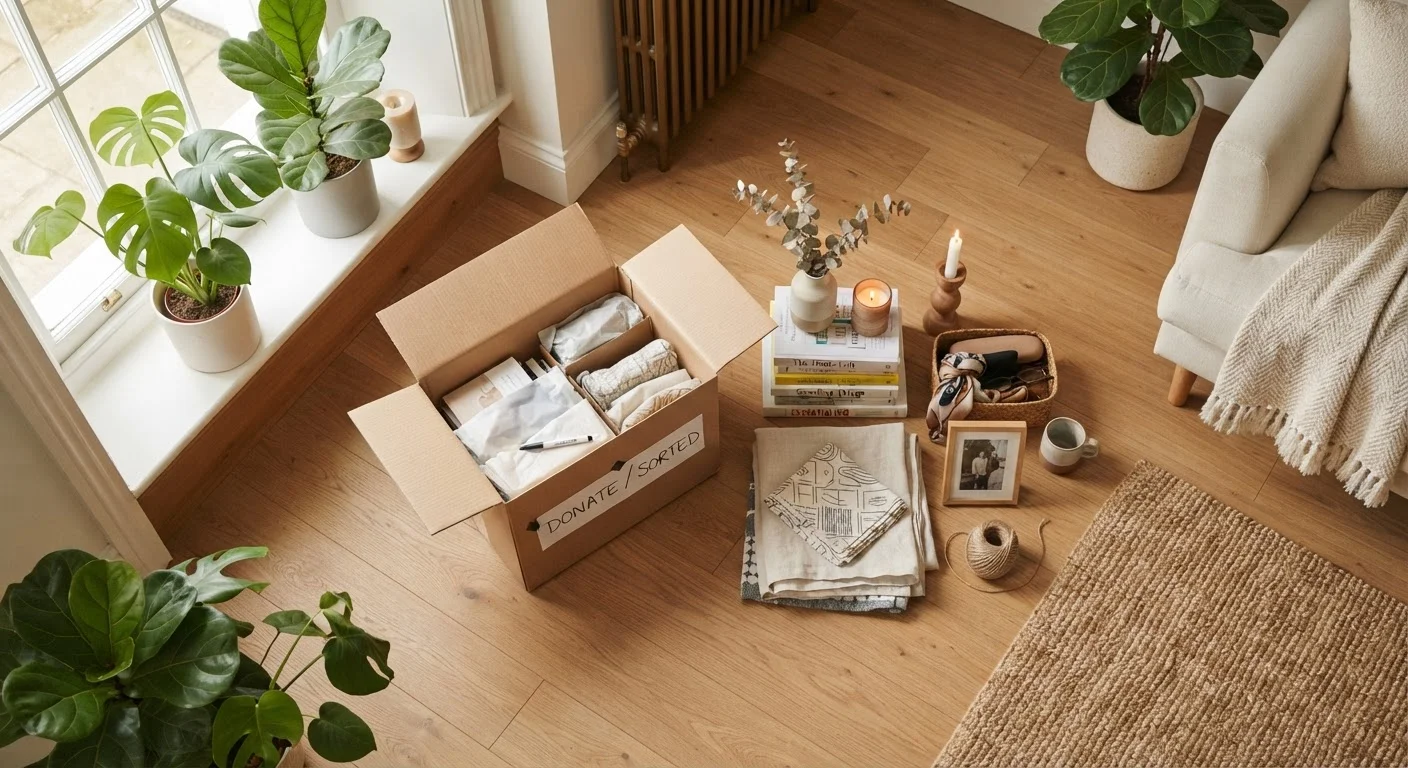
- Gather three containers. Label them: Keep, Donate/Rehome, and Trash. A fourth for Belongs elsewhere is optional but useful.
- Handle each item once. Pick it up, make a decision, place it in a container. Avoid the "maybe" pile - it typically becomes a permanent home for items you're avoiding.
- Stop when the timer ends. Return keep items to the space neatly. Move donate and trash bags out of the room immediately.
Resist the urge to reorganize while you declutter. Storage solutions should come after you've decided what stays - otherwise you end up organizing clutter rather than eliminating it.
What to Do With Items You're Removing
One of the fastest ways to undermine a declutter session is leaving bags of removed items sitting in a hallway or garage for weeks. The items haven't left your home, your space doesn't feel different, and it becomes easy to second-guess decisions and retrieve things.
Have a plan before you start:
- Donate: Many communities have local thrift stores, shelters, or community centers that accept household goods. Check their current accepted-items list before dropping off, as needs vary.
- Recycle: Electronics, certain plastics, and textiles often have dedicated recycling streams. Municipal waste authority websites typically list drop-off locations.
- Rehome locally: Buy-nothing groups, neighborhood apps, and local free-stuff listings can move items quickly to people who will use them.
- Trash: Some things are simply worn out and need to go. Holding onto them out of guilt doesn't serve anyone.
Set a rule for yourself: anything leaving the keep pile leaves the house within 48 hours. That single habit has an outsized impact on maintaining the clarity you've created.
Building Momentum After Day One
The goal after your first session isn't perfection - it's a second session. Momentum is built through repetition, not intensity. A 30-minute session twice a week will move you further than one exhausting all-day effort that leaves you burned out for a month.
After a few sessions, you'll naturally develop your own decision-making rhythm. You'll start to recognize patterns in what you hold onto unnecessarily, and the per-item decisions will become faster. That's when you can expand to larger areas with more confidence.
If you share your home with others, the process gets more complex. Different people have different attachments, different tolerances for clutter, and different ideas about what counts as useful. Our guide on decluttering with a household addresses how to navigate that without friction becoming a reason to stop entirely.
When you're ready to plan the full arc of your home, the complete decluttering guide covers everything from method selection to maintaining results long-term. For now, though, the only next step that matters is scheduling your second session.
Frequently Asked Questions
Start with the smallest, lowest-stakes area you can find - a single drawer, a bathroom shelf, or a countertop. Finishing one contained space creates a visible win that motivates the next session. Avoid beginning with sentimental items, which are emotionally demanding and best tackled after you've built some decision-making momentum.
There is no universal timeline. A small apartment may take a few focused weekends; a larger family home with accumulated belongings could take several months of consistent sessions. Working in regular short bursts - say, 30 to 60 minutes a few times a week - is generally more sustainable than marathon all-day efforts.
Decluttering by room means finishing one space before moving to the next, which suits people who want immediate, visible results. Decluttering by category (such as all clothing or all books at once) gives a clearer picture of how much you own across the home. See our <a href="/home-organization/decluttering-methods/decluttering-by-category-vs-by-room-which-approach-works-better">comparison of both methods</a> to decide which suits you.
Sort removed items into donate, recycle, or trash as you go, and get bags or boxes out of the house within a day or two. Letting sorted items sit in your home for weeks can blur the progress you've made and tempt second-guessing. Local donation centers, recycling programs, and community buy-nothing groups are common options.
Yes, especially when handling objects tied to memories or significant life chapters. Slowing down, acknowledging the feeling, and setting a time limit on deliberation can help. If shared belongings are creating conflict, approaches for <a href="/home-organization/decluttering-methods/decluttering-with-a-household-navigating-different-attachment-styles">decluttering with a household</a> may be useful.
No - a method helps but is not required. What matters most is making a decision about each item and removing what no longer serves you. A framework simply provides decision-making shortcuts so you spend less mental energy on each object. Start simple and adapt as you learn what works for your household.
The content on this site is for informational purposes only and is not a substitute for professional advice. Always consult a qualified professional for guidance specific to your situation.