

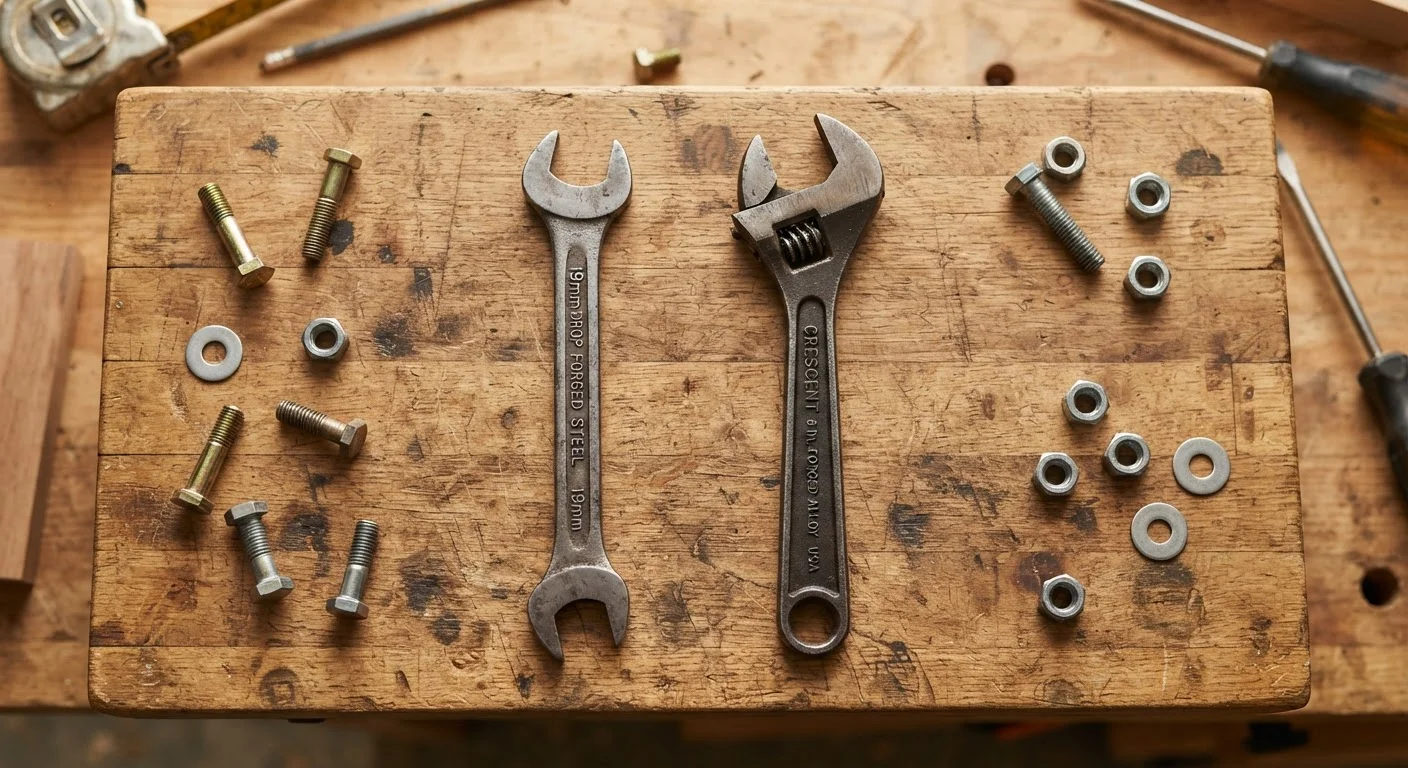
Option A
Fixed-Joint Wrench (Box-End / Open-End Spanner)
The precise, purpose-built specialist.
Best for: Repetitive work on known fastener sizes where grip strength, torque, and a slim profile matter most.
Option B
Adjustable Wrench (Crescent-Style)
The flexible, one-tool solution for varied jobs.
Best for: Occasional use on unknown or mixed fastener sizes when carrying a full spanner set isn't practical.
How Each Wrench Actually Works
A fixed-joint wrench has jaws machined to one exact measurement - say, 9/16 inch or 14 mm. That jaw fits one fastener size and one size only. Most come in two flavors: the open-end style (a U-shaped jaw that slides onto the fastener from the side) and the box-end style (a fully enclosed ring that wraps around all six or twelve points of a hex fastener). Some combine both on opposite ends of the same handle.
An adjustable wrench uses a worm gear - a small thumbwheel - to slide one jaw toward or away from a fixed jaw. Turn the wheel, and the gap between the jaws narrows or widens to match the fastener you're working on. One tool, theoretically, fits dozens of bolt sizes.
Understanding this mechanical difference is the key to knowing when each tool earns its place. The adjustable wrench asks you to do a step the fixed wrench already has done for you: fit the jaws precisely. That extra step introduces a variable - and variables in tool fit are where problems start. For a broader look at how hand tools stack up as a category, see our guide to hand tools vs. power tools.
What Fixed-Joint Wrenches Give Up - and What They Don't
The obvious limitation of fixed wrenches is range. If you own a set from 1/4 inch to 3/4 inch and encounter a 13/16-inch bolt, you're stuck. Building a comprehensive set also costs more upfront and takes up more drawer space than a single adjustable wrench.
But what fixed wrenches don't give up is grip security. Because the jaw is machined precisely, there's no play between the wrench and the fastener when the fit is correct. That matters enormously when you're applying real torque - loosening a corroded pipe fitting, for example. A box-end wrench distributes force across all six sides of a hex fastener, which is why mechanics rely on them for the stubborn stuff.
| Criterion | Fixed-Joint Wrench | Adjustable Wrench |
|---|---|---|
| Fastener size range | One size per wrench | Wide range per wrench |
| Grip precision | Exact, no jaw play | Some jaw wobble possible |
| Risk of rounding fasteners | Low with correct size | Higher if fit is loose |
| Profile in tight spaces | Slim, easy to maneuver | Bulkier jaw assembly |
| Upfront cost for full coverage | Higher (set required) | Lower (one tool does more) |
| Best torque application | Box-end excels here | Limited at high torque |
Fixed wrenches also tend to be slimmer, making them easier to maneuver in cramped spots - behind an access panel, inside a cabinet, or along a baseboard pipe.
What Adjustable Wrenches Give Up - and What They Don't
The adjustable wrench's main weakness is fit precision. Even when you dial the jaws in carefully, there's often a small amount of jaw wobble. Under high torque, that wobble can cause the wrench to slip and round off the corners of a bolt head - making a straightforward job suddenly much harder.
The fix is proper technique: always pull the handle toward the side where the fixed jaw is doing the work, not the moveable jaw. This puts the primary load on the more stable side. Also dial the jaws as snug as they'll go before applying force - never leave slack in the fit.
What the adjustable wrench doesn't give up is versatility. A single 10-inch adjustable wrench can handle most fasteners you'll encounter in a home setting, from the locknut on a sink drain to the bolts on a water heater connection. For a homeowner who isn't working on cars or machinery daily, that adaptability is genuinely valuable.
The same principle - picking the right tool for the right job - applies across all hand tools. Our piece on screwdriver types and drive heads explores a similar set of trade-offs worth understanding.
Always Snug the Jaws Before You Pull
The most common adjustable wrench mistake is applying force before fully tightening the thumbwheel. Even a half-turn of slack translates into jaw slippage under load. Get the jaws as tight as they'll go against the fastener, double-check the fit, and then apply your pull. This one habit prevents the majority of rounded-bolt problems.
Building a Sensible Wrench Collection
For most DIY households, the answer isn't one wrench type or the other - it's a deliberate mix. A good starting point: one medium adjustable wrench (around 8-10 inches) for general household tasks, plus a small set of fixed combination wrenches (open-end on one side, box-end on the other) covering the sizes you encounter most often in your home's plumbing and appliances.
As you take on more specific projects, let the work guide what you add. Doing regular bike maintenance? A metric fixed set in 8-17 mm covers almost everything. Tackling plumbing more often? Consider adding a dedicated pipe wrench to the mix, which is a different tool category built for round fittings.
The key insight is that both wrench types are complements, not competitors. Reach for the adjustable when flexibility matters; reach for the fixed when torque or precision does. That mental model will serve you better than any single universal tool.
6-point
Box-end grip recommended for high-torque work
Mechanics and trade professionals generally prefer 6-point box-end sockets and wrenches over 12-point designs when breaking loose stubborn fasteners, as the contact area per side is larger and less prone to slipping.
~10 in
Most versatile adjustable wrench size for home use
A 10-inch adjustable wrench typically spans jaw openings from 0 to about 1-3/16 inches, covering the majority of household plumbing and appliance fasteners with a single tool.
The content on this site is for informational purposes only and is not a substitute for professional advice. Always consult a qualified professional for guidance specific to your situation.