

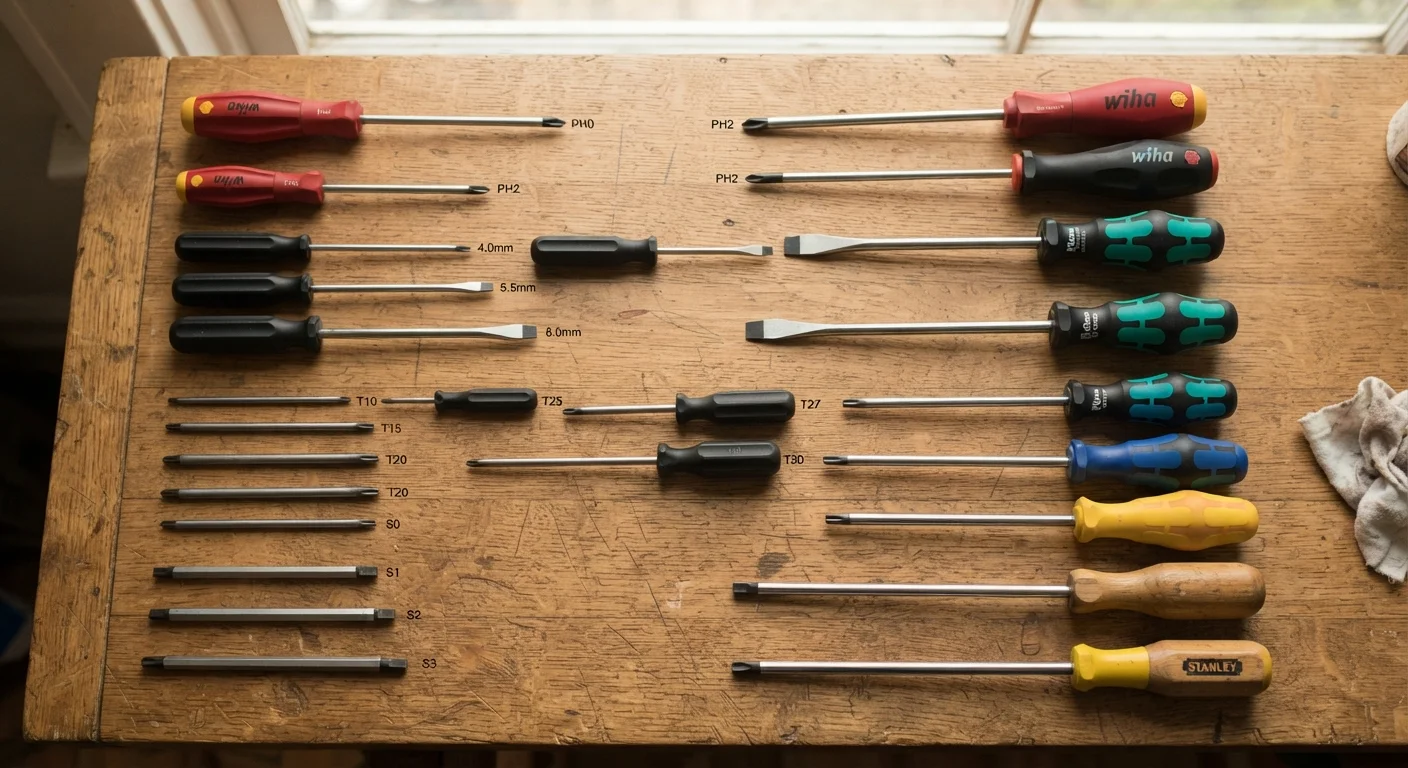
The Drive Types You'll Actually Encounter
Walk into any hardware store and you'll find screws with a dizzying variety of head recesses. In practice, most DIY projects in the US involve just four or five drive types - and knowing what distinguishes them prevents stripped screws, wasted time, and unnecessary frustration. See our guide to why drills strip screws for a closer look at what goes wrong when the match is off.
| Most common drive type in US residential hardware | Phillips (PH2) |
| Number of standard Phillips sizes | 4 (PH0-PH3) |
| Drive type least prone to cam-out | Torx / Robertson |
| Flat-head screwdrivers also used as | Pry tools, paint-can openers, chisel substitutes |
| Typical starter bit set coverage | PH1, PH2, SL4, SL6, T15, T25, SQ2 |
| Stripping risk increases when | Bit size doesn't match screw recess exactly |
Flat-Head (Slotted)
The oldest drive type - a single horizontal slot across the screw head. A flat-head driver engages it, but the shallow geometry means the bit slides out sideways under even moderate torque. Slotted screws are still common on older light switches, electrical terminals, and decorative hardware. For any application where you're applying real force, slotted screws are not ideal. Use the widest blade that fits snugly in the slot without overhanging the screw head.
Phillips (PH)
The dominant drive type in North American construction, Phillips screws have an X-shaped recess. They come in sizes PH0 through PH3; PH2 handles the vast majority of drywall, wood, and cabinet screws you'll meet on a typical project. Phillips was actually designed with mild cam-out in mind - it was meant to prevent overtightening on assembly lines. That same property frustrates DIYers when driving by hand. Always use the correctly sized bit: a PH2 bit in a PH1 screw will strip it immediately.
Robertson (Square)
Recognizable by its square socket, the Robertson drive grips the bit mechanically, so you can hold a screw on the tip without it falling off - useful when working overhead or in awkward corners. Robertson is standard in Canadian construction and increasingly available in US woodworking and decking hardware. Sizes run from SQ0 (small) to SQ3 (large); SQ2 covers most mid-size screws.
Torx (Star)
A six-lobed star pattern that dramatically increases the contact surface between bit and screw. The result: very high torque transfer with minimal cam-out risk. Torx fasteners are standard in electronics, appliances, automotive interiors, and premium structural hardware. Common sizes for home projects include T15, T20, T25, and T30. If you're assembling flat-pack furniture with metal brackets or working on any appliance, a basic Torx set is essential.
Hex (Allen/Internal Hex)
A six-sided socket requiring an Allen key or hex bit. Flat-pack furniture, bike hardware, and machine bolts use hex drives. They hold the bit securely and transmit torque well, though the socket can strip if an improperly sized key is forced.
Choosing the Right Driver - and Avoiding Common Mistakes
Drive head
The shaped recess on the top of a screw that a screwdriver bit engages with. The geometry of the drive head determines which bit type is needed.
Cam-out
When a driver bit slips out of a screw's drive head under torque, often damaging the recess. Some drive types are engineered specifically to resist cam-out.
Torque
The rotational force applied when turning a fastener. Matching the drive type to the task helps transfer torque efficiently without slipping or stripping.
Bit
The interchangeable tip fitted into a driver or drill that contacts the screw head. Bits come in dozens of profiles to match different drive types.
Robertson (Square) drive
A square-shaped screw recess developed in Canada. It resists cam-out effectively and is common in Canadian construction and some North American woodworking.
Torx (Star) drive
A six-pointed star-shaped drive head that distributes torque across a large contact area, minimizing slippage and making it popular in electronics and automotive work.
The single most important rule: match the bit size exactly to the screw recess. A bit that's even slightly too small rocks inside the recess and chews out the soft metal quickly. When in doubt, test-fit the bit before applying torque - it should seat firmly with no wobble.
Hand Screwdriver vs. Power Driver
For delicate work - electronics, hinges, small trim screws - a manual screwdriver gives you tactile feedback that a drill can't replicate. For repetitive fastening like decking or drywall, a power driver saves enormous effort. If you're making the switch to power tools, the hand tools vs. power tools comparison walks through where each approach earns its place. And when you're ready to pick the right powered option, the drill vs. driver vs. hammer drill guide explains the differences clearly.
Bit Quality Matters More Than Most People Realize
Cheap bits wear down quickly, developing rounded edges that cam out from screw heads. Harder steel bits - identifiable by a darker, often black-oxide or titanium-nitride finish - hold their geometry through many more uses. For occasional home use, a modest mid-range bit set with PH1, PH2, SL4, SL6, T15, T25, and SQ2 covers an enormous range of tasks without overspending.
Working with Older or Specialty Fasteners
Older homes often contain slotted screws in electrical panels and plumbing fixtures. Tamper-resistant Torx (with a center pin) appear in public fixtures. Security hex screws show up on appliances. If you encounter an unfamiliar recess, compare it against a drive-type reference chart before forcing any available bit - doing so preserves the fastener and prevents injury. For context on how hand tools fit into the broader picture, see choosing between a claw hammer and mallet - understanding every tool's design logic sharpens your instincts across the board.
This article is for general educational purposes. Always follow manufacturer instructions for tools and fasteners, and consult a licensed electrician or trades professional for any electrical or structural work requiring permits.
The content on this site is for informational purposes only and is not a substitute for professional advice. Always consult a qualified professional for guidance specific to your situation.