

Why Spatial Illusions Work - and Where They Break Down
Our brains read rooms through visual cues: line direction, contrast, reflected light, and the scale of objects relative to one another. When those cues are manipulated deliberately, a 10-by-12-foot room can register as meaningfully larger than its footprint. But not every trick sold as a space-expander actually delivers - and some backfire entirely.
The goal here is to cut through the decorating folklore and give you a clear-eyed look at which techniques are grounded in how human perception actually works. For deeper context on how objects influence the feel of a space before you move anything, see how visual weight shapes a room.
Myth
Any mirror on any wall will make a small room feel bigger.
Fact
Mirror placement determines effectiveness. A mirror reflecting a window or doorway multiplies perceived depth; one facing a blank wall mostly reflects the wall.
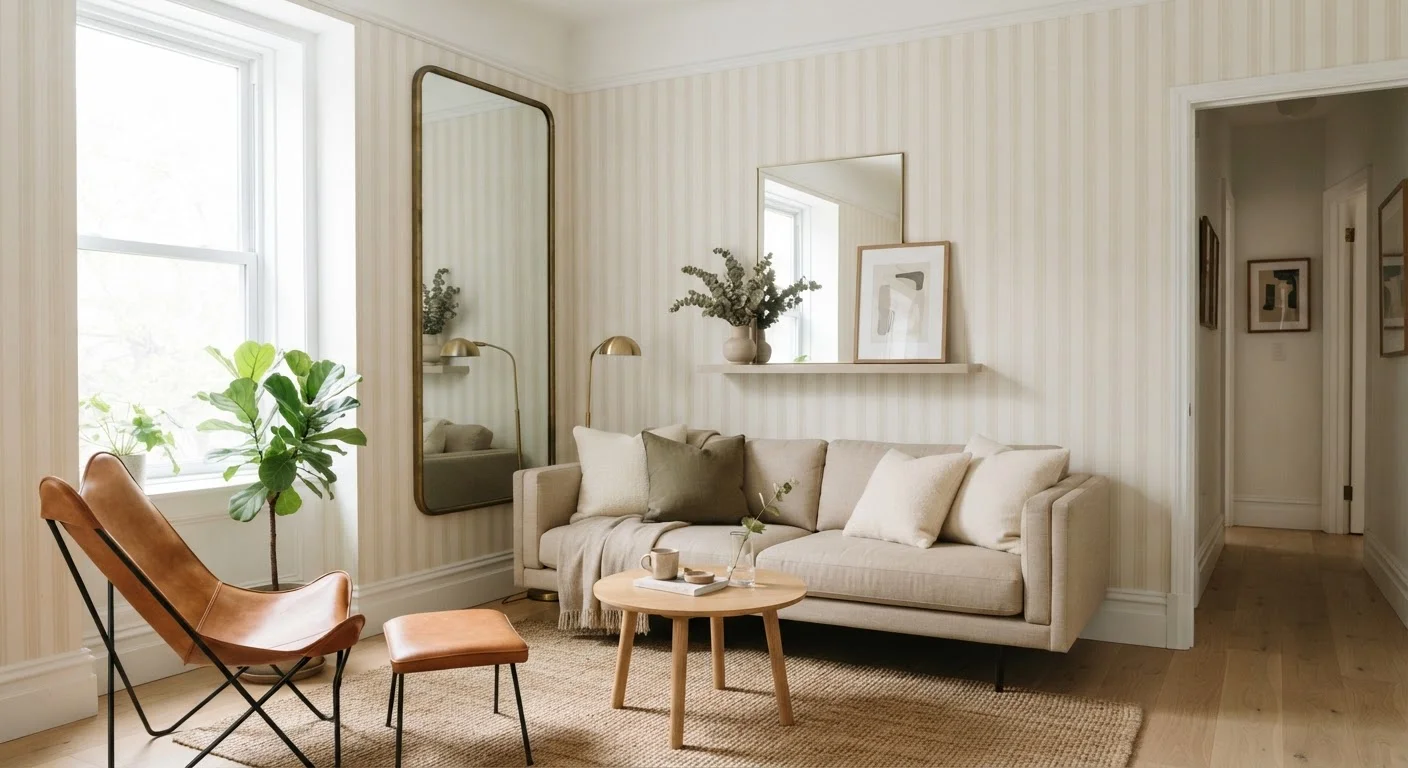
The mechanism behind mirrors is light and sightline extension. When a mirror captures and bounces natural light or a view into the room, the brain reads that reflected depth as additional space. Position a large mirror on the wall directly opposite or adjacent to your primary window. Avoid placing mirrors where they reflect closed doors, cluttered shelving, or dark corners - those reflections compress rather than open the space. Size also matters: a 24-inch mirror in an 80-inch wall gap reads as an accessory, not a spatial tool. Aim for mirrors that span at least one-third of the wall height.
Myth
White or off-white paint is always the right choice for a small room.
Fact
Light paint helps, but lighting quality is the dominant factor. A dark, well-lit room can feel larger than a white room with poor light.
Paint reflectance (measured as LRV, or Light Reflectance Value) does affect how much light bounces around a room, and higher LRV values generally make surfaces recede. But contrast between walls and trim, shadow caused by inadequate fixture placement, and the color temperature of bulbs all override paint choice. A small room with one north-facing window and standard ceiling fixtures will feel dim regardless of wall color. Before repainting, assess your lighting: adding a floor lamp in a dark corner or switching to higher-lumen, warmer-temperature bulbs can do more than a fresh coat of white. For a detailed look at when darker paint actually helps, see when dark walls make rooms feel bigger.
Myth
More furniture means a more furnished, cozy small room - not a crowded one.
Fact
Scale consistency matters far more than piece count. One appropriately scaled sofa reads better than two mismatched loveseats fighting for the same footprint.
Small rooms don't necessarily need small furniture - they need proportionate furniture. A single low-profile sofa with clean lines and exposed legs creates visual breathing room because you can see the floor beneath it. Six small occasional chairs crammed into the same space creates a cluttered, incoherent perimeter that reads as chaotic. The practical test: after placing a piece, you should still be able to identify clear floor zones. If the floor disappears entirely, the room will feel smaller regardless of each piece's individual dimensions. Furniture arrangement principles can help you evaluate what belongs and what to remove.
Myth
A small rug keeps a small room from feeling overcrowded.
Fact
Undersized rugs are one of the most common causes of a room feeling visually fragmented and smaller than it is.
A rug that's too small for its furniture grouping acts as a visual island, isolating pieces from each other and creating competing focal zones. The standard guideline: in a seating area, at minimum the front two legs of all major furniture pieces should sit on the rug. Ideally, a rug extends 6-12 inches beyond the furniture group on all sides. In a bedroom, the rug should extend at least 18-24 inches past the sides and foot of the bed. Yes, larger rugs cost more - but a single well-sized rug anchors the entire room's composition in a way that no amount of smaller accessories can replicate.
Myth
Vertical stripes on walls are the best way to make ceilings feel taller.
Fact
Floor-to-ceiling curtains and tall, narrow shelving units are more reliably effective at drawing the eye upward than painted stripes.
Vertical wall stripes can help, but they require precise execution - uneven spacing or low contrast makes them read as busy wallpaper rather than a height cue. In contrast, hanging curtain rods at ceiling height (even if windows are only mid-wall) and letting panels drop to the floor creates an unambiguous vertical line that the eye follows from floor to ceiling. Similarly, a bookshelf that runs from floor to ceiling communicates height through mass and scale. These approaches work in virtually any room without the risk of a painting mistake. For rooms with genuinely awkward proportions - low ceilings, narrow entries - see gallery wall layouts for awkward spaces for how vertical art arrangements can reinforce ceiling height.
Putting the Techniques Together on a Budget
None of these strategies requires a contractor. The highest-impact moves - repositioning mirrors, rehemming curtains to floor length, swapping an undersized rug - typically cost under $50 in materials and a weekend afternoon in labor. Strategic furniture placement costs nothing at all. See our furniture arrangement guide for the spatial principles that govern where pieces should go.
When combining techniques, prioritize light first, then vertical cues, then scale. Trying to layer every trick simultaneously often produces visual noise rather than openness. Pick two or three that address your room's specific constraints - low ceiling, narrow footprint, poor natural light - and execute them cleanly. A thoughtfully styled compact room consistently reads larger than a cluttered one with every trick applied at once. For more room-specific styling direction, the Room Styling Tips hub covers practical approaches for every type of space.
This article is for informational purposes only. Results vary based on individual room conditions, existing architecture, and personal interpretation of spatial perception.
The content on this site is for informational purposes only and is not a substitute for professional advice. Always consult a qualified professional for guidance specific to your situation.