

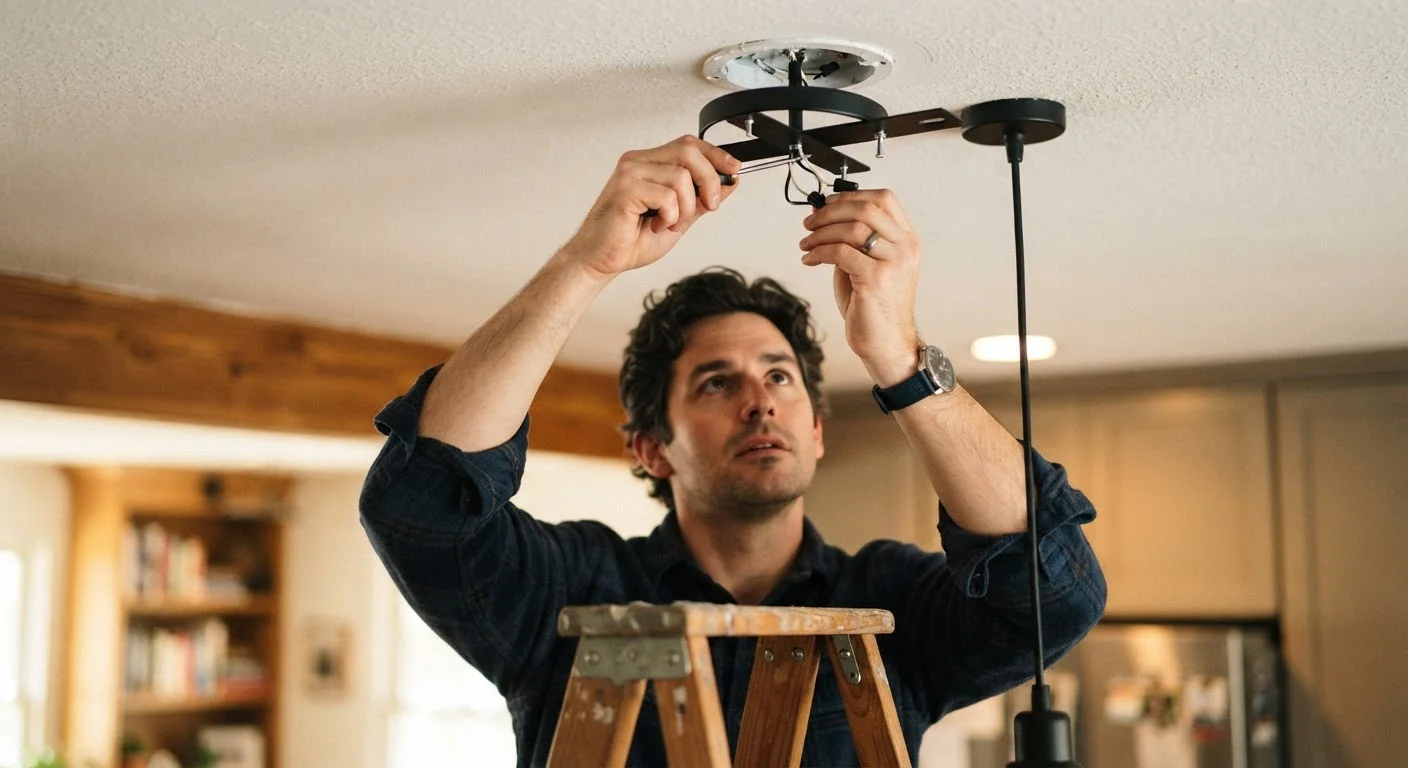
Why Lighting Upgrades Are Often the Best Weekend Win
Swapping a dated overhead fixture for something more intentional - a brushed-nickel pendant, a flush-mount with better diffusion, a ceiling fan with a light kit - is one of the highest-impact, lowest-disruption improvements you can make in a single afternoon. New fixtures are typically a direct swap on an existing ceiling box, meaning no new wiring, no permits, and no drywall repair.
The catch is knowing when that assumption holds and when the job is more complicated than it looks. Not every ceiling box is rated for the weight of a fan. Not every home's wiring plays by the rules a modern fixture expects. Understanding the boundaries is what separates a confident DIY afternoon from a hazardous mistake.
For a broader picture of how lighting choices shape a room's feel, see Lighting Layers Every Room Makeover Should Address. This article focuses specifically on what you can safely handle yourself - and where you should stop.
The DIY-Safe Zone: What Most Homeowners Can Handle
The following tasks fall within reach for a careful, non-licensed DIYer - provided the home's wiring is in good condition and the circuit is properly de-energized first.
De-energize at the breaker, then verify with a non-contact voltage tester before touching wires
Wall switches interrupt only one conductor on a standard circuit; the other remains live. Turning off the breaker removes power from both, but wire labeling errors happen - a $15-$25 non-contact tester confirms the circuit is actually dead before your hands go anywhere near it.
Confirm the ceiling box is rated for the fixture weight before hanging anything heavier than 35 lbs
Standard plastic ceiling boxes are rated for lightweight fixtures only - typically up to 35 lbs. Ceiling fans and heavier pendants require a fan-rated or heavy-duty metal box anchored to a joist or a rated brace bar. A fixture that falls mid-spin is a genuine injury risk.
Match wire connections like-for-like: black to black, white to white, ground to ground
Reversing hot and neutral in a light circuit creates a shock hazard even when the switch is off - the socket shell remains energized. Correct polarity is non-negotiable and is required by the National Electrical Code (NEC).
Use wire nuts rated for the conductor count and gauge you're joining
Undersized or mismatched wire connectors can loosen over time, creating arcing at the connection point - a fire risk hidden inside a closed ceiling box. Wire nut packaging specifies the wire gauge combinations it's rated for.
Restore power and test before closing up the ceiling box
It's far easier to diagnose a wiring error before the canopy is tightened and the fixture is fully assembled. A quick function test takes 30 seconds and can save 20 minutes of disassembly.
If you're weighing whether a DIY approach genuinely saves money here, "DIY Is Always Cheaper" and Other Decor Myths Worth Questioning offers a grounded reality check on where DIY delivers and where it quietly doesn't.
Quick Actions You Can Take This Weekend
Before touching any fixture, run through this fast checklist to confirm you're in safe DIY territory:
When You Must Call a Licensed Electrician
Several lighting situations look simple on the surface but require licensed work - in most jurisdictions, that's a legal requirement, not just a cautious suggestion.
- Adding a new circuit or circuit breaker: Any work inside the main electrical panel is restricted to licensed electricians in all U.S. states. Miswired breakers are a leading cause of house fires.
- Installing recessed lighting where none exists: Cutting into ceilings and running new cable through finished walls almost always requires a permit and inspection. The wiring path, insulation contact rating, and junction box placement all carry code implications.
- Upgrading to a ceiling fan where there's no fan-rated box: A fan-rated box must be installed before hanging the fan - this usually means accessing the ceiling cavity and may involve structural blocking. If you're not certain the existing box is fan-rated, a licensed electrician can verify and replace it safely.
- Any home with knob-and-tube or aluminum branch-circuit wiring: These systems require specific handling that deviates from standard modern practice. Work with a licensed electrician who has experience with these systems before disturbing anything.
- Outdoor or wet-location fixtures tied to buried or conduit wiring: Connections in these environments involve weatherproofing standards and sometimes GFCI requirements that are easy to get wrong. For wire-free outdoor alternatives, Outdoor Lighting on a Budget covers solar and low-voltage options that sidestep the complexity entirely.
Permits and Inspections for Electrical Work
In most U.S. jurisdictions, replacing a fixture on an existing outlet (like-for-like) does not require a permit. However, any work that adds wiring, moves a box, or changes circuit capacity typically does. Permit requirements vary by municipality - what's exempt in one county may require inspection in the next. Always verify with your local building department before starting work that goes beyond a straight fixture swap.
When in doubt about whether your specific project needs a permit or professional, contact your local building department - they're often willing to answer quick scope questions over the phone.
The content on this site is for informational purposes only and is not a substitute for professional advice. Always consult a qualified professional for guidance specific to your situation.