

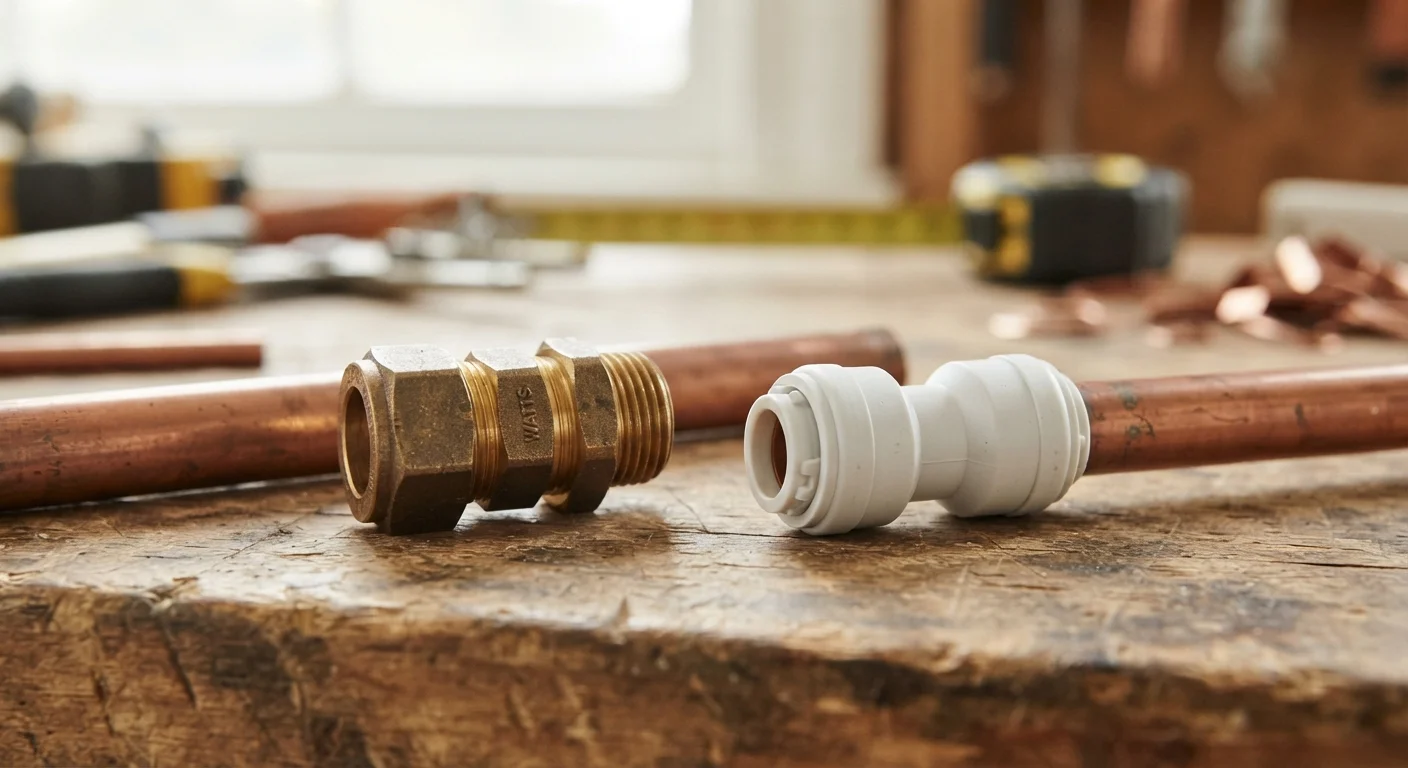
Option A
Compression Fittings
The time-tested, mechanically reliable choice.
Best for: Best for permanent supply-line repairs where a secure, inspectable connection is needed and disassembly may be required later.
Option B
Push-to-Connect Fittings
The fast, tool-light option for quick fixes.
Best for: Best for accessible locations where speed matters, pipe material varies, or you need a temporary-to-permanent stopgap during a repair.
How Each Fitting Creates a Seal
Understanding the mechanics behind each fitting type helps you predict how they'll perform in your specific repair scenario.
Compression fittings work through mechanical force. You slide a compression nut onto the pipe, followed by a small ring called a ferrule (usually brass or olive-shaped). When you thread the nut onto the fitting body and tighten it with a wrench, the ferrule compresses into the pipe's outer surface, creating a watertight metal-to-metal seal. The process is straightforward, but over-tightening is a common beginner mistake - one quarter-turn past hand-tight is usually sufficient after wrench engagement.
Push-to-connect fittings (sometimes called push-fit or quick-connect fittings) rely on an internal grab ring with angled teeth and an O-ring. Push the pipe in until it bottoms out, and the teeth lock around the pipe while the O-ring forms the water seal. Removal requires pressing a release collar to disengage the grab ring. No tools, no torque - but the pipe end must be cut cleanly and deburred, or the O-ring won't seat properly and the joint will leak.
| Criterion | Compression Fittings | Push-to-Connect Fittings |
|---|---|---|
| Installation method | Wrench required to tighten nut | Hand-push only, no tools needed |
| Compatible pipe materials | Copper, brass (material-specific) | Copper, PEX, CPVC (multi-material) |
| Seal mechanism | Compressed ferrule against pipe | Internal O-ring and grab ring |
| Reusability | Ferrule not reusable; body reusable | Fitting reusable with clean pipe cut |
| Relative unit cost | Generally lower cost per unit | Generally higher cost per unit |
| Skill level required | Beginner-friendly with care | Minimal - but pipe prep is critical |
| Code acceptance (concealed) | Widely accepted; verify locally | Varies by jurisdiction; confirm first |
Where Each Fitting Belongs - and Where It Doesn't
Choosing the wrong fitting for a location can mean a callback leak or a failed inspection. Here's how to match fitting to situation.
Compression Fittings
- Shutoff valves: The classic application. Most under-sink and toilet shutoff valves use a compression connection to the supply tube.
- Accessible, visible locations: Because you need a wrench to install and can visually inspect the ferrule, compression fittings work best where you can reach them.
- High-pressure lines: Compression fittings are generally rated for full household water pressure on copper and brass pipe.
Push-to-Connect Fittings
- Emergency repairs: If a pipe bursts and you need water restored fast, a push-to-connect coupler buys time - though verify with your local code whether concealment is permitted. See our guide on temporary vs. permanent repairs for when a stopgap becomes a problem.
- Mixed-material transitions: Many push-to-connect fittings are compatible with copper, PEX, and CPVC in a single body - ideal for homes with layered renovation history.
- Tight spaces: No wrench swing needed. You can make a joint at nearly any angle.
One area where both fitting types have limits: waste (drain) pipe connections. Those typically call for different joinery methods entirely. If you're working on plastic drain lines, our comparison of solvent weld vs. push-fit for waste pipes covers those trade-offs in detail.
Cost, Reusability, and Code Considerations
Neither fitting type is universally superior - the right answer depends on your priorities and jurisdiction.
Pipe Prep Matters for Both Types
Regardless of which fitting you choose, pipe preparation is where most DIY leaks originate. For compression fittings, ensure the pipe end is straight and free of burrs that could damage the ferrule. For push-to-connect fittings, a clean, square cut and a deburred edge are non-negotiable - any roughness will compromise the O-ring seal. A tube cutter produces a cleaner edge than a hacksaw and is worth the investment for repeat use.
Cost: Compression fittings are generally less expensive per unit than push-to-connect fittings of equivalent size. For a multi-connection repair, that difference can add up. However, push-to-connect fittings save labor time and reduce the risk of a misaligned ferrule causing a slow drip.
Reusability: Compression fittings can often be disassembled and the ferrule replaced, though the original ferrule deforms on first use and should not be reused on the same pipe stub. Push-to-connect fittings are designed to be removable and reusable on a new pipe cut - useful if you need to adjust a run during installation.
Code acceptance: This is the most important practical consideration. Plumbing codes vary by municipality. Some jurisdictions restrict push-to-connect fittings in concealed locations; others accept them freely. Compression fittings have broader historical acceptance but are still subject to local rules on pipe material and application. Always check with your local building department before choosing a fitting for any permitted work.
This article is for general informational purposes. Plumbing work may require permits and inspections depending on your local codes. For any work involving main water supply lines, significant pipe replacement, or work inside walls, consult a licensed plumber to ensure safety and code compliance.
The content on this site is for informational purposes only and is not a substitute for professional advice. Always consult a qualified professional for guidance specific to your situation.