

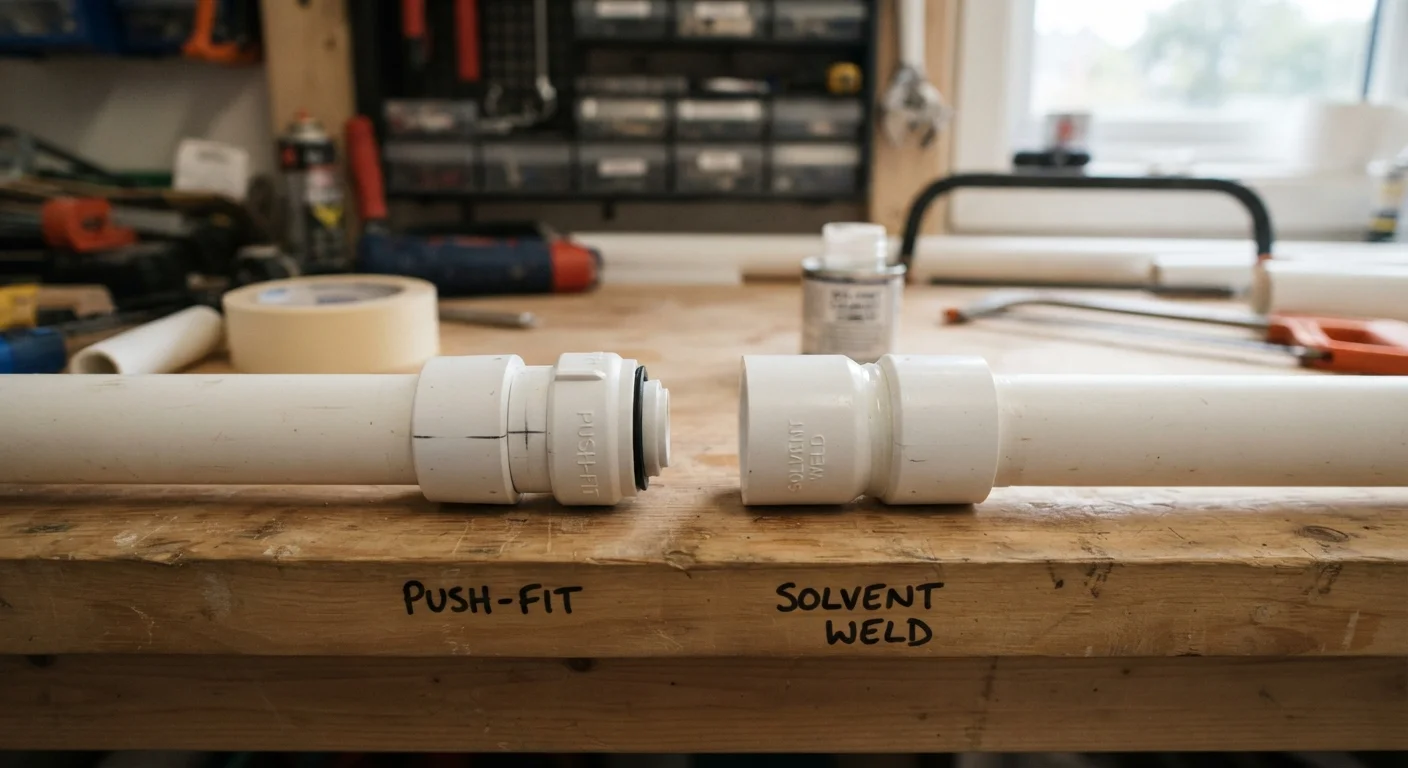
Our Verdict
Push-fit joints win on speed and reversibility, making them the practical choice for most DIY repairs where access is good. Solvent weld is the stronger long-term solution for concealed runs or high-flow situations where a reliable, permanent bond matters more than flexibility. Many plumbers use both within a single system, and there's no rule against doing the same.
Push-fit suits homeowners tackling quick repairs or working in tight spaces; solvent weld is better for those planning a permanent installation behind walls or under floors.
What These Two Methods Actually Do
Both push-fit and solvent weld are used to join plastic waste pipes - typically ABS or PVC - in drain, waste, and vent systems inside the home. Understanding how each works at a mechanical level helps you pick the right one for your situation.
Push-fit connections rely on a rubber O-ring inside the fitting. You simply push the pipe end in until it seats, and the O-ring compresses to form a watertight seal. Most push-fit fittings also have a retaining clip or collar to resist pull-out. The joint can usually be released and reassembled.
Solvent weld uses a chemical solvent cement that partially dissolves the outer surface of the pipe and the inner surface of the fitting socket. As the solvent evaporates, the two surfaces fuse into a single continuous piece of plastic. This bond is effectively permanent - the joint cannot be undone without cutting.
For a broader look at how waste pipes fit into your home's overall plumbing, see our complete household plumbing reference.
Pros and Cons of Push-Fit Connections
Push-fit fittings are widely available, require no primer or cement, and can be installed in minutes. Here's the full picture:
No tools or adhesives required
Push-fit joints can be assembled by hand in seconds, making them accessible to beginners and useful in cramped spaces where tools are hard to maneuver.
Fully reversible and adjustable
If the layout needs to change or a fitting is misaligned, push-fit components can be released and repositioned without cutting the pipe.
Accommodates slight pipe movement
The O-ring seal allows a small degree of flex, which can be an advantage in situations where pipes experience minor thermal expansion.
Faster for repairs in occupied homes
There's no cure time to wait for - once the pipe is seated, the system can be put back into use almost immediately.
O-ring can degrade or be dislodged
Rubber O-rings can harden, crack, or shift out of position over years of use, particularly with frequent hot water discharge or if grit enters the fitting during assembly.
Not suitable for concealed installations
Building codes and good practice generally discourage push-fit joints inside walls or under floors, where a slow leak could go undetected for months.
Pull-out risk under unsupported spans
Without adequate pipe clips, a long unsupported run can place enough stress on a push-fit joint to cause it to separate, particularly if the pipe sags under load.
Less reliable under sustained high flow
In waste runs that carry large volumes of water regularly - such as from a bathtub - solvent weld provides a more consistent, leak-resistant seal over the long term.
One important note: push-fit joints can creep slightly under repeated thermal cycling. In runs that carry regular hot water discharge - such as from a dishwasher or washing machine - this can eventually compromise the seal if the pipe isn't properly supported.
When Solvent Weld Is the Right Call
Solvent weld demands more preparation but delivers a joint that will outlast most of the surrounding pipework. It's the standard choice for new installations and concealed runs.
Solvent Cement Compatibility Matters
Not all solvent cements are suitable for both ABS and PVC pipe. Using the wrong cement can result in a weak bond that fails under normal use. Always check that the cement is rated for the specific plastic your pipe is made from - this information is printed on the can and on the pipe itself. When in doubt, consult the pipe manufacturer's guidance before proceeding.
The process involves cleaning the pipe end, applying solvent cement to both surfaces, pushing the pipe home with a slight twist, and holding it firmly for around 30 seconds. A full cure typically takes 24 hours before the system should be pressure-tested with water. Always work in a ventilated space - solvent cement fumes are strong and should not be inhaled in an enclosed area.
If you're weighing whether a quick fix is appropriate before committing to a permanent solvent weld repair, our article on temporary vs permanent pipe leak repairs walks through that decision clearly.
Choosing Based on Your Specific Situation
Neither method is universally superior - the best choice depends on three factors: access, permanence, and whether you might need to modify the run later.
- Accessible under-sink repairs: Push-fit is faster and allows future adjustment without cutting pipe.
- Behind-wall or under-floor runs: Solvent weld is strongly preferred. A push-fit joint in a concealed location is a liability if the O-ring ever fails.
- Rental property or temporary fix: Push-fit gives landlords the flexibility to adapt pipework without major intervention.
- Brand-new bathroom or kitchen install: Solvent weld from the stack to the fixture gives the cleanest, most durable result.
Push-fit and solvent weld can be combined in a single waste run - for example, a solvent-welded trap connected via push-fit to a longer horizontal run. This is a legitimate approach used by working plumbers. For related context on fitting types and compatibility, see our guide on compression vs push-to-connect fittings.
24 hrs
Minimum cure time before testing solvent weld joints
Most solvent cement manufacturers recommend a full 24-hour cure before subjecting new joints to water flow or pressure testing.
30 sec
Hold time needed after inserting a solvent weld joint
Releasing the joint too soon allows the pipe to back out of the socket before the cement sets; holding firm for 30 seconds is standard practice.
The content on this site is for informational purposes only and is not a substitute for professional advice. Always consult a qualified professional for guidance specific to your situation.