

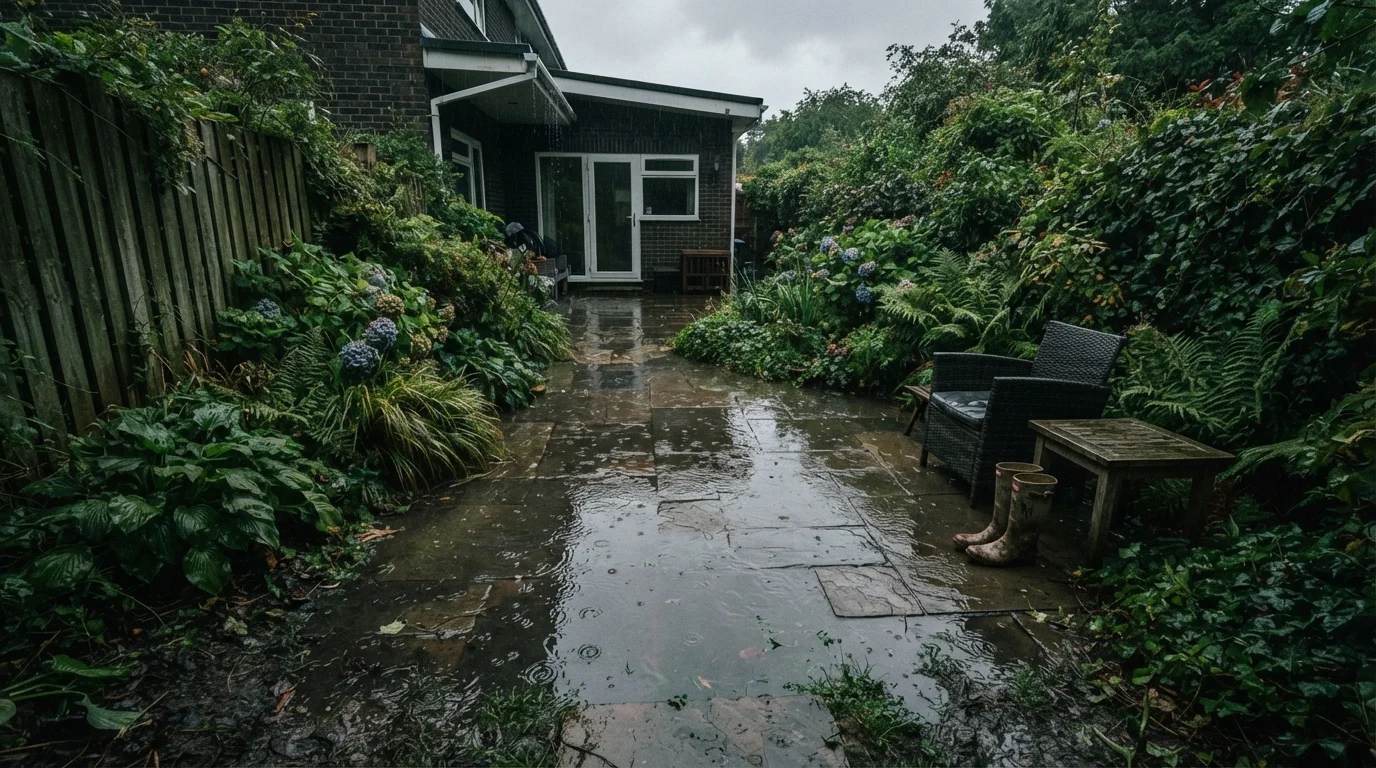
Why Drainage Myths Are So Persistent
Patio drainage is invisible by design. When a well-built patio works correctly, water simply disappears - which makes it easy to misattribute good results to the wrong factors, and equally easy to misdiagnose problems when they appear. Most myths around patio drainage arise from surface-level reasoning: gravel looks porous, so it must drain; a level surface looks tidy, so it must be correct. In reality, drainage is a whole-system problem involving surface gradient, sub-base construction, soil permeability, and outlet provision.
Getting these basics wrong is genuinely costly. Pooled water accelerates deterioration of mortar and pointing, promotes algae and moss growth on the surface, and can migrate toward house foundations if slopes are wrongly directed. It's worth comparing these errors to the kind of thinking that creates expensive problems indoors - our article on plumbing myths that cost homeowners money covers similar pattern-of-reasoning failures in a different context.
Myth
A level patio is the goal - perfectly flat means no drainage problems.
Fact
Patios need a deliberate slope, typically 1-2% gradient, to move water away from structures and toward designated outlets.
Many homeowners assume a perfectly level surface is the mark of quality work. In practice, a truly flat patio has nowhere to send rainfall, and water collects in any low spot or joint. Building codes and paving industry guidance consistently recommend a fall of around 1 in 80 (roughly 1.25%) away from the house foundation. Without it, even a modest rainfall event can leave puddles that take hours to clear - and repeated wetting can accelerate mortar degradation and frost damage in colder climates.
Myth
Permeable pavers solve all drainage issues - just lay them and water disappears.
Fact
Permeable pavers allow infiltration, but they only perform well when installed over a correctly compacted, open-graded sub-base that connects to stable soil below.
Permeable or porous pavers are genuinely useful for managing surface water, but they are not a universal fix dropped onto any ground. If the sub-base is compacted dense aggregate or sits over compacted clay, water infiltrating through the surface joints has nowhere to go and simply pools below the paving. Effective permeable installations require open-graded crushed stone sub-bases of adequate depth, unobstructed by fine particles that clog pore spaces over time. Maintenance matters too - joints need occasional clearing of accumulated sediment to preserve permeability.
For a broader look at low-intervention permeable surfaces, see our guide to gravel gardens.
Myth
Adding a layer of gravel under paving automatically improves drainage.
Fact
Gravel alone under paving can create a perched water table effect if the layer isn't graded and connected to a proper outlet or well-draining soil.
The intuition here is understandable - gravel has large air voids, so it should drain well. The problem is that water moving downward through soil or a sub-base will stop at the boundary between two layers of different texture, a phenomenon known as a perched water table. A gravel layer sitting on dense, poorly draining clay can actually hold water just above the clay surface rather than letting it pass through. Gravel sub-bases work best when the native soil has adequate permeability, or when a positive outlet - such as a drainage channel, French drain, or soakaway - is connected to the gravel layer.
This is closely related to a common misconception in container gardening too - our article on container drainage and soil mix explains why the same perched water table logic applies inside pots.
Myth
It's fine to slope the patio toward the garden - plants like water.
Fact
Continuously directing patio runoff into adjacent planting beds can saturate root zones and leach soil nutrients, harming rather than helping most garden plants.
Channeling water from a hard surface into a planted border sounds resourceful, but concentrated runoff from an impermeable patio can deliver far more water than plants can absorb - particularly during heavy rain. Chronic saturation deprives roots of oxygen, promoting root rot and encouraging moss. It also compacts soil and displaces fine particles over repeated cycles. Patio drainage should ideally be directed to a soakaway, a rain garden specifically designed to handle surge volumes, or a storm drain - not defaulted into ornamental planting beds. For more on how waterlogged conditions invite moss and poor soil health, see our piece on moss causes and control.
Myth
Old patios drain fine - drainage problems only happen with new or cheap installations.
Fact
Older patios frequently develop drainage problems as mortar joints crack, sub-bases settle unevenly, and original slopes distort over time.
Settlement is cumulative and often invisible until a drainage problem becomes obvious. Frost heave, tree root movement, and simple sub-base compaction over years can all tilt individual slabs, reverse intended slopes, or create low spots that collect water. A patio that drained well in its first decade may pool noticeably a decade later without any visible structural failure. Regular inspection - particularly after harsh winters - and prompt re-bedding or re-leveling of individual sunken slabs can prevent what becomes a wholesale re-lay job if left unaddressed.
What Good Patio Drainage Actually Looks Like
A well-drained patio combines three elements working in sequence: a correctly graded surface that moves water off the paving quickly, a sub-base that supports the paving without trapping water beneath it, and a designated outlet that receives and disperses collected water safely. None of these elements alone is sufficient.
Don't Direct Drainage Toward Your Foundation
Any slope or channel that moves water toward a house wall or foundation can lead to damp ingress, basement moisture, and long-term structural issues. Always ensure drainage flows away from the building - typically toward a soakaway, channel drain, or a purpose-built rain garden at least 3 meters from the structure. If you are unsure about drainage paths near your foundation, consult a qualified landscaper or structural engineer before making changes.
For existing patios showing early signs of drainage failure - minor pooling, single sunken slabs, joint erosion - targeted repairs are often manageable for a competent DIYer. Re-bedding individual slabs, improving perimeter channel drainage, or clearing blocked gullies can resolve many problems without full reconstruction. However, if the issue is a fundamentally incorrect slope across the whole patio, or a sub-base that has failed structurally, professional assessment is worth seeking before committing to patchwork fixes that may not address the root cause.
Understanding how permeable surface alternatives perform can also inform decisions about future patio upgrades - our overview of gravel garden surfaces is a useful companion read, as is our broader look at garden myths that waste time and money for related misconceptions about outdoor surfaces and soil.
The content on this site is for informational purposes only and is not a substitute for professional advice. Always consult a qualified professional for guidance specific to your situation.