

Why Garden Myths Persist
Gardening advice travels fast - from neighborhood fences to social media feeds - and much of it has never been tested against actual plant science. The result is a culture of well-meaning but counterproductive habits that cost gardeners real time, effort, and money each season. The good news is that debunking these myths doesn't require a horticulture degree: it just requires knowing what to look for.
Curious how the same pattern plays out in home improvement broadly? Our look at widely repeated DIY decor assumptions covers similar ground. And if lawn care is your focus, popular lawn beliefs that turn out to be fiction are worth a look too.
Myth
Putting gravel or stones at the bottom of a container improves drainage and prevents waterlogged roots.
Fact
A gravel layer at the base of a pot raises the perched water table inside the container, keeping roots wetter for longer - the opposite of the intended effect.
Water movement through soil is governed by capillary forces, not gravity alone. When soil sits above a coarser material like gravel, water is held in the fine soil particles and resists moving into the larger pores below until the soil above is completely saturated. This phenomenon - called a perched water table - means the lowest portion of the root zone stays consistently wet. The fix is simple: use a well-draining potting mix appropriate for your plant, ensure the drainage hole is unobstructed, and skip the gravel layer entirely.
Myth
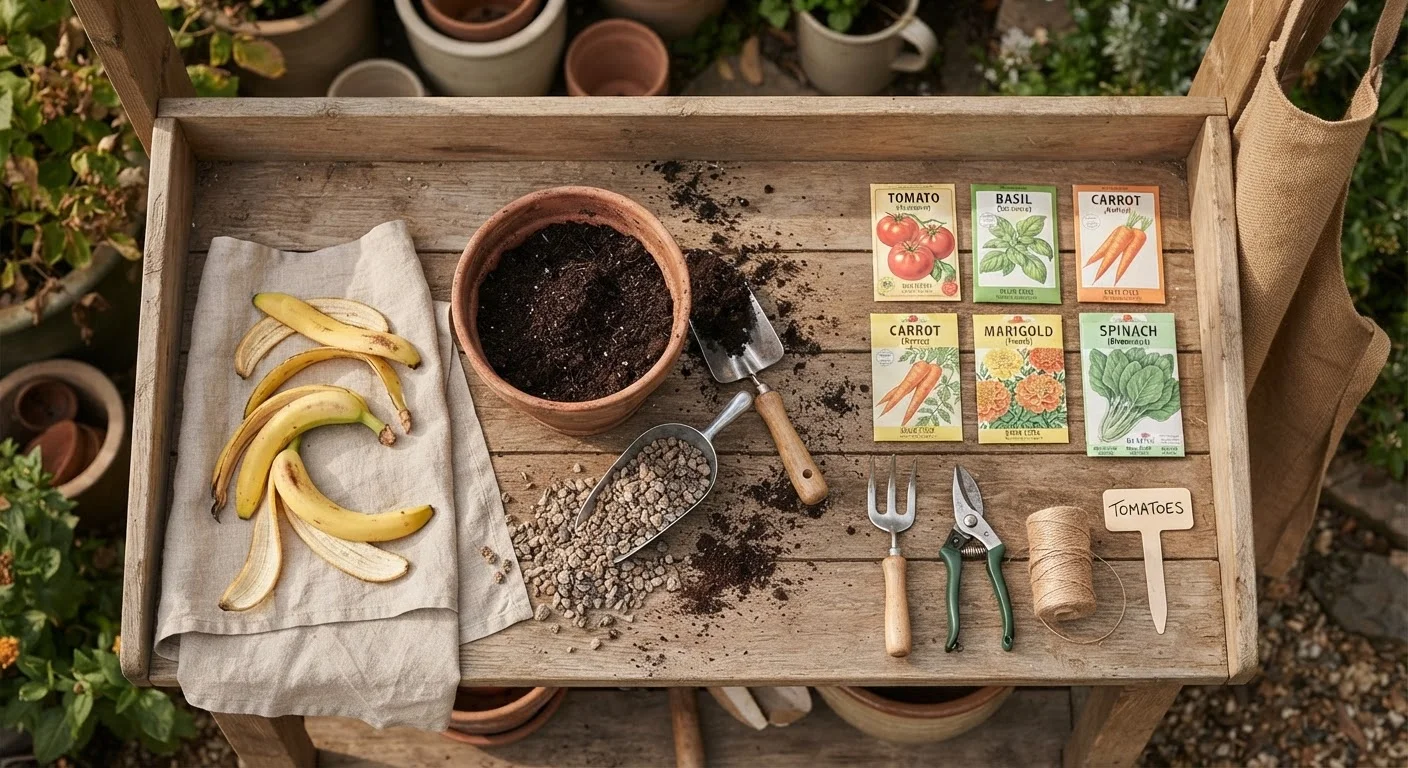
Burying banana peels near plant roots gives them a quick potassium boost.
Fact
Whole banana peels decompose slowly in soil and do not release nutrients at a rate roots can readily use. The potassium is real, but the delivery mechanism is unreliable.
Banana peels do contain potassium, phosphorus, and some calcium - but intact organic material must be broken down by soil microbes before nutrients become plant-available. That process takes weeks to months depending on soil temperature and moisture. A better approach is to add peels to a compost pile, where the microbial environment actively breaks them down. Finished compost applied to beds delivers those nutrients in a far more accessible form. For a full composting workflow, see how to set up a home composting system.
Myth
Watering plants in full sun scorches the leaves because water droplets act like a magnifying glass.
Fact
Research has not confirmed that water droplets on leaves cause sun scorch under normal outdoor conditions. The greater risk of midday watering is evaporation loss, not leaf burn.
The magnifying-glass idea is intuitive but not well supported by field evidence under typical gardening conditions. Leaf scorch is almost always caused by heat stress, underwatering, wind desiccation, or chemical sensitivity - not by sunlight passing through water. That said, early morning watering is still recommended because it allows foliage to dry before evening (reducing fungal disease risk) and reduces evaporation compared to midday. If plants are wilting at midday, that's a sign of heat stress or insufficient root moisture, not a symptom of wet leaves in sun.
Myth
Cutting a tree or shrub back hard makes it grow back bigger and stronger.
Fact
Hard pruning stimulates vigorous regrowth in some species, but it can weaken structure, reduce flowering, or stress the plant depending on the species and timing.
Pruning removes stored energy (in the form of carbohydrates) along with the cut growth, and the plant responds by pushing new shoots from dormant buds. In fast-growing shrubs like buddleia or forsythia, this can look like the myth is confirmed. But in slower-growing trees, heavy pruning creates large wounds that are entry points for disease, and may permanently compromise the canopy's structural integrity. Correct pruning matches cut depth and timing to the plant's growth habit. When in doubt, consult your local cooperative extension service for species-specific guidance.
Myth
Coffee grounds acidify soil and are an ideal amendment for acid-loving plants like blueberries and azaleas.
Fact
Used coffee grounds have a near-neutral pH and contribute minimal lasting acidification to garden soil when applied at practical rates.
Fresh brewed coffee is acidic, but by the time grounds are spent, most of the acidic compounds have been extracted. Studies measuring used coffee grounds generally place their pH between 6.5 and 6.8 - close to neutral. Applied in thin layers to a compost pile, grounds are a useful nitrogen source. But using them in bulk around acid-loving plants is unlikely to change soil pH meaningfully and can actually inhibit germination in some cases due to allelopathic compounds. To genuinely acidify soil, soil sulfur applied according to a soil test result is a more reliable approach.
Soil, Feeding, and Container Myths
Some of the most stubborn myths concern what you put into your soil and pots. These mistakes are easy to make because they sound logical on the surface - but plant physiology tells a different story.
~30%
Water lost to midday evaporation vs. morning watering
University cooperative extension programs commonly cite significantly higher evaporation rates for midday irrigation compared with early-morning watering in warm-season conditions.
6-8 weeks
Typical decomposition time for whole banana peels in soil
Decomposition rates for organic material in soil vary by temperature and moisture, but intact fruit peels generally take weeks to months before nutrients become plant-available.
Understanding how soil water actually moves is the key to correcting most container and feeding errors. If you want to go deeper on improving garden soil naturally, composting kitchen scraps into garden amendments is a practical place to start. For anyone using gravel as a garden surface rather than in pots, how gravel gardens are actually constructed clears up further confusion.
Watering, Pruning, and Plant-Care Myths
Timing and technique myths are particularly common because results aren't always immediate - making it hard to connect cause and effect. A plant that looks stressed after midday watering may actually be suffering from root compaction or underwatering, not from sun hitting wet leaves.
Pruning myths deserve special attention because bad cuts don't just waste time - they can introduce disease or permanently alter a tree's structure. If you find plant care labels confusing when trying to determine the right approach for a species, decoding plant label information is a useful starting point. And for anyone managing a mulched bed, how mulch actually functions in the soil system complements what you'll find below.
The information in this article is intended for general educational purposes. Gardening outcomes vary depending on climate, soil type, plant species, and local conditions. Always verify practices with your local cooperative extension service or a qualified horticulturalist for region-specific advice.
The content on this site is for informational purposes only and is not a substitute for professional advice. Always consult a qualified professional for guidance specific to your situation.