

Why the Word 'Modular' Gets Misused
Walk into any home goods store and you'll find shelves, bins, and cabinets labeled 'modular.' In practice, the word has become a marketing stand-in for 'somewhat flexible' or 'comes in multiple pieces.' That loose usage creates real confusion when you're trying to plan a DIY storage system that actually scales.
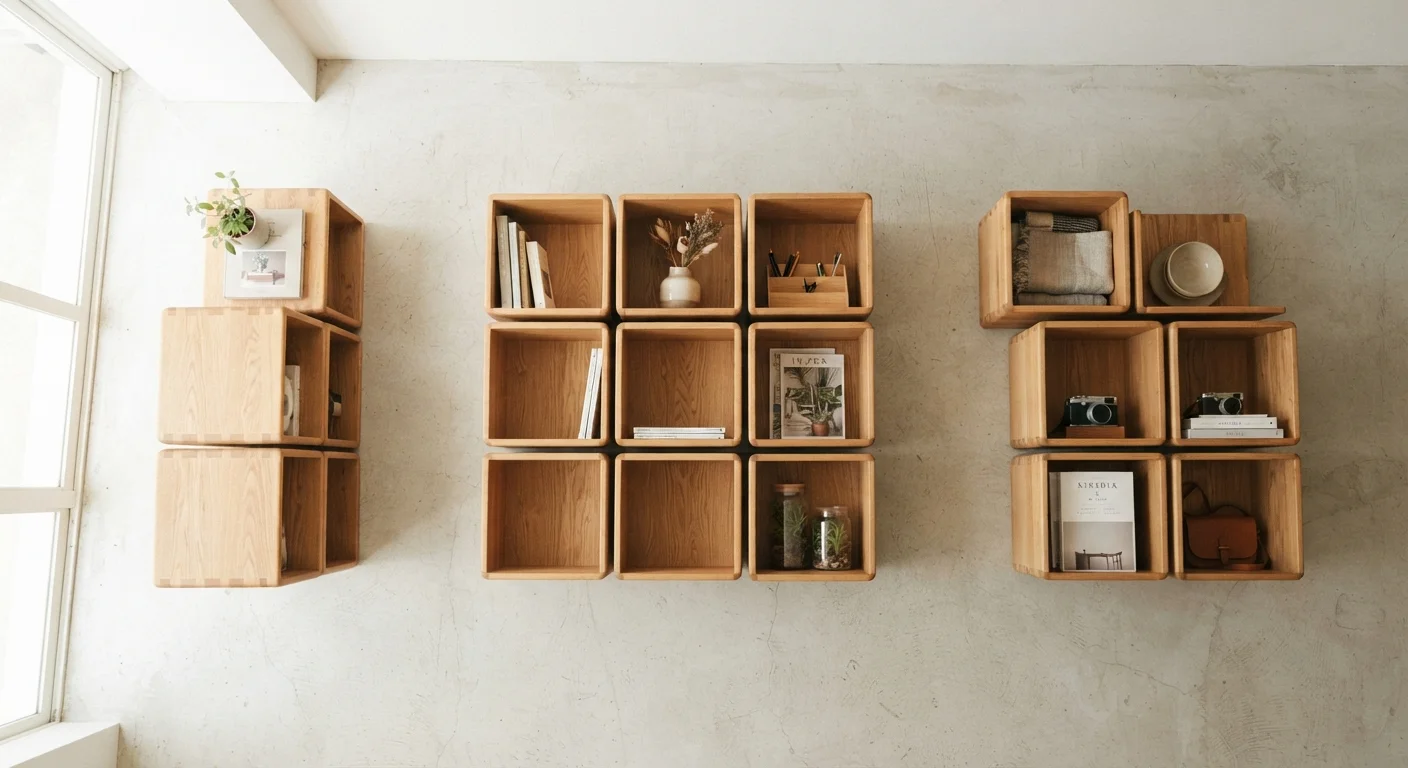
Genuine modularity has a precise meaning: a system built from standardized, interchangeable units where each piece works independently and combines predictably with any other piece in the same system. The distinction matters because a system that only looks modular can still trap you into a dead end if its parts don't repeat consistently.
For DIY builders, understanding this difference upfront determines whether your storage grows gracefully with your needs - or forces you to tear out and rebuild when your situation changes.
The Three Properties That Define True Modularity
A storage system earns the label 'modular' when it satisfies three core properties:
- Standardized dimensions. Every unit shares the same external measurements - height, width, and depth. This is what allows stacking and side-by-side placement without shimming or custom cutting.
- Independence. Each module works on its own. You can use one cube as a nightstand, then add five more to build a wall of storage, without modifying the original unit.
- Expandability without disruption. New units integrate into the existing arrangement without requiring you to disassemble or alter what's already in place.
When all three properties are present, you have a true modular system. When only one or two apply, you have something more limited - which isn't necessarily bad, but you should know what you're working with before you start cutting lumber.
Start With One Module, Build Your Cut List From It
Before cutting any material, build a single prototype module and live with it for a week. Check that the dimensions actually suit what you're storing and that it fits the intended space with room to maneuver. Once you're satisfied, use that unit's cut list as the template for every subsequent module - this consistency is what makes the system truly modular.
How Modular Thinking Changes a DIY Build
Most first-time DIY storage projects are designed around a single problem: 'I need a place for these shoes' or 'the pantry is a mess.' That's a reasonable starting point, but it often leads to one-off builds that can't adapt.
Applying a modular mindset from the start means choosing a module unit first - a single box, shelf section, or drawer insert with consistent dimensions - and then designing everything else around repeating that unit. The practical payoff is significant:
- Your cut list becomes repetitive, reducing measuring errors and material waste.
- Future additions only require you to build more of the same unit, not a new design.
- Moving to a new home means your system moves with you and reassembles in the new space.
This approach also connects naturally to broader room planning. Whether you're addressing a single closet or working through a whole-home strategy, a modular storage framework makes each project part of a coherent system rather than a collection of mismatched fixes. For a room-by-room view of how this thinking scales, the complete home organisation framework walks through every space in the house.
Modular vs. Fixed: Knowing When Each Makes Sense
Modular storage isn't always the right answer. Fixed, built-in storage - think a floor-to-ceiling mudroom locker or a fitted kitchen cabinet - offers structural stability and a custom fit that modular systems can't always match. The trade-off is flexibility: once built in, a fixed unit is difficult to adapt or relocate.
A useful rule of thumb: choose modular when your storage needs are likely to change (growing family, rented space, evolving hobbies) and choose fixed when you're optimizing a permanent space for a stable, well-understood purpose. Many well-organized homes use both - fixed built-ins for anchor storage, modular units for zones that shift over time.
It's also worth noting that open modular shelving and closed storage present different trade-offs for visibility, dust accumulation, and style. If you're weighing those options for a living space, open shelving vs. closed storage explores both sides in practical detail.
If you're weighing whether to build your own storage versus buying ready-made units, the decision involves more than just modularity - time, skill, and material costs all factor in. The upsides and downsides of building your own storage offers an honest assessment of both paths.
Ready to put the concept into practice? Your first DIY organizer project walks through materials, basic joints, and realistic starting projects for anyone new to building.
Frequently Asked Questions
Adjustable storage changes within a fixed frame - for example, shelf heights that move up or down. Modular storage means the enclosures or units themselves can be combined, separated, or multiplied. A shelf with movable pegs is adjustable; a cube that stacks with identical cubes is modular.
Yes. Basic modular systems - such as open cubes or simple crates - require only straightforward cuts, a level surface, and consistent measurements. Starting with a single repeated unit keeps complexity low. See our guide for complete beginners for a practical starting point.
Measure the largest item you need to store first, then size your module around it with a little clearance. A common approach is to pick a module dimension that divides evenly into your total wall or shelf space so units fit without awkward gaps.
Not necessarily. Because each module uses the same cut list, material waste tends to be lower. The cost scales with how many modules you build, giving you control over spending incrementally rather than committing to a large upfront build.
Often yes. Freestanding modular systems - cubes, stacking crates, rolling carts - don't require wall anchors or permanent installation, making them well suited to rental situations. Always check your lease before any wall-mounted work.
Plywood and MDF (medium-density fiberboard) are popular because they cut cleanly and hold fasteners well. Pre-primed boards reduce finishing steps. The right choice depends on weight load, moisture exposure, and your available tools.
The content on this site is for informational purposes only and is not a substitute for professional advice. Always consult a qualified professional for guidance specific to your situation.