

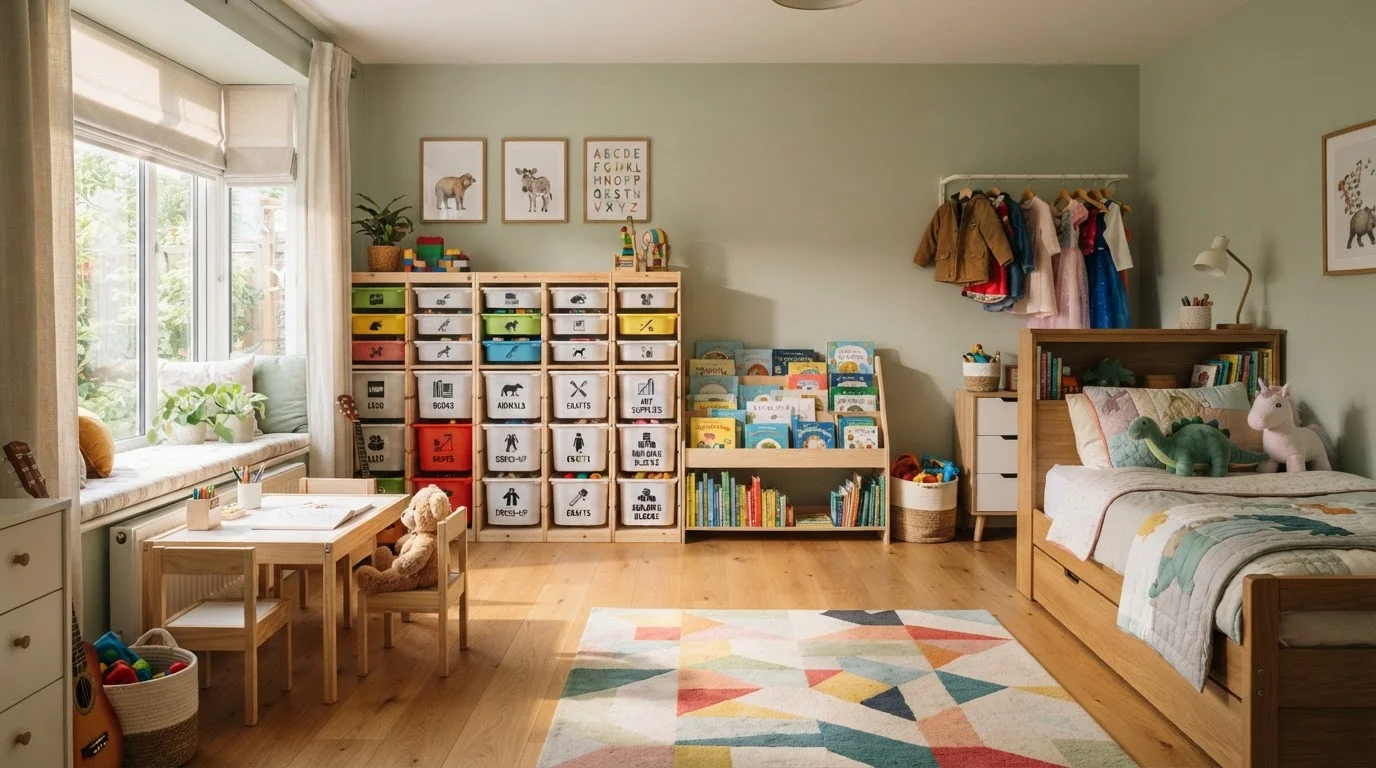
Plan for Stages, Not Just Today
The most common-and expensive-mistake in setting up a child's room is designing for who they are right now. A toddler becomes a reader, a reader becomes a hobbyist, and a hobbyist becomes a teenager who wants privacy and a charging station. Storage that works for one stage can actively obstruct the next.
The smarter approach is to think in three broad phases: early childhood (roughly ages 2-5), middle childhood (6-11), and adolescence (12+). Each phase brings different storage demands-toy rotation gives way to book and craft storage, which eventually gives way to tech gear, clothing variety, and personal keepsakes. When you design for transitions rather than a single snapshot, you spend less and adapt faster.
This is also the right moment to think about the whole-home storage framework your child's room fits into-overflow items that don't belong in the bedroom can often find a better home elsewhere in the house.
Best Practices for Adaptable Kids' Room Storage
The following practices are organized to help you make decisions that hold up across multiple years-not just the next six months.
Invest in modular shelving with adjustable shelves from the start.
Fixed shelving that suits a 4-year-old's toy bins will be too low and too shallow for a 10-year-old's books and binders. Adjustable shelving lets you reconfigure the same unit for different storage heights and depths without buying new furniture. This single decision can eliminate at least one major furniture replacement cycle.
Choose neutral, durable storage furniture rather than character-themed pieces.
Themed furniture tied to a specific franchise or aesthetic has a short runway-children outgrow favorites quickly, and reselling character pieces is difficult. Neutral wood tones, whites, or grays pair with changing decor and can outlast multiple room style shifts. Durability matters equally: lightweight particleboard under heavy use rarely survives more than one phase.
Use labeled, lidded bins rather than open toy baskets for the under-10 set.
Open baskets encourage dumping everything in without sorting, which makes finding specific items difficult and discourages independent tidying. Lidded bins with picture labels (for pre-readers) or text labels (for readers) break a room's contents into logical categories kids can actually navigate. The labeling system itself can evolve without replacing the bins.
Maximize vertical wall space at every stage.
Floor space in a child's room is always at a premium, especially when play areas need room to breathe. Wall-mounted shelves, pegboards, and hooks shift storage upward and free the floor without shrinking the room. As children grow taller, previously out-of-reach shelves naturally become accessible, which effectively adds storage without adding furniture.
Build a declutter routine into every seasonal transition.
Children accumulate items faster than most adults, and storage systems fill beyond capacity quickly. A twice-yearly declutter-at the start of school and mid-year-prevents buildup from overwhelming any system. Making this a routine rather than a crisis response also models good habits for children at any age.
Quick Upgrades You Can Make This Weekend
Not every improvement requires a full room overhaul. Several targeted changes can meaningfully extend the life of your current setup without major expense or effort.
Managing the Transition to Teen Storage Needs
The jump from middle childhood to adolescence is where most storage systems break down. Suddenly, clothing volume increases, devices multiply, and personal space takes on a whole new meaning. Built-in toy bins become awkward; open shelves feel too exposed.
At this stage, consider adding a dedicated desk zone with drawer inserts for cables and stationery, replacing open bins with closed boxes or drawers for clothing overflow, and clearing a shelf section for a small collection of meaningful personal items. Privacy matters more now-closed storage signals respect for independence.
For clothing specifically, a bedroom without a walk-in wardrobe can be surprisingly well-organized with the right combination of hanging rails, stackable drawers, and door-back organizers. The principles that work for adults apply equally well once a child outgrows toy-centric storage.
If your teenager is ready to take ownership of their space, loop them into the decision-making. Teenagers who choose their own organization system-even a simple one-are far more likely to maintain it. Our DIY organizer guide offers straightforward weekend projects that older kids can help build, making the storage feel genuinely theirs.
The content on this site is for informational purposes only and is not a substitute for professional advice. Always consult a qualified professional for guidance specific to your situation.