

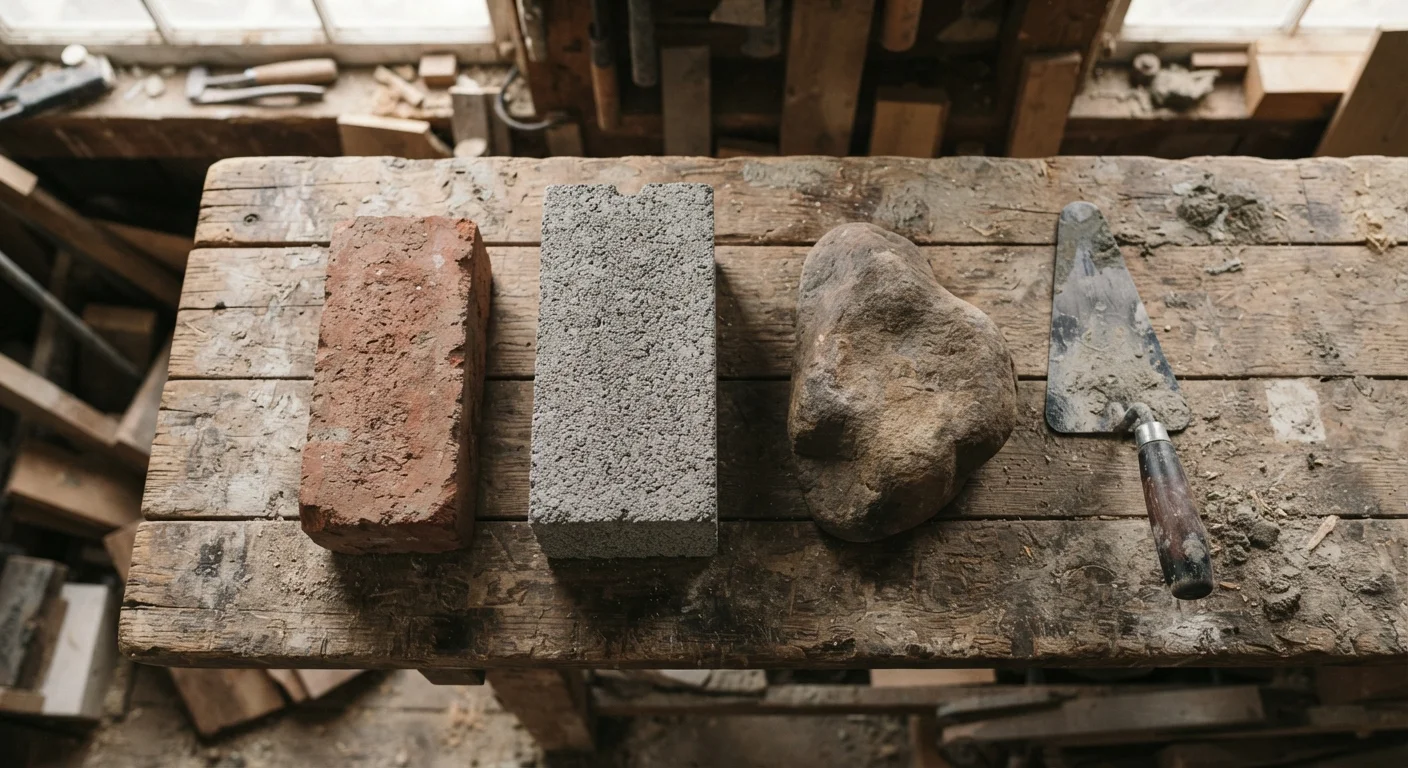
Why Material Choice Matters in Masonry
Picking the wrong masonry material doesn't just affect how a project looks - it can compromise structural integrity, accelerate weathering, and create repair headaches down the road. Brick, concrete block, and natural stone are often treated as interchangeable, but each has a distinct set of properties that make it better suited to certain jobs.
Understanding those differences - compressive strength, absorption rate, dimensional consistency, and workability - lets you build smarter rather than just harder. This guide walks through each material honestly, so you can match the masonry to the task rather than guessing at the lumberyard.
If you're also choosing a bonding material, our companion piece on concrete, mortar, and cement explains what those terms actually mean and when each applies.
Brick: Reliable, Familiar, and Forgiving
Fired clay brick is one of the oldest manufactured building materials still in active use - and for good reason. Standard modular brick (roughly 3¾" × 2¼" × 8") is dimensionally consistent, making it easy to lay to a predictable pattern. That consistency is a genuine advantage for DIYers still developing their trowel skills.
Brick's compressive strength typically falls between 3,000 and 15,000 psi depending on grade and firing temperature. Severe-weather (SW) rated brick handles repeated freeze-thaw cycles without spalling - important in northern climates. Moderate-weather (MW) brick suits interior and sheltered applications.
Common DIY applications for brick include garden walls, planters, decorative edging, mailbox surrounds, and outdoor fireplaces. It's less commonly used for load-bearing structural walls in residential new construction, where engineered systems have largely taken over, but it remains a solid choice for low-to-moderate load garden and landscape structures.
Before laying any brick in warm, dry weather, lightly mist the units with water and let them absorb it for a minute. This prevents the brick from wicking moisture out of your mortar before it can cure properly.
Mortar needs water to hydrate the cement and develop strength. Overly dry brick is one of the leading causes of weak bond lines in DIY brickwork, particularly in hot or low-humidity conditions.
When dry-stacking fieldstone, place each stone so it bridges the joint below - the same 'one over two' principle used in brick laying. Avoid running vertical joints continuously up the wall.
Continuous vertical joints (called 'running joints') create structural weak planes. Staggering them distributes load laterally and dramatically improves the wall's resistance to shifting and collapse.
One limitation worth knowing: brick absorbs water. If the units are too dry when laid, they can pull moisture from fresh mortar and weaken the bond. Lightly misting highly absorbent brick before laying is a standard practice that many beginners skip.
Concrete Block: The Workhorse of Structural Masonry
Concrete masonry units (CMUs), commonly called cinder blocks or concrete blocks, are the go-to material when structural performance outweighs aesthetics. Standard 8" × 8" × 16" hollow-core block is roughly three times the volume of a brick, so walls go up faster - but each unit is heavier, requiring more physical effort and, for tall walls, sometimes mechanical assistance.
The hollow cores serve a purpose beyond reducing weight: they can be filled with grout and reinforced with steel rebar to create walls with significant load-bearing and lateral strength. This makes CMU the standard choice for foundation walls, retaining walls over about 3 feet, basement perimeter walls, and any structure where engineering matters.
Don't Use Standard Brick Near Open Flame
Standard clay brick is not rated for direct fire exposure. For fireboxes, fire pits, and wood-burning ovens, use firebrick (also called refractory brick), which is formulated to withstand sustained high heat without cracking or spalling. Using standard brick in these applications is a safety and durability risk.
For exposed applications, standard gray CMU is not particularly attractive, though it accepts paint and stucco readily. Split-face and ground-face CMU varieties offer textured, architectural finishes for projects where appearance counts.
CMU is also economical - the material cost per square foot of wall is generally lower than brick or cut stone, which makes it a practical choice when the wall will be buried, covered, or finished over.
Natural Stone: Beautiful but Demanding
Natural stone - fieldstone, limestone, bluestone, granite, sandstone, slate - is the most variable masonry material a DIYer will encounter. No two pieces are alike in size, shape, or surface texture, which is both its charm and its challenge. Laying stone well requires patience, a good eye for fitting irregular shapes, and a willingness to cut or chip pieces to achieve stable bearing.
Dry-stacked stone (no mortar) is a traditional technique used for garden walls and landscape edging. It relies entirely on gravity, friction, and careful placement. Mortared stone walls are more permanent and weather-resistant but unforgiving of mistakes - repointing stone is more labor-intensive than repointing brick.
For patio and pathway applications, cut or sawn stone (like bluestone flags or irregular stepping stones) is more manageable than rubble fieldstone because the flat, consistent faces make bedding and leveling practical. Compare your surface options in our guide to patio surface materials.
Stone's compressive strength varies widely by type: granite is extremely hard and durable; sandstone and limestone can be softer and more prone to surface erosion in acidic rain environments. Know your stone species before committing to a structural or high-traffic application.
Matching Material to Application
Here's a practical framework for common DIY masonry tasks:
| Application | Recommended Material | Key Reason |
|---|---|---|
| Garden wall (under 3 ft) | Brick or dry-stacked stone | Workable scale, good aesthetics |
| Retaining wall (over 3 ft) | CMU with rebar or engineered block system | Lateral load demands professional engineering |
| Outdoor fireplace or fire pit surround | Firebrick (refractory) for firebox; standard brick for surround | Heat resistance is non-negotiable near flame |
| Foundation or below-grade wall | CMU | Moisture resistance, structural strength, cost |
| Decorative edging or planter | Brick or cut stone | Dimensional control, ease of handling |
| Pathway or patio surface | Flagstone, pavers, or brick | Flat faces, freeze-thaw durability |
Important note on retaining walls: Any retaining wall that holds back significant soil - generally considered 3 to 4 feet or taller in most jurisdictions - typically requires a permit and engineering review. Consult your local building department before starting. Failure of a retaining wall is a genuine safety risk.
Workability, Tools, and Mortar Considerations
Each masonry material cuts and shapes differently. Brick can be scored with a cold chisel and snapped, or cut cleanly with an angle grinder fitted with a diamond blade. CMU is best cut with a diamond blade - its aggregate is hard on abrasive discs. Natural stone ranges from slate (splits easily along cleavage planes) to granite (requires a wet-saw with a diamond blade and patience).
If you're drilling into any of these materials to mount hardware or run conduit, you'll need a hammer drill with masonry bits - a standard drill driver won't make a dent. See our guide on choosing the right drill for the job for a clear breakdown of when each tool type applies.
Mortar selection is equally important. A mortar that is too strong - higher Portland cement content than the masonry unit requires - can cause the units themselves to crack rather than the joints, which is the intended failure point for maintenance. Soft historic brick typically calls for a Type N or Type O mortar; modern CMU typically uses Type S. If you're unsure, our article on common mortar mistakes covers the errors that most often compromise DIY masonry work.
For sourcing materials cost-effectively, the Materials & Savings hub offers practical guidance on getting quality masonry materials without overspending.
This article provides general educational guidance only. Structural masonry, load-bearing walls, and retaining walls above minimum heights typically require permits, engineering review, and in some cases licensed contractor involvement. Always verify local building codes and requirements before beginning any masonry project.
The content on this site is for informational purposes only and is not a substitute for professional advice. Always consult a qualified professional for guidance specific to your situation.