

Our Verdict
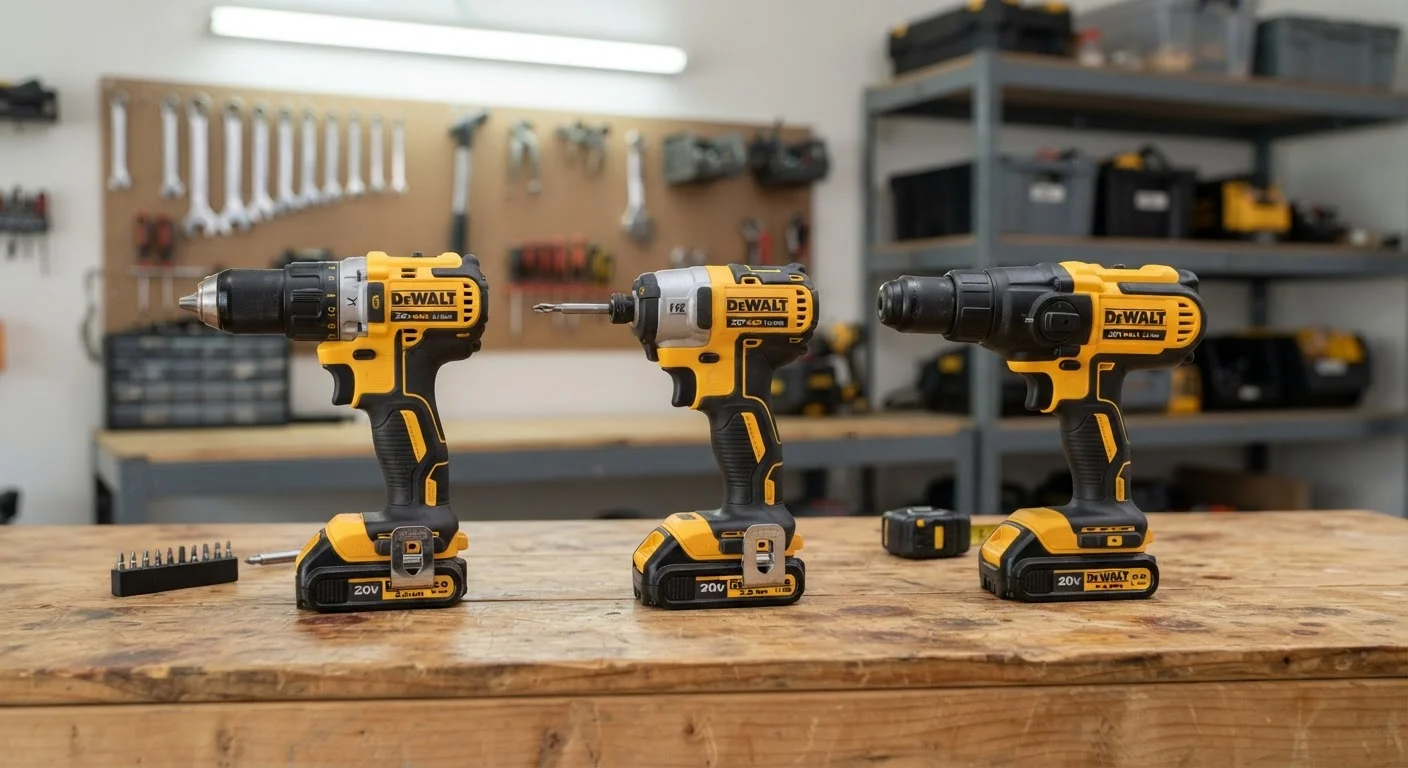
All three tools share a basic shape but serve distinct roles. A drill/driver is the right starting point for the majority of home DIY tasks. An impact driver shines when you're running many fasteners or driving long screws. A hammer drill is the only sensible option when concrete or masonry is involved.
| Best for | Recommended |
|---|---|
| Beginners and general-purpose DIY projects | Drill/Driver |
| Repetitive fastening, decking, long screws, and lag bolts | Impact Driver |
| Drilling into concrete, brick, block, or stone | Hammer Drill |
| Heavy-duty anchoring in reinforced concrete | Rotary Hammer (SDS) |
Why the Distinction Actually Matters
Walk into any hardware store and the drill aisle can feel overwhelming. Drill/drivers, impact drivers, hammer drills, and rotary hammers all look like variations on the same tool - but their internal mechanics are fundamentally different. Using the wrong one doesn't just slow you down; it can strip screws, crack tile, shatter concrete anchors, or burn out a motor entirely.
Understanding how each tool delivers power - rotational force, impact force, or percussive force - is the key to making the right call before a project starts. If you're still building out your basic toolkit, check out what hand tools every first-time DIYer actually needs before adding power tools to the mix.
The Drill/Driver: Your Everyday Workhorse
A standard cordless drill/driver uses a rotating chuck to spin a bit. It's the most versatile tool of the three: drill pilot holes, drive screws, mix paint, or bore through wood, drywall, and soft plastics. The adjustable clutch - that numbered collar behind the chuck - lets you set a torque limit so the tool stops spinning before it strips a screw head or over-drives into soft material. If you've never used that clutch ring, learn what the clutch setting on a drill actually does before your next project.
A drill/driver's limitation is torque delivery. When a screw meets significant resistance - a long lag bolt, dense hardwood, or a stripped-thread situation - the bit can cam out of the fastener head, chewing it up. For light to medium fastening in wood and drywall, it's excellent. For masonry or heavy fastening, it falls short.
Start on the Lowest Clutch Setting
When driving screws into an unfamiliar material for the first time, set your drill/driver's clutch to a low number and work upward until the screw seats flush without over-driving. This one habit prevents most stripped screw heads and surface damage that frustrate beginners. Keep a scrap piece of the same material nearby to test your settings before committing to the actual workpiece.
The Impact Driver: Built for Fastening
An impact driver looks similar to a drill/driver but works very differently. Inside, a spring-loaded hammer mechanism fires rapid rotational impacts - typically 1,500-3,000 impacts per minute - at the moment the bit meets resistance. This concussive rotational action drives fasteners with significantly more torque than a standard drill, and because the force is delivered in pulses, the tool doesn't twist in your hand the same way.
The result: long screws, structural screws, and lag bolts go in faster with far less cam-out. Impact drivers use a 1/4-inch hex chuck rather than a keyed or keyless chuck, so they don't accept standard round-shank drill bits - they're purpose-built for driving. If stripped screws are already a recurring problem for you, understand why your drill keeps stripping screws - an impact driver often solves the root cause.
Impact drivers are not ideal for drilling clean, precise holes because the impact mechanism can cause wandering, especially in softer materials.
The Hammer Drill: When Masonry Is Involved
A hammer drill adds a third type of motion: axial percussion. While the bit rotates, a cam mechanism causes it to pulse in and out - essentially hammering forward thousands of times per minute while spinning. This combination chips and abrades masonry rather than just trying to spin through it, making it the correct tool for drilling into concrete, brick, block, and natural stone.
Standard masonry bits (carbide-tipped) mounted in a hammer drill will bore anchoring holes for shelves, railings, and fixtures that a drill/driver simply cannot create reliably. For a deeper look at the materials themselves, see how brick, block, and stone differ - the material type affects which bit and speed you should use.
| Drill/Driver | Impact Driver | Hammer Drill | |
|---|---|---|---|
| Primary motion | Rotation only | Rotation + rotational impacts | Rotation + axial percussion |
| Best material | Wood, drywall, plastic | Wood, metal fasteners | Concrete, brick, block, stone |
| Main use | Drilling holes & driving screws | Driving screws & lag bolts | Boring into masonry |
| Bit type | Standard round shank | 1/4-inch hex shank only | Standard or SDS shank |
| Torque control | Adjustable clutch | No clutch (high torque) | Variable speed; mode switch |
| Best for beginners? | Yes - most versatile | Good second tool | Specialized; buy when needed |
A note on rotary hammers: For extensive concrete work or anchoring into thick reinforced slabs, a rotary hammer (SDS-plus or SDS-max) is a step up from a standard hammer drill. These use a true piston mechanism for far more powerful percussion and are typically rented for occasional use rather than purchased by most DIYers.
Choosing Based on Your Project
The practical decision usually comes down to what material you're working with and what action you're performing. For general wood framing, cabinet hanging, furniture assembly, or drywall: a drill/driver covers nearly everything. Pair it with the right screwdriver bit type - knowing your drive heads matters more than most beginners expect. If you're laying decking, assembling a pergola, or driving dozens of structural screws, an impact driver will save your wrists and your screw heads. If any part of your project involves anchoring into a concrete floor, a masonry wall, or a brick facade, you need a hammer drill and carbide-tipped masonry bits - trying to use a standard drill is a common beginner mistake that damages both the bit and the surface.
Most DIYers find a cordless drill/driver is the right first purchase. An impact driver is a genuinely useful second tool rather than a luxury. A hammer drill earns its spot when masonry work becomes a recurring part of your projects. For more context on choosing between corded and cordless versions of any of these, compare corded vs. cordless power tools before you buy.
The content on this site is for informational purposes only and is not a substitute for professional advice. Always consult a qualified professional for guidance specific to your situation.