

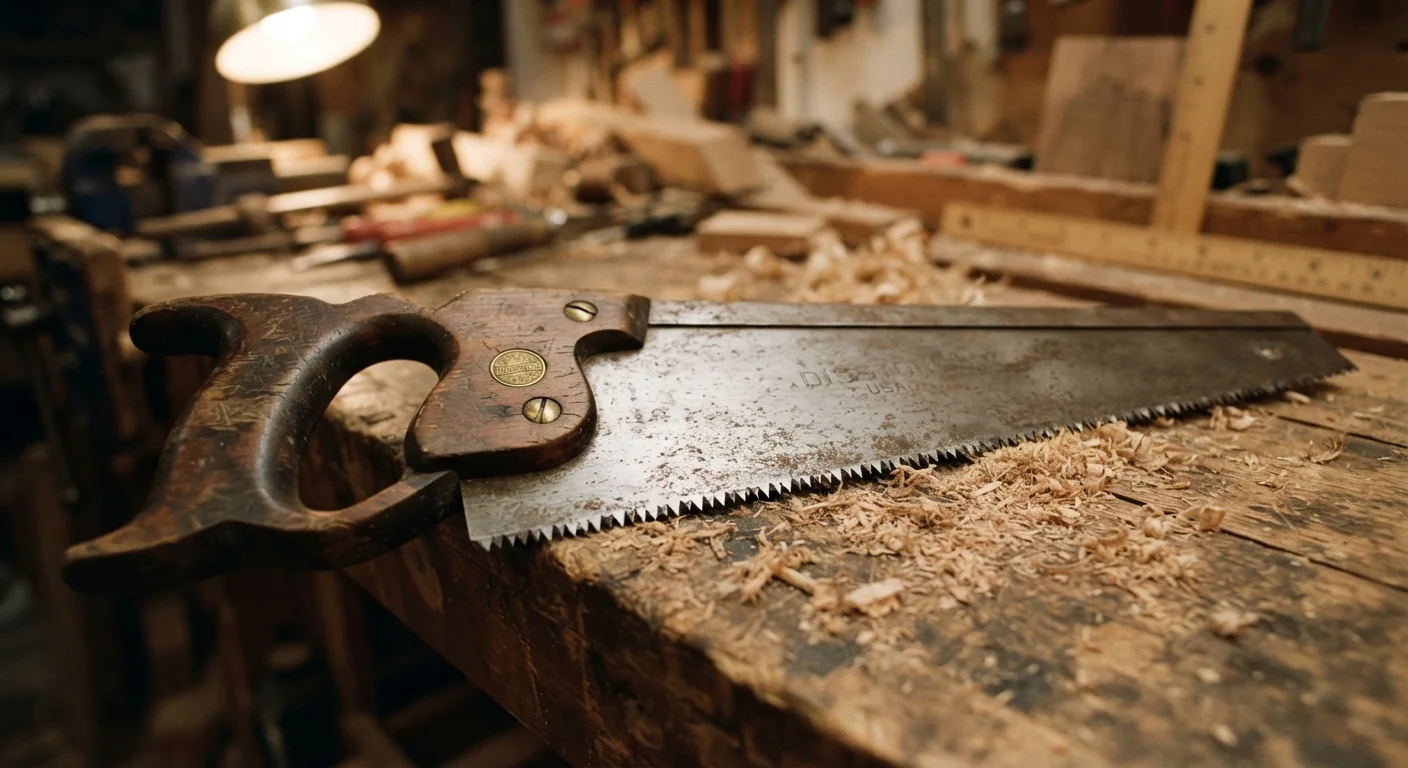
The Blade: Where the Work Happens
The blade is the long, flat steel body of the saw. Its length (typically 20-26 inches for general-purpose saws) determines how much of the cut you complete in each stroke. Longer blades allow longer strokes, which reduces fatigue on wide boards. Blade thickness affects rigidity - a stiffer blade tracks straighter, while a thinner blade flexes more and can drift off line if you're not careful.
Along the cutting edge, teeth are shaped and set at precise angles. Tooth set describes how each tooth is bent slightly outward, alternating left and right. This creates a kerf - the slot the saw cuts - that is fractionally wider than the blade body, so the blade doesn't bind and jam mid-cut. Understanding kerf is practical: if you're cutting a board to an exact length, always cut just outside your pencil line on the waste side, or you'll end up a hair short. For precise measurement habits that complement accurate sawing, see what a tape measure is really telling you.
TPI and Tooth Geometry: The Science of the Cut
TPI - teeth per inch - is the most important number stamped on a saw. It governs the trade-off between speed and surface quality. Saws with 6-8 TPI cut aggressively and are suited to rough framing lumber where surface finish doesn't matter. Saws with 12-15 TPI cut slowly but leave a smooth edge ideal for finish carpentry and trim work.
Tooth geometry goes one level deeper. Each tooth has a rake angle (how aggressively it leans into the cut) and a fleam angle (whether the tip is filed straight or at an angle across the tooth face). Rip saws have teeth filed straight across, acting like tiny chisels that shear wood fibers running parallel to the grain. Crosscut saws have teeth filed at an angle, creating knife-like points that sever fibers running perpendicular to the blade. Using a rip saw to crosscut - or vice versa - is possible but inefficient and produces a rougher finish.
6-15
Typical TPI range for general-purpose hand saws
Lower values (6-8 TPI) suit rough cuts in softwood framing; higher values (12-15 TPI) are used for smooth finish cuts in hardwood and trim.
~1/16"
Typical kerf width on a standard hand saw
Kerf width varies by tooth set; on most general-purpose saws it falls between 1/16 and 1/8 inch - enough to shift a measurement if not accounted for.
20-26"
Common blade length range for general-purpose hand saws
Longer blades allow longer strokes per cut, reducing the number of strokes needed and lowering fatigue on wide boards.
Many modern saws use hardpoint teeth - hardened after manufacture so they stay sharp much longer than traditional teeth. The trade-off is that hardpoint teeth cannot be resharpened by hand and the entire blade must be replaced when dull.
The Handle, Back, and Hang Angle
The handle (also called the tote) connects you to the blade. Traditional handles are shaped wood or molded plastic with a pistol-grip form. Look for one that fits your hand comfortably - a poorly shaped handle causes fatigue and loss of control on longer cuts.
The hang angle is the angle between the handle and the blade. It determines your natural wrist position mid-stroke and affects how much power you apply. Most general-purpose hand saws are designed so the ideal cutting angle - roughly 45° for crosscuts - aligns with a relaxed arm position when holding the handle naturally.
Some saws have a back: a stiffening spine of brass or steel folded over the top edge of the blade. This spine is found on backsaws (tenon saws, dovetail saws) and keeps the blade perfectly rigid for extremely precise joinery work. The trade-off is that the back limits how deep the saw can cut. Backsaws are not interchangeable with standard hand saws - they serve different purposes entirely.
If you're building out your first tool kit and deciding whether a hand saw belongs in it before you invest in power tools, our guide to hand tools every first-time DIYer actually needs walks through the reasoning. And when you're ready to compare hand sawing to powered alternatives, hand tools vs. power tools covers the trade-offs honestly.
Frequently Asked Questions
TPI stands for teeth per inch - the number of saw teeth packed into each inch of blade length. A lower TPI (such as 6-8) removes material quickly but leaves a rougher edge. A higher TPI (such as 12-15) cuts more slowly but produces a smoother, cleaner surface.
Kerf is the width of material the blade removes as it cuts. It's determined by how far the teeth are set (bent) outward from the blade body. When making precise cuts, you need to account for kerf by cutting just outside your measurement line, not through it.
A rip saw has teeth shaped like tiny chisels designed to cut along the wood grain efficiently. A crosscut saw has teeth angled to slice across the grain cleanly. Using the wrong type for the job produces a rougher cut and requires more effort.
Yes. A thicker blade is stiffer, which helps it track straight in long cuts but creates a wider kerf. A thinner blade produces a narrower kerf and can follow curves more easily, but may wander without a guide. Choose based on the precision your project demands.
Hand saws excel at controlled, precise cuts in smaller workpieces and confined spaces where power tools are impractical. For a broader comparison of when to reach for hand tools versus power tools, see our <a href="/tools-materials/essential-hand-tools/hand-tools-vs-power-tools-understanding-the-trade-offs-for-home-projects">hand tools vs. power tools guide</a>.
Tooth set refers to how far each tooth is bent alternately outward from the blade body. This outward bend creates a kerf slightly wider than the blade itself, preventing the blade from binding in the cut. More set means less binding but a rougher cut surface.
The content on this site is for informational purposes only and is not a substitute for professional advice. Always consult a qualified professional for guidance specific to your situation.