

Start here
Why Hand Tools Come First
Core knowledge
The Core Twelve Tools and What They Actually Do
Buying smart
What to Look For When Choosing Each Tool
Stay focused
Tools You Can Skip for Now
Level up
Building Smart Habits Alongside Your Kit
Why Hand Tools Come First
Before you think about power tools, a first-time DIYer's most important investment is a solid set of hand tools. They require no batteries, no electricity, no learning curve around variable speed settings - just your hands and a little practice. They also develop your feel for materials: how wood grain pushes back, how metal bites, how a tight joint sounds different from a loose one.
Hand tools are forgiving teachers. Mistakes happen more slowly, which means you have time to notice and correct them. That's a real advantage when you're still building confidence. If you're weighing whether to start with hand or power tools, our article on hand tools vs. power tools walks through the trade-offs clearly.
The goal here isn't to hand you a shopping list - it's to explain what each core tool does and why it earns its place in a beginner's kit.
The Core Twelve Tools and What They Actually Do
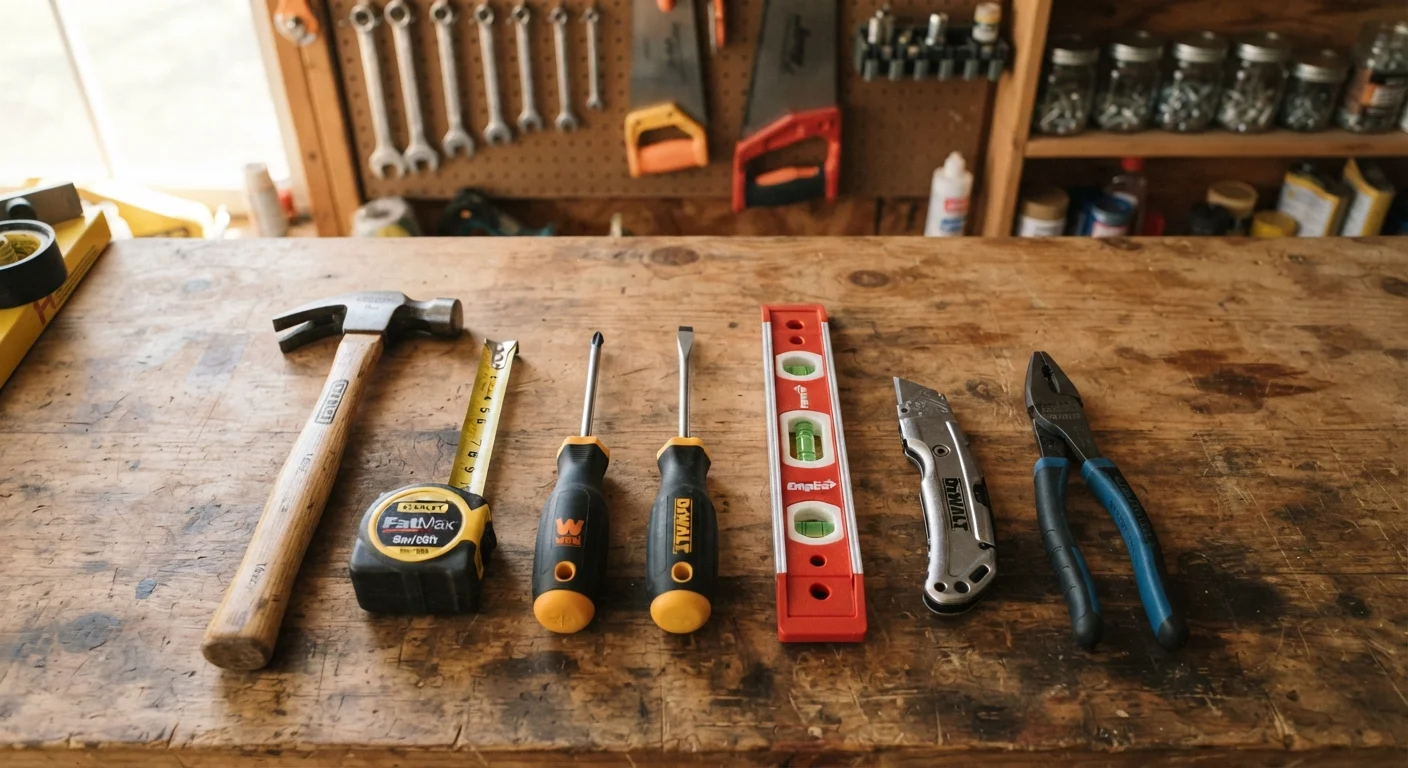
Below is a breakdown of the tools that genuinely earn a place in a first kit, and the specific job each one handles.
TPI (Teeth Per Inch)
The number of cutting teeth per inch on a saw blade. Fewer teeth cut faster but rougher; more teeth cut slower but cleaner. For general wood cutting, 8 TPI is a practical starting point.
Drop-forged steel
A manufacturing process where hot steel is shaped under heavy pressure, producing a denser, stronger tool than one made by casting molten metal into a mold.
Kerf
The width of material a saw blade removes as it cuts. Knowing the kerf helps you position cuts accurately so finished pieces end up the right size.
Combination square
A measuring tool with a ruler and a sliding head that lets you mark both 90° and 45° angles precisely - essential for accurate layout work.
Slip-joint pliers
Pliers with an adjustable pivot point that lets the jaws open to different widths, making them useful for gripping nuts, pipes, and fittings of varying sizes.
Adjustable wrench
A wrench with a movable jaw that can be set to fit different nut and bolt sizes, reducing the need to carry a full set of fixed-size wrenches.
- Tape measure (25 ft.)
- Measures length, width, and height before any cut or purchase. The 25-foot length handles most interior tasks.
- Claw hammer (16 oz.)
- Drives nails and pulls them out with the curved claw. The 16-ounce head balances power and control for general work. See our comparison of claw hammers vs. mallets if you're unsure which striking tool fits your project.
- Multi-bit screwdriver
- Covers Phillips and flat-head fasteners - the two types found in almost every household fixture and piece of furniture.
- Utility knife
- Scores, trims, and cuts materials from drywall to carpet to cardboard. Replaceable blades keep it sharp at low cost.
- Adjustable wrench (8 in.)
- Grips hex and square nuts across a range of sizes - one wrench replaces a whole set of fixed-size options for light work.
- Needle-nose pliers
- Reaches into tight spaces to grip, bend, and position small components - wire, clips, cotter pins.
- Slip-joint pliers
- Handles the larger gripping and bending jobs the needle-nose can't. The adjustable pivot lets it span different widths.
- Level (24 in.)
- Confirms that shelves, frames, and fixtures are genuinely horizontal or vertical - not just close enough.
- Combination square
- Marks 90° and 45° angles accurately, and doubles as a short ruler for layout work.
- Hacksaw
- Cuts metal, PVC pipe, and plastic. A hand saw handles wood - having both expands your range considerably.
- Hand saw (8 TPI)
- Cuts dimensional lumber cleanly. TPI stands for teeth per inch; 8 TPI is a good all-rounder for rough and general cuts in wood.
- Rubber mallet
- Drives components together - drawer slides, furniture joints, tile - without leaving marks or damaging surfaces.
What to Look For When Choosing Each Tool
You don't need the most expensive version of any tool on the list, but construction quality does matter. Here's what to actually examine:
- Handle comfort and grip: A tool you'll hold for twenty minutes needs a handle that doesn't transfer vibration or dig into your palm. Rubberized or contoured grips generally outperform bare wood or hard plastic for extended use.
- Steel quality: For cutting and striking tools, look for drop-forged or hardened steel rather than cast metal. Drop-forged tools are shaped under pressure, making them denser and less prone to cracking.
- Joint tightness: On pliers and wrenches, a loose pivot means slippage under load. Test by gripping something firm - there should be no wobble.
- Blade thickness: Saws and utility knives with thin, flimsy blades flex during cuts, reducing accuracy. A blade with visible rigidity makes cleaner work.
Common myths about hand tool buying - including the idea that price always signals quality - are worth reading before you shop.
Handle the tool before you commit
If you have the opportunity, hold the tool before purchasing. A hammer that feels front-heavy in your hand will fatigue you quickly. A screwdriver handle that's too narrow gives you less torque. Physical fit is a legitimate selection criterion - not just aesthetics.
Tools You Can Skip for Now
Specialty tools are easy to accumulate and slow to use. As a beginner, resist buying tools for projects you don't have yet. A few common purchases that tend to disappoint early:
- Chisels: Essential for joinery and mortise work, but rarely needed until you're tackling carpentry beyond basic assembly.
- Block plane: Useful for fine wood fitting - a skill that comes after your first dozen projects, not before.
- Caulk gun: Worth owning eventually, but only when you have a specific sealing or weatherproofing task lined up.
- Specialty wrenches: Basin wrenches, pipe wrenches, and torque wrenches serve specific jobs. Our guide on plumbing tools for homeowners can help you decide what's genuinely needed when plumbing work arises.
Expanding gradually - buying for a real project rather than a hypothetical one - is covered in depth in our article on building your kit over time.
Building Smart Habits Alongside Your Kit
Tools are only part of the picture. How you use and store them shapes both safety and longevity. A few principles worth building from day one:
- Always cut away from your body, and keep your non-dominant hand behind the blade path.
- Store sharp tools - utility knives, saws, chisels - with guards or sheaths. Blade-to-blade contact in a toolbox dulls edges quickly and creates injury risk when reaching in.
- Wipe metal surfaces after use. Even indoor humidity causes surface rust over months, and light oil applied occasionally keeps tools in working condition far longer.
- Read the tool before using it. Manufacturers include handling guidance that's worth two minutes of your time before a first cut or strike.
Our companion article on hand tool safety habits goes deeper on the practices that protect beginners and experienced DIYers alike. Once you've built confidence with hand tools, you may want to explore power tools basics - but there's no rush. A well-used hand tool is always the right tool for the job it was made for.
You can also use our starter toolkit audit to check whether anything genuinely essential is missing from what you already own.
Frequently Asked Questions
Most everyday home tasks can be handled with around ten to twelve hand tools. Starting small lets you learn each tool properly before adding more. A focused kit prevents the clutter and confusion that comes from buying tools speculatively.
Mid-range tools with solid construction - comfortable grips, durable steel - generally outperform cheap options and last considerably longer. That said, price alone doesn't guarantee quality. Look at construction details like handle material, joint strength, and blade thickness rather than the price tag.
Yes, the majority of hanging, assembly, repair, and light carpentry tasks around the home can be done entirely with hand tools. Power tools add speed and convenience but are rarely strictly necessary for a first-timer tackling common projects.
A tape measure is arguably the most universally needed - no project starts without measuring. A multi-bit screwdriver runs a very close second, covering the fasteners found in almost every household task.
Any work involving your home's electrical wiring, gas lines, structural elements, or mains plumbing should be handled by a licensed professional. These tasks carry safety and legal risks that go well beyond what hand tools and beginner knowledge can safely address.
Keep tools dry to prevent rust, store sharp-edged tools with blade guards or sheaths, and hang or tray-organize them so blades don't contact each other. A simple toolbox or wall-mounted pegboard works well for a starter kit.
The content on this site is for informational purposes only and is not a substitute for professional advice. Always consult a qualified professional for guidance specific to your situation.