

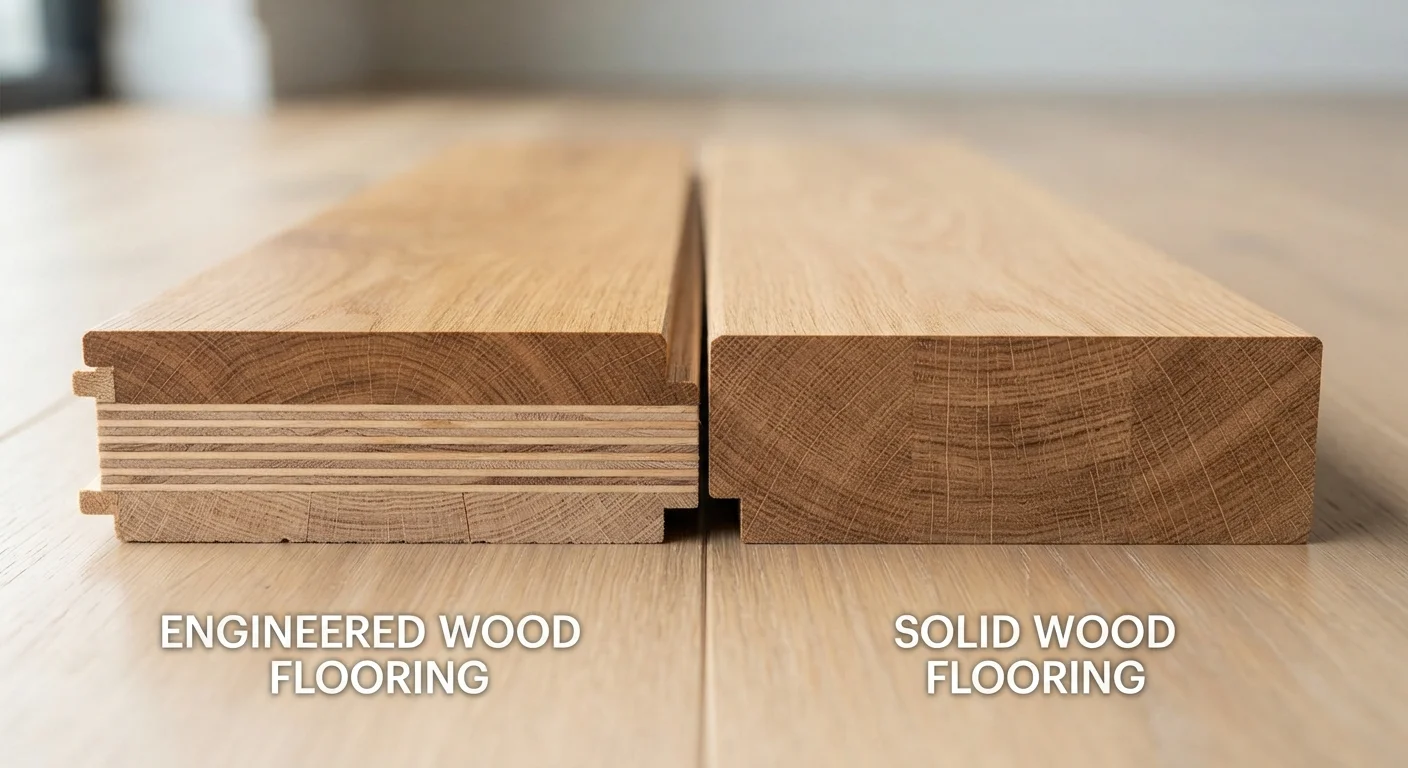
Option A
Engineered Hardwood
The dimensionally stable, moisture-tolerant option.
Best for: Basements, slab-on-grade installs, radiant heat floors, and budget-conscious renovators who want a real wood surface.
Option B
Solid Hardwood
The traditional, fully refinishable choice.
Best for: Above-grade rooms in climate-controlled homes where long-term refinishability and heirloom durability are priorities.
What You're Actually Buying
Both materials have a genuine hardwood surface - the distinction is what's underneath it. Solid hardwood is milled from a single piece of wood, typically ¾ inch thick. Engineered hardwood bonds a real hardwood veneer (commonly 1/12 to 1/6 inch thick) over a cross-ply plywood or HDF core.
That core is the key engineering detail. By alternating grain directions across the layers, manufacturers create a plank that resists expansion and contraction caused by humidity and temperature changes - the main enemy of any wood floor. Solid hardwood, being all one grain direction, is far more susceptible to those dimensional shifts.
For a broader look at how engineered wood products are constructed and categorized, see the field guide to engineered wood options.
| Criterion | Engineered Hardwood | Solid Hardwood |
|---|---|---|
| Typical material cost | $3-$10 per sq ft | $5-$12 per sq ft |
| Refinishing cycles | 0-2 (veneer-dependent) | 3-5 cycles |
| Moisture tolerance | Good (not waterproof) | Poor - expands/contracts |
| Suitable over concrete slab | Yes (glue or float) | No (not recommended) |
| Radiant heat compatible | Generally yes | Rarely - check species |
| DIY installation difficulty | Moderate (float or glue) | Moderate-High (nail-down) |
| Typical lifespan (well-maintained) | 25-40 years | 50-100+ years |
Cost Comparison: Material and Installation
Material prices vary by species, grade, and plank width, but as a general range: solid hardwood flooring typically runs $5-$12 per square foot for materials, while engineered hardwood spans $3-$10 per square foot. The overlap is real - a wide-plank white oak engineered floor can cost as much as a narrow-strip solid maple floor.
Where engineered hardwood creates clearer savings is installation. Floating or glue-down methods reduce subfloor prep requirements and can cut labor costs. Solid hardwood requires a nail-down installation over a wood subfloor, which rules it out over concrete without significant additional work. If your subfloor situation is complicated, those costs add up fast.
Don't overlook the cost of failure either. Solid hardwood installed in a high-humidity zone risks cupping, warping, and expensive replacement. Choosing the wrong material for the environment negates any upfront savings.
Longevity and Refinishing: The Long Game
Solid hardwood's biggest advantage is refinishability. A ¾-inch plank can typically be sanded and refinished 3 to 5 times over its life - meaning a floor installed today could still look fresh in 50 or 60 years with proper care. That's a compelling value proposition if you're staying put long-term.
Engineered hardwood's refinishability depends entirely on veneer thickness. Thin-veneer products (1/12 inch) may allow only one light refinish, or none at all. Thicker veneers (1/6 inch or more) can typically handle two refinishes. Before purchasing, ask the manufacturer or retailer specifically about the veneer thickness and sanding allowance - it varies significantly by product.
If you're planning to refinish an existing solid floor, our guide on sanding and refinishing hardwood floors covers the common pitfalls that catch DIYers off guard.
Installation Considerations for DIYers
Engineered hardwood is generally more DIY-friendly. Floating installations - where planks click or glue together without fastening to the subfloor - require fewer specialized tools and are more forgiving on uneven surfaces. Glue-down is more demanding but suitable over concrete with proper moisture testing.
Solid hardwood nail-down installation requires a flooring nailer (typically rented), a wood subfloor at least ¾ inch thick, and careful acclimation of the material - usually 3 to 5 days in the room at its normal humidity level. Skipping acclimation is a frequent cause of post-installation gapping or buckling.
Both types require the same underlayment and subfloor flatness standards (typically no more than 3/16 inch variation over a 10-foot span). Check local building codes before starting - some municipalities have specific requirements for flooring over certain subfloor types or in multi-family buildings.
If you're weighing other material trade-offs for your renovation, the comparison of porcelain vs. ceramic tile applies similar cost-vs-durability logic to another common flooring choice.
¾ inch
Standard solid hardwood plank thickness
This is the industry-standard thickness that allows multiple sanding and refinishing cycles over a floor's lifetime.
3-5 days
Recommended acclimation time before installation
Flooring manufacturers and installers broadly recommend acclimating solid hardwood planks to the room's temperature and humidity before laying.
1/6 inch
Veneer thickness needed for two refinishes
Engineered hardwood veneers at or above this thickness generally allow at least two sanding cycles, according to industry guidance.
The content on this site is for informational purposes only and is not a substitute for professional advice. Always consult a qualified professional for guidance specific to your situation.