

Start here
Why Material Planning Matters Before You Buy Anything
Next
How to Measure and Calculate Material Quantities
Then
Reading Product Specs and Coverage Claims
Apply it
Building a Simple Materials List and Budget
Final step
Smart Sourcing Without Over-Buying
Why Material Planning Matters Before You Buy Anything
Most first-time renovators underestimate materials in one of two ways: they buy too little and face a mid-project store run, or they overbuy and write off hundreds of dollars in unused product. Neither outcome is inevitable. A little planning - before any money leaves your wallet - closes that gap significantly.
Material planning is the process of identifying exactly what you need, in what quantity, at what spec, and in what order. It's not glamorous, but it's the single habit that separates renovators who stay on budget from those who don't. For a deeper look at where unplanned buying drains renovation dollars, see our article on renovation budget leaks.
How to Measure and Calculate Material Quantities
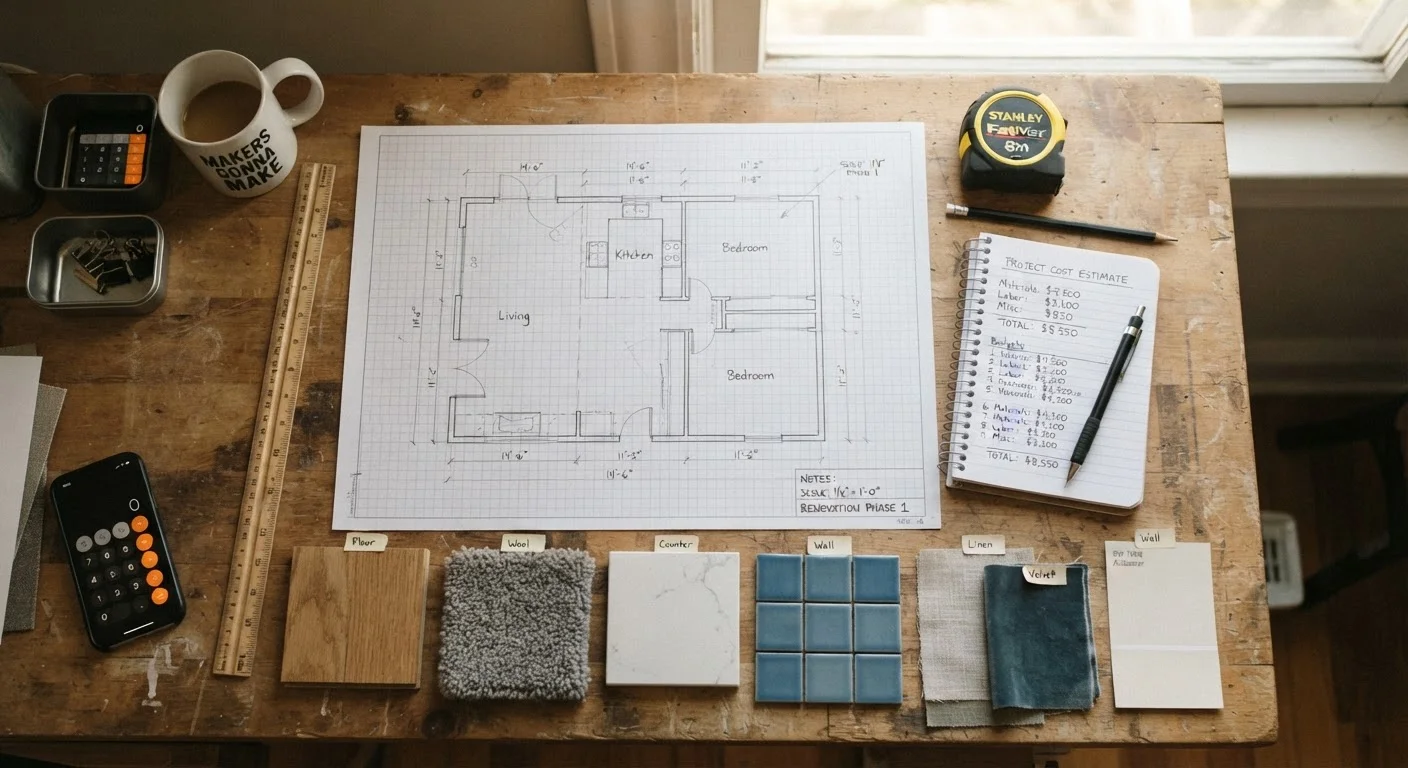
Every material quantity starts with a measurement. For floors and walls, you need square footage: multiply length by width for each surface, then add them together. For baseboards, trim, or anything sold by the linear foot, measure the total run of each element. For cubic materials like concrete or gravel, you'll calculate volume - length × width × depth.
Once you have your raw number, add a waste buffer before you order. A standard 10% overage handles normal cuts and minor errors on simple layouts. Jump to 15% for diagonal tile patterns, rooms with lots of angles, or materials that chip or break easily. This isn't padding - it's the practical reality of cutting materials to fit real spaces.
Document every measurement in a simple notebook or spreadsheet as you go. You'll reference these numbers repeatedly, and it's far easier to double-check a written record than to re-measure a room mid-project.
Reading Product Specs and Coverage Claims
Packaging coverage claims are almost always optimistic. A gallon of paint rated for 400 sq ft assumes a smooth, already-primed surface applied in ideal conditions. Textured drywall, raw wood, or a dark color going over a light one will each consume more product per coat. Read coverage rates as a ceiling, not a guarantee.
For flooring, spec sheets list the nominal dimensions of each piece, but the installed size is what matters - grout joints or click-gap tolerances affect how many pieces you actually need per square foot. Check the spec sheet for both the nominal size and the manufacturer's recommended coverage calculation.
Cross-Check Before You Commit
Before finalizing your materials list, take your measurements and the product spec sheet and do the math independently - don't rely solely on an in-store estimator or a website calculator. These tools can use different assumptions about waste, coverage, and layout. Doing your own calculation takes ten minutes and can prevent a significant over- or under-order.
Understanding what a spec sheet tells you - and what it doesn't - is a foundational skill for choosing between materials. The building materials hub walks through common material types and how to interpret their technical details before you commit.
Building a Simple Materials List and Budget
A materials list doesn't need to be a spreadsheet masterpiece. It needs four columns: item, quantity, unit of sale, and estimated cost. That's it. Work through your project scope systematically - surface by surface, element by element - and fill in each row before you price anything.
List materials in the order you'll actually use them. Subfloor before flooring, primer before paint, backer board before tile. This sequencing prevents you from buying finish materials before you've confirmed the substrate is right, which is a common and costly mistake.
Once your list is complete, price each item at current local rates, not from memory or old receipts. Material prices shift, and budgeting from outdated figures leads to real shortfalls. Keep a running total as you go, and flag any single line item that's a large portion of your total - those are worth shopping around or reconsidering.
Smart Sourcing Without Over-Buying
Once you have a firm list and quantities, you're in a much stronger position to source materials without impulse buying. Stick to your list at the store. Substituting a different product on the spot - without rechecking specs or coverage - is how discrepancies creep in.
Consider non-traditional sources for certain items. Salvage outlets, Habitat for Humanity ReStores, and architectural salvage yards can offer genuine value on tile, flooring, lumber, and fixtures. The trade-off is availability: what's in stock is what you get, and restocking isn't guaranteed. Our guide to salvage yards and ReStores covers what to realistically expect from these sources.
Similarly, discontinued and end-of-line materials can offer real savings - but only if the full quantity you need is available in a single lot. Running short on a discontinued product mid-project is a difficult problem to solve.
If you're looking for quick projects to put these skills to work, the weekend projects section offers scoped, budget-friendly ideas well-suited to first-timers building their planning confidence.
Frequently Asked Questions
A 10% overage is a common rule of thumb for straightforward layouts like painted walls or simple flooring runs. Diagonal tile patterns, irregular rooms, or materials prone to breakage warrant 15% or more. Always check the manufacturer's guidelines, as some products have specific recommendations.
Coverage rate is the square footage one gallon is estimated to coat in a single coat on a smooth, primed surface. Rough, porous, or unprimed surfaces absorb more paint, so your actual coverage will be lower. Plan your quantities based on your surface condition, not just the number on the label.
Start by listing every surface or element you're changing. Measure each one, calculate the quantity of material needed (adding your waste buffer), and note the unit of sale for that material - bag, sheet, linear foot, or gallon. Group items by trade so you can price them category by category.
It can be, but only if you can verify the total quantity you need is available in one lot, the condition is sound, and you understand there will be no restocking if you run short. Our article on <a href="/budget-renovations/materials-savings/end-of-line-and-discontinued-materials-a-practical-approach-to-buying-carefully">end-of-line materials</a> covers how to assess this trade-off carefully.
Buying materials before finalizing measurements and sequencing the project. This leads to wrong quantities, mismatched products, and trips back to the store mid-project. Write your full list first, price it out, then purchase in the correct order for your workflow.
Permits are required for structural, electrical, plumbing, and mechanical work in most US jurisdictions - and buying materials before permit approval can mean changes are required later. Always check with your local building department before committing to materials for any regulated scope of work.
The content on this site is for informational purposes only and is not a substitute for professional advice. Always consult a qualified professional for guidance specific to your situation.