

Our Verdict
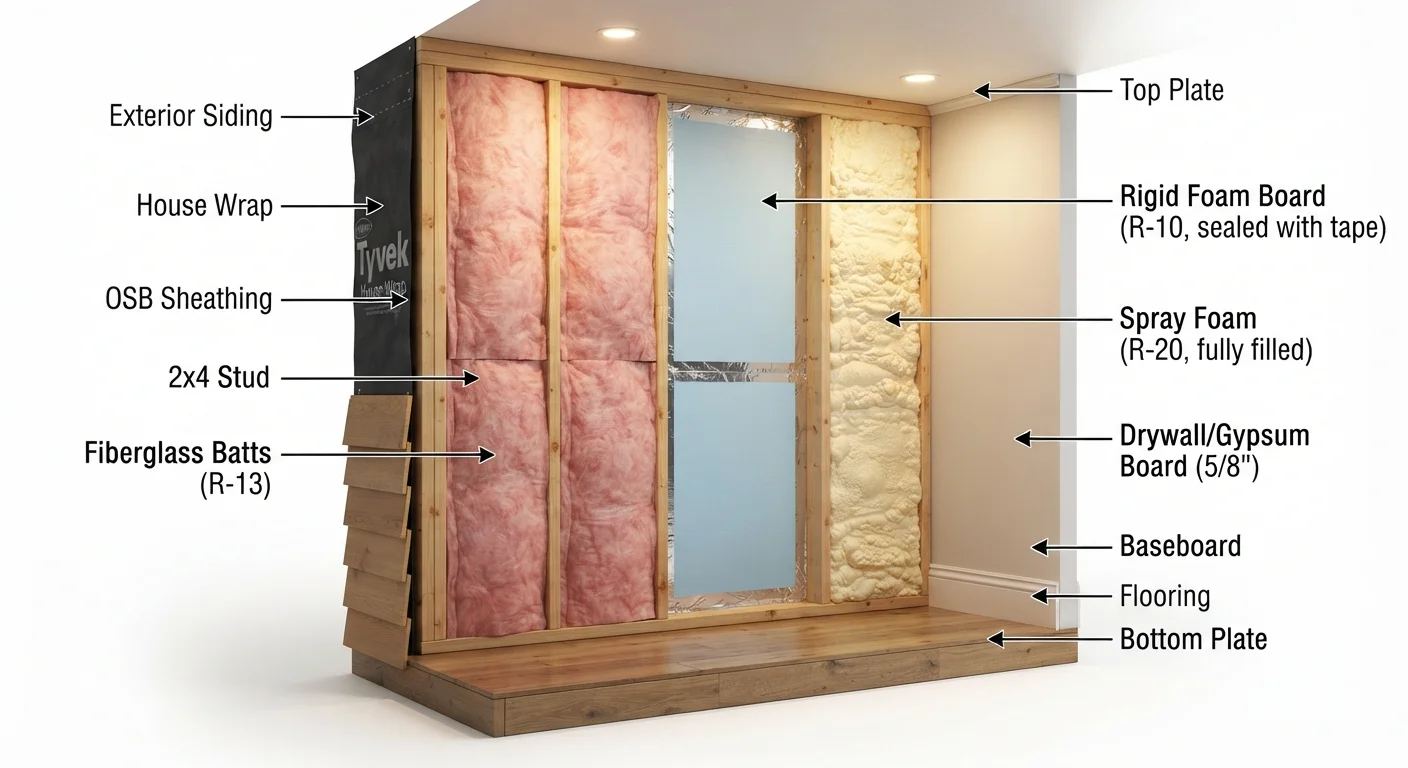
No single insulation type wins across every scenario. Fiberglass batts remain the go-to for budget-conscious DIYers insulating open stud bays, while blown-in is the most practical upgrade for existing attics. Rigid foam fills a unique role in continuous insulation assemblies, and spray foam delivers unmatched performance where air sealing is critical - at a price that usually warrants a professional.
| Best for | Recommended |
|---|---|
| Budget-focused DIYers insulating open stud cavities | Fiberglass Batts |
| Homeowners upgrading attic insulation with minimal demo | Blown-In (Loose-Fill) |
| Basement walls and exterior continuous insulation layers | Rigid Foam Board |
| Maximum air sealing and R-value in tight or irregular spaces | Spray Foam |
Why Insulation Type Matters Beyond R-Value
R-value - the measure of thermal resistance - is the number printed on every insulation package, and it matters. But it's only one part of the equation. Air sealing performance, moisture behavior, installation complexity, and total installed cost all determine whether an insulation upgrade actually pays off. Two materials with the same R-value can perform very differently in a real wall or attic assembly depending on how well they block air movement and manage vapor.
For a broader breakdown of materials and their applications, see our insulation quick-reference guide or the full home insulation hub for project-specific guidance.
| Fiberglass Batts | Blown-In Loose-Fill | Rigid Foam Board | Spray Foam | |
|---|---|---|---|---|
| R-Value per Inch | R-2.9-3.8 | R-2.5-3.8 | R-3.8-6.5 | R-3.5-7.0 |
| Typical Material Cost (per sq ft) | $0.30-$0.60 | $0.50-$1.00 | $0.25-$1.00+ | $1.50-$4.00+ installed |
| DIY Difficulty | Easy | Moderate | Moderate | Difficult / Pro recommended |
| Air Sealing Performance | Poor | Moderate | Moderate (taped) | Excellent |
| Best Application | Open stud bays | Attic floors | Continuous layers, basements | Tight or irregular cavities |
| Moisture Resistance | Low | Moderate (cellulose) | High (XPS/closed-cell) | High (closed-cell) |
| Special Equipment Needed | No | Blower (rentable) | No | Yes (pro equipment) |
Fiberglass Batts: The DIY Standard
Fiberglass batts are the most widely available insulation format and the default choice for most DIY projects. Pre-cut to fit standard 16-inch and 24-inch stud spacing, they require no special equipment - a utility knife, straightedge, and staple gun are sufficient. Typical R-values run from R-11 for 2×4 walls to R-21 for 2×6 framing, with R-38 or R-49 batts available for attic applications.
Material costs generally run $0.30-$0.60 per square foot for the insulation itself, making batts the most affordable option by purchase price. The trade-off: batts do not air-seal on their own. Gaps around wiring, plumbing, and imperfect cuts reduce real-world performance significantly. Wear a respirator and gloves - fiberglass particles are an irritant.
Blown-In Loose-Fill: Best Attic Value
Blown-in insulation - available in fiberglass or cellulose - is poured and blown through a hose to fill irregular spaces and cover attic floors without disturbing existing finishes. Cellulose (made from recycled paper) runs roughly R-3.2-3.8 per inch and is treated for fire resistance. Fiberglass loose-fill offers R-2.5-3.0 per inch but settles less over time.
Many home improvement retailers loan blowing machines with purchase of a minimum number of bags, making this a legitimate DIY option for attic floors. Total installed cost for a DIY attic project typically ranges from $0.50-$1.00 per square foot in materials. It's not practical for open wall cavities without netting, but for bringing an under-insulated attic up to code, it's hard to beat on value. For a side-by-side of loose-fill against other formats, see batts, blown-in, and rigid boards compared.
Rigid Foam Board: Continuous Coverage Without Thermal Bridging
Rigid foam panels - EPS (expanded polystyrene), XPS (extruded polystyrene), and polyisocyanurate - offer R-values from about R-3.8 per inch (EPS) up to R-6.5 per inch (polyiso). Their real advantage is continuous insulation: applied over studs or sheathing, foam board eliminates the thermal bridging that reduces effective R-value in stud-framed walls by 15-20%.
Rigid foam is well-suited to basement walls, crawlspace rim joists, and exterior wall assemblies. It cuts with a utility knife or table saw and installs with construction adhesive or mechanical fasteners. Material costs range from roughly $0.25-$0.50 per square foot for EPS to $0.60-$1.00+ for polyiso. Gaps between boards must be taped or foamed to limit air leakage. Note that foam board left exposed on interior surfaces typically requires a thermal barrier (usually drywall) per building code.
Spray Foam: High Performance, High Cost
Spray polyurethane foam comes in two forms: open-cell (about R-3.5 per inch, vapor-permeable, less expensive) and closed-cell (R-6.0-7.0 per inch, vapor barrier, structural rigidity). Both types expand to fill gaps, making spray foam the most effective air-sealing insulation available. That dual function - insulation plus air barrier - is what justifies its cost premium.
Professional spray foam installation typically runs $1.50-$4.00+ per square foot installed, depending on type and thickness, making it the most expensive option by a wide margin. Small DIY cans work for air-sealing specific gaps but are impractical for whole-wall coverage. Two-component DIY kits exist for limited applications but require careful mixing, ventilation, and protective equipment. For most homeowners, spray foam is a professional trade application - get multiple quotes and ask contractors to specify open-cell vs. closed-cell for your use case. Review insulation materials compared across types for fire ratings and moisture data on all four options.
Reminder: Local building codes set minimum R-value requirements by climate zone and application. Verify permit requirements with your local building department before beginning any insulation project.
The content on this site is for informational purposes only and is not a substitute for professional advice. Always consult a qualified professional for guidance specific to your situation.