

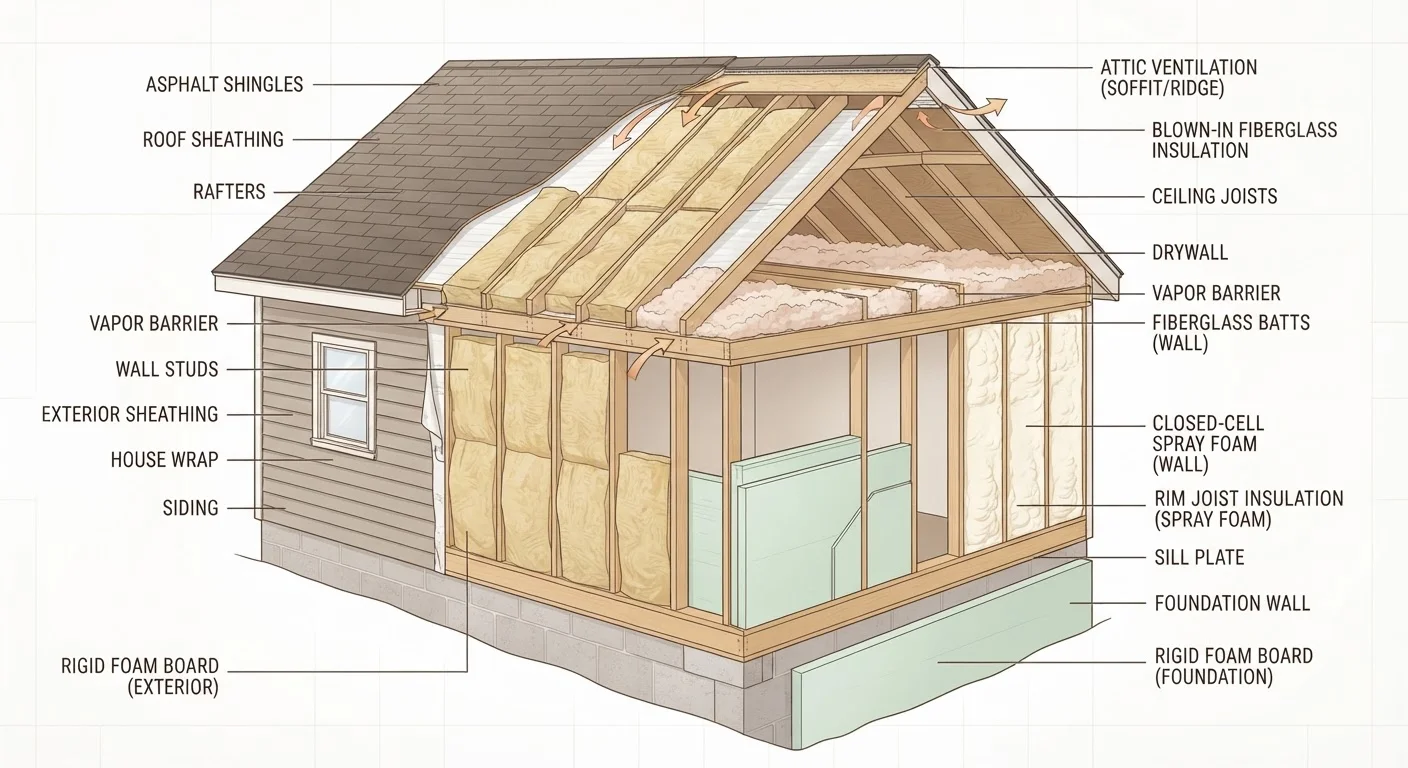
How to Use This Reference
This quick-reference guide is designed to give you the key specs on common insulation materials at a glance. Whether you're auditing your attic, insulating a basement rim joist, or evaluating what's already in your walls, matching the right material to the right location makes a measurable difference in energy performance.
The R-value per inch figures below are representative ranges drawn from industry-standard data. Actual performance can vary by product density, installation quality, and age. For a deeper explanation of what this number means - and what it doesn't guarantee - see what R-value actually tells you. For guidance on choosing between insulation types before committing to a project, compare batts, blown-in, and rigid boards in our dedicated guide.
| Highest R-value per inch (common materials) | Closed-cell spray foam: ~6.0-7.0 per inch (U.S. Department of Energy insulation guidance) |
| Most common DIY-friendly material | Fiberglass batt (pre-cut rolls and batts) |
| Recommended attic R-value (cold climates, Zones 5-8) | R-49 to R-60 (U.S. DOE climate zone recommendations) |
| Best moisture resistance | Closed-cell spray foam or XPS rigid board |
| Spray foam: licensed contractor required? | Yes - in most U.S. jurisdictions (Verify with your local building department) |
| Air sealing required alongside batts? | Yes - batts alone do not stop air infiltration |
Insulation Materials at a Glance
The table below summarizes six widely available insulation types, covering thermal resistance, moisture behavior, and typical installation zones. Use it as a starting point - always verify manufacturer specs and local code requirements before purchasing or installing.
| Material | R-Value per Inch | Moisture Resistance | Typical Applications |
|---|---|---|---|
| Fiberglass Batt | 2.9-3.8 | Poor - absorbs moisture if facing is damaged | Wall cavities, attic floors, crawl spaces (with vapor control) |
| Mineral Wool (Rock Wool) Batt | 3.0-3.3 | Good - inherently water-repellent, won't support mold | Exterior walls, party walls, soundproofing applications |
| Blown-In Fiberglass | 2.2-2.7 | Moderate - susceptible to wind-washing and moisture settling | Attic floors, finished wall retrofits via drill-and-fill |
| Blown-In Cellulose | 3.2-3.8 | Moderate - treated with borate; can absorb moisture if saturated | Attic floors, dense-pack wall retrofits |
| Rigid Foam (EPS) | 3.6-4.2 | Good - low vapor permeability; requires sealing at edges | Basement walls, exterior sheathing, under-slab installations |
| Rigid Foam (XPS) | ~5.0 | Very good - closed-cell structure resists bulk water and vapor | Below-grade walls, rim joists, exterior continuous insulation |
| Closed-Cell Spray Foam | 6.0-7.0 | Excellent - acts as both insulator and vapor retarder | Rim joists, vaulted ceilings, tight or irregular cavities |
| Open-Cell Spray Foam | 3.5-3.8 | Poor - highly vapor-permeable; not suitable for below-grade use | Interior wall cavities, soundproofing, attic undersides in conditioned attics |
Important: Closed-cell and open-cell spray foam installation involves chemicals that require proper respiratory protection and, in most jurisdictions, must be applied by a licensed contractor. Do not attempt spray foam application without professional guidance.
For a side-by-side comparison of cost and installation difficulty, see insulation types compared by cost and difficulty. If you're starting from scratch on understanding insulation as a system, the complete home insulation guide covers every zone in a typical home.
Matching Material to Location: Key Considerations
R-value per inch is useful, but it's only one variable. When identifying insulation gaps or choosing a replacement material, also weigh these factors:
- Climate zone: The U.S. Department of Energy's climate zone map sets recommended total R-values by region - a colder zone requires significantly higher R-values in the attic than a mild one. R-value and climate zones explained walks through how to apply these targets.
- Moisture risk: Below-grade and crawl space applications demand materials with high moisture resistance. Using fiberglass batts in a damp basement, for example, can lead to mold and degraded performance.
- Available cavity depth: Where space is limited - such as a 2×4 framed wall or a low-pitch roof - higher R-per-inch materials like rigid XPS or closed-cell spray foam allow you to meet code targets within a thinner profile.
- Air sealing: No insulation fully stops air movement on its own. Spray foam is the exception - it insulates and air-seals simultaneously. Batts and loose-fill should always be paired with deliberate air sealing using caulk, foam sealant, or house wrap at penetrations and seams.
- Permits and codes: Some insulation upgrades - particularly those involving spray foam, adding insulation to conditioned attics, or encapsulating crawl spaces - may require permits or inspections. Always verify with your local building department before starting work.
For help interpreting the data sheets that come with insulation products, reading material data sheets for DIYers explains which numbers actually matter.
R-Value
A measure of an insulation material's resistance to heat flow. Higher numbers indicate better thermal resistance. R-value is additive - stacking two layers doubles the total R-value.
Vapor Retarder
A material that slows the movement of water vapor through a building assembly. Closed-cell spray foam and some rigid foams act as vapor retarders; fiberglass batts alone do not.
Air Sealing
The process of closing gaps, cracks, and penetrations in a building envelope to prevent uncontrolled air movement. Air sealing and insulation work together - insulation alone does not stop drafts.
Dense-Pack
A blown-in installation method where insulation - typically cellulose or fiberglass - is blown into an enclosed cavity at high density to resist settling and limit air movement.
Closed-Cell Foam
A spray foam type with a dense, closed cellular structure that provides high R-value per inch and acts as a vapor retarder. It is more expensive than open-cell foam and must be professionally applied.
Thermal Bridging
Heat loss that occurs through conductive elements - such as wood studs or metal framing - that bypass the insulation layer. Continuous exterior insulation helps reduce thermal bridging.
Wind-Washing
A phenomenon where air movement through or beneath loose-fill insulation in an attic reduces its effective thermal performance. Proper baffles and air sealing at eaves help prevent this.
EPS / XPS
Two types of rigid foam insulation boards. EPS (expanded polystyrene) is less expensive and vapor-open; XPS (extruded polystyrene) offers higher moisture resistance and a consistent ~R-5 per inch.
The content on this site is for informational purposes only and is not a substitute for professional advice. Always consult a qualified professional for guidance specific to your situation.