

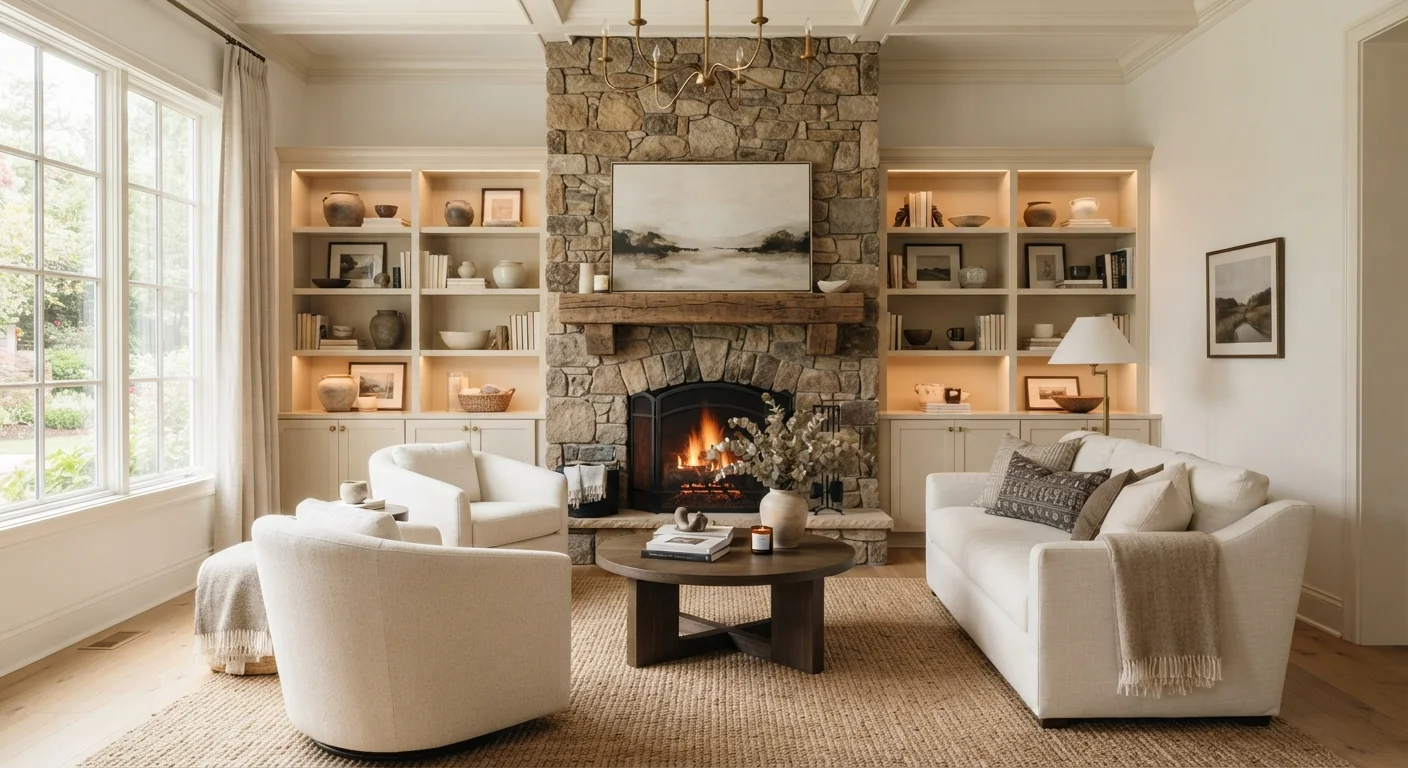
Why Focal Points Matter More Than Most Decor Decisions
Walk into a room that feels "off" and you'll rarely be able to identify exactly why. More often than not, the problem isn't the furniture or the color — it's the absence of a clear focal point. Without one, the eye has nowhere to settle. Every element competes equally for attention, and the result is visual noise rather than cohesion.
A focal point solves this by creating hierarchy. It tells the room — and everyone in it — where to begin. From there, every other piece of furniture, art, and accessory has a logical relationship to that anchor. This is why a well-placed focal point can make a modestly furnished room feel pulled-together, while an expensive room without one can still feel unresolved.
For DIYers working with limited budgets, this is genuinely good news. You don't need new furniture or a renovation to transform how a room feels — you need one strong visual anchor. See our beginner's guide to styling a room for how focal points fit into the broader design process.
Architectural Features: Work With What's Already There
Before you buy or build anything, look at what your room already offers. Fireplaces are the most obvious ready-made focal point — they provide scale, symmetry, and a natural gathering center. If you have one, lean into it: arrange seating to face it, keep the mantel edited and intentional, and avoid hanging a television directly above it (the competing screens split attention).
Large windows with strong views, exposed brick walls, coffered ceilings, or even a structural beam can all function as focal points if you draw attention to them rather than away. The key is contrast — a brick wall reads as a focal point when surrounding walls are neutral; it disappears when everything around it is equally busy.
$30–$60
Typical cost of a single accent wall in paint
Based on standard interior latex paint coverage for an average 12×10 ft wall using one gallon at retail pricing.
2/3
Minimum art width relative to furniture below
A widely used interior design proportion guideline to ensure wall art reads as intentional rather than undersized.
1 anchor
Focal points recommended per room
Design professionals consistently recommend one dominant focal point per space to avoid visual competition between elements.
If your room lacks any architectural drama, don't try to manufacture it everywhere. Pick one wall — ideally opposite the entry — and give it all the visual weight.
How to Build a Focal Point From Scratch
When there's no fireplace or feature wall to work with, you have four reliable DIY options:
- Accent paint: A single wall in a contrasting or deeper color immediately reads as intentional. Use the same color family as the room to keep it cohesive, just several shades richer. Materials typically run $30–$60 for a standard wall.
- Large-format art or mirrors: A single piece scaled correctly for the wall — generally at least 2/3 the width of the furniture below it — anchors the eye far more effectively than a cluster of small pieces. Oversized mirrors also add light and perceived space.
- Gallery wall: Done with deliberate layout logic, a gallery wall creates a unified visual mass that reads as a single focal element. Gallery wall layouts for awkward spaces covers how to make this work in rooms where the geometry isn't ideal.
- Statement furniture: A bed with a tall upholstered headboard, a boldly colored sofa, or a substantial bookcase can serve as the room's anchor. Styling a room around a hero piece explains how to build the rest of the room outward from that decision.
Arranging Furniture to Reinforce — Not Compete With — Your Focal Point
Once you've established your focal point, furniture arrangement either confirms or undermines it. The guiding principle: orient the main seating toward the focal point. In a living room, the sofa and primary chairs should face or angle toward it. Avoid pushing all furniture against the walls — pulling pieces slightly inward actually strengthens the visual connection to the anchor.
Rugs play a significant role here. A properly scaled rug — one large enough that front legs of all key furniture pieces rest on it — ties the seating group together and reinforces the focal point's territory. Rug placement and scale principles goes deep on sizing logic if you're uncertain.
Lighting is the final layer. A floor lamp, sconces flanking a fireplace, or picture lights aimed at a gallery wall all reinforce visual priority. Where you put light, the eye follows.
Explore more practical approaches in the Room Styling Tips hub, where each guide tackles a specific design challenge with the same budget-first mindset.
Frequently Asked Questions
Most rooms without a fireplace or architectural feature can have one created through paint, large-format art, a statement furniture piece, or a gallery wall. Choose one wall — typically the one you face when you enter — and build visual weight there deliberately.
A room can have a primary focal point and a secondary one, but two equally dominant elements will compete and make the space feel restless. Establish a clear hierarchy — one element leads, others support.
Stand at the room's main entry and notice where your eye goes first. If it goes directly to your intended focal point, it's working. If your eye wanders or lands on clutter, the focal point lacks sufficient scale or contrast.
An accent wall in a bold or contrasting paint color is typically the lowest-cost option, often under $50 in paint. A large mirror or a DIY gallery wall are also budget-friendly alternatives that deliver strong visual impact.
Yes — in a bedroom, the bed is almost always the natural focal point. A strong headboard, layered bedding, or artwork centered above the bed reinforces this and makes the room feel purposefully designed.
The content on this site is for informational purposes only and is not a substitute for professional advice. Always consult a qualified professional for guidance specific to your situation.