

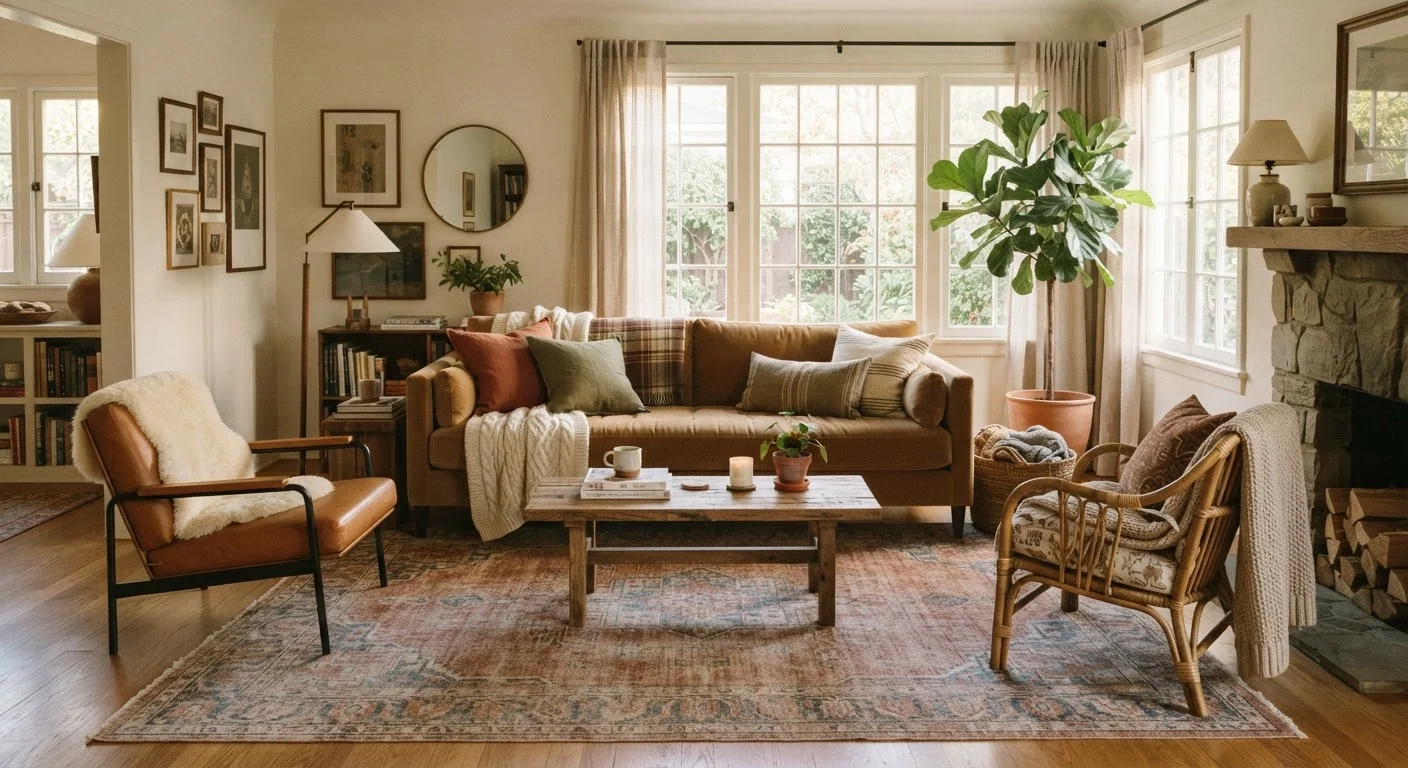
Why Rug Placement Changes Everything
A rug doesn't just cover a floor - it draws a boundary, signals intention, and tells the eye where a room's story begins. When a rug is too small, furniture floats in disconnected islands and the space feels unresolved. Get the placement right, and the whole room clicks into focus.
Interior stylists often describe the rug as a room's "anchor" for good reason. It grounds furniture, absorbs sound, and introduces warmth that hard floors can't offer on their own. For a deeper look at how textiles work together, see our guide to using rugs, cushions, and curtains as decorating tools.
Before shopping or repositioning what you already own, identify your room's focal point - the fireplace, feature wall, or primary furniture grouping the rug should support. Our article on creating a focal point in any room walks through that process step by step.
Getting Scale Right: The Bigger-Than-You-Think Rule
Undersized rugs are the number one decorating mistake stylists flag on home tours. A rug that floats in the middle of a room without connecting to surrounding furniture reads as an afterthought rather than an anchor.
Choose a rug at least one size larger than your instinct suggests
Most people default to a rug that feels right in the store but reads too small in a room with furniture. A rug that leaves wide expanses of bare floor around a seating group fails to unify the space. Going up one standard size almost always improves proportion.
Use painter's tape to test your rug footprint before purchasing
Buying a rug is a significant investment of both money and effort. Testing the exact dimensions on your floor with tape lets you visualize scale, furniture leg placement, and border spacing without any risk.
Ensure at least the front legs of all seating pieces rest on the rug
Furniture that floats entirely off a rug looks disconnected, as if pieces were placed randomly rather than arranged intentionally. Front legs on the rug pulls pieces into a unified grouping and visually closes the seating circle.
Center the rug under the dominant piece of furniture, not the room
Centering a rug in the geometric middle of a room often looks awkward if furniture isn't symmetrically arranged. Anchoring the rug to your primary furniture grouping is what creates visual logic.
Layer a textural top rug over a natural-fiber base rug for added depth
A single flat rug can feel one-dimensional in a well-styled room. Layering adds warmth, visual complexity, and a sense of curation that makes a space feel thoughtfully put together rather than simply furnished.
If you're working with a compact space, scale still matters - it just needs to be handled thoughtfully. See our small room styling strategies for guidance on making proportions work in tighter layouts.
Placement Rules by Room
Each room type calls for slightly different logic when positioning a rug. Here are the principles stylists rely on:
- Living room: In the most common configuration, all front legs of sofas and chairs rest on the rug - this links pieces visually without requiring a massive rug. Alternatively, place all four legs fully on the rug for a more formal, contained look.
- Bedroom: A rug should extend 18-24 inches beyond the sides and foot of the bed so the first thing you feel in the morning is soft underfoot. For a king or queen bed, a 9×12 rug is typically the minimum to achieve this.
- Dining room: The rug should be large enough that chairs remain on it even when pulled out - typically 24-30 inches beyond the table on all sides.
- Hallways and entryways: Runners should leave 3-4 inches of bare floor visible on each side - too narrow creates a tripping hazard; too wide loses the definition a runner provides.
Pattern and color choices will flow naturally once placement is locked in. If your rug has a strong pattern, it can anchor your entire palette - something we explore in pulling a room palette from a patterned piece.
Layering Rugs: Adding Depth Without Overspending
Rug layering is one of those styling moves that looks expensive but is actually budget-smart. The technique involves placing a smaller, more decorative rug over a larger, simpler base rug - often a natural fiber like jute or sisal - to create visual richness and textural contrast.
Start With a Neutral Base Rug
Natural fiber rugs in jute, sisal, or seagrass make ideal base layers because their texture reads as organic and their neutral color doesn't compete with the top rug. They're also widely available at accessible price points, making them a smart investment even before you find your statement piece. Look for a flat or low pile - high-pile bases make the layered rug unstable and harder to walk on safely.
When layering, keep a few principles in mind: the base rug should be neutral and flat-woven; the top rug can be patterned, textural, or a pop of color. Offset the top rug slightly or angle it at 45 degrees for a relaxed, curated effect. Make sure the size difference is significant enough that both rugs read as intentional - a 5×8 layered over an 8×10 works beautifully; similar sizes compete.
For more ways texture layering transforms a room's mood, explore our guide on layering textures for a cozy, styled room. And if you're mixing patterns between your rugs and other textiles, our pattern-mixing framework will help you do it with confidence.
Quick Wins to Try Today
You don't need a new rug to start improving how your current one functions. Small repositioning moves and a few styling tricks can make a significant difference right away.
If you're ready to think bigger - building an entire room's look around a standout piece - our article on styling a room around one hero furniture piece offers a smart framework for doing exactly that.
The content on this site is for informational purposes only and is not a substitute for professional advice. Always consult a qualified professional for guidance specific to your situation.