

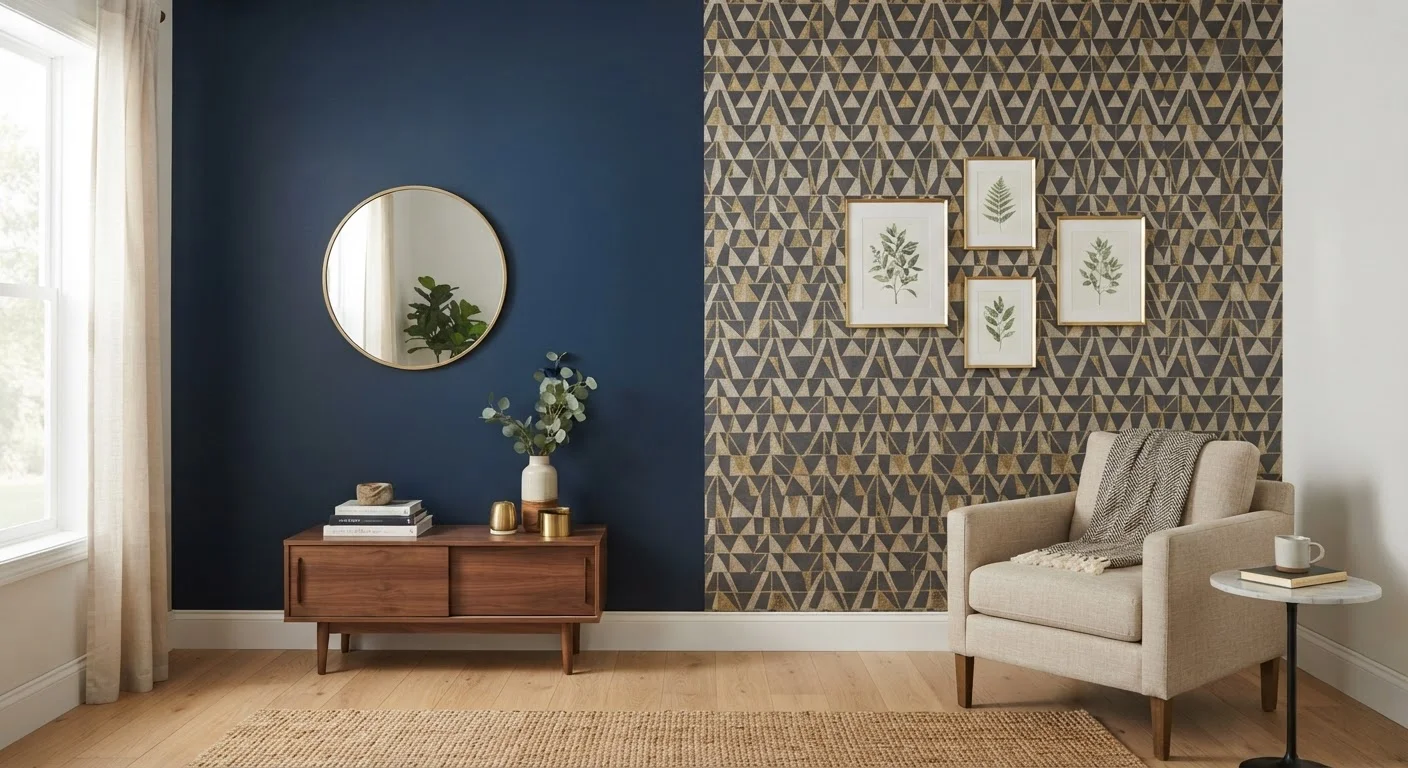
Option A
Repainting an Accent Wall
The fast, low-commitment way to shift a room's mood.
Best for: DIYers who want a clean, color-driven statement they can redo in an afternoon if they change their mind.
Option B
Peel-and-Stick Wallpaper
The renter-friendly, pattern-forward upgrade with minimal tools.
Best for: Renters or homeowners who want texture and pattern without paste, primer drama, or permanent commitment.
What Each Method Actually Involves
Repainting an accent wall means selecting a color, taping off trim and adjacent walls, applying one to two coats of interior paint with a roller, and letting it cure. The entire project - including prep and drying time between coats - typically fits inside a single day. Most DIYers already own the basic tools. The only variables are wall condition and how much prep work the surface requires.
Peel-and-stick wallpaper is a pressure-sensitive vinyl or fabric material that comes in panels or rolls. You measure, cut, peel the backing, and apply panel by panel, smoothing out air bubbles as you go. The main challenge isn't the adhesive - it's managing pattern repeats so the seams look intentional. On a straightforward 8-by-10-foot accent wall, a first-timer can typically finish in two to four hours. For a deeper look at the trade-offs between pattern approaches, comparing stencilling to wallpaper is worth a read before committing.
| Criterion | Repainting | Peel-and-Stick Wallpaper |
|---|---|---|
| Material cost (per accent wall) | $30-$80 | $100-$400 |
| Time to complete | Half to full day | 2-4 hours (no drying wait) |
| Skill level required | Beginner-friendly | Beginner to intermediate |
| Reversibility | Repaint over anytime | Peels off cleanly (on flat walls) |
| Works on textured walls | Yes | No - requires smooth surface |
| Pattern and texture options | Color only | Wide variety of patterns |
| Humidity tolerance | Good (with right formula) | Limited - may peel in moisture |
| Renter-friendly | Depends on lease terms | Generally yes |
Cost, Materials, and Skill Level
For a standard accent wall of around 80-120 square feet, repainting runs roughly $30-$80 in materials: a quart or small can of paint, painter's tape, a roller with sleeve, and a small brush for cutting in at edges. If you're making a dramatic color shift - say, from white to a deep charcoal - budget for a primer coat as well, which adds $15-$25 and another hour of work.
Peel-and-stick wallpaper materials average $1-$4 per square foot depending on the pattern complexity and panel quality. For a 100-square-foot accent wall, that puts material cost at $100-$400. No additional adhesive or special tools are needed beyond a sharp utility knife, a level, and a smoothing tool (a credit card works in a pinch). Skill-wise, paint is more forgiving - drips and roller texture can be corrected mid-project. Wallpaper demands slower, more deliberate work, especially around outlets, switches, and corners.
Before reaching for either option, running through a pre-paint checklist helps you assess lighting, undertones, and surface condition - factors that influence both paths.
Wall Condition: The Factor Most People Skip
Surface condition is the single most underweighted decision factor. Paint is forgiving over minor imperfections - screw holes, hairline cracks, and light texture don't prevent adhesion. Peel-and-stick panels, by contrast, need a flat, clean, fully cured surface. Walls that have been recently patched, that retain a sheen from semi-gloss paint, or that have any texture pattern will cause panels to fail at the edges within weeks. For guidance on getting walls properly patched and smooth before either application, the drywall and walls resource hub covers surface prep in detail.
High-humidity rooms like bathrooms also present a challenge for adhesive-backed wallpaper, which can begin to peel when moisture cycles repeatedly through the wall surface. Paint - particularly a mildew-resistant formula - holds up significantly better in those environments.
Test Adhesion Before Committing to a Full Wall
Before applying peel-and-stick wallpaper to an entire accent wall, peel and press a single panel section in a corner or less visible spot. Leave it for 48 hours, then check the edges for lifting. This quick test reveals whether your wall's paint finish, texture, or moisture level will support the material - before you've invested in the full install.
Design Impact and Reversibility
Paint delivers color impact cleanly and pairs well with nearly any furniture style. It recedes or advances in a room depending on hue and finish - matte absorbs light and reads as cozy, while eggshell and satin reflect light and feel more energetic. The design ceiling is real, though: paint is flat. It cannot replicate the tactile dimension of a grasscloth look or the visual complexity of a repeating geometric.
Wallpaper - even the peel-and-stick variety - adds a layer of visual texture that genuinely changes how a room reads. That said, pattern selection is a commitment in its own right. Accent walls can easily feel off when the pattern scale doesn't match the room's proportions - a common misstep worth avoiding before purchasing panels. For a broader take on when wallpaper earns its place versus when it overshoots, the case for and against bold wallpaper lays out the honest trade-offs.
Reversibility favors peel-and-stick wallpaper in theory - panels come off without damaging drywall when removed carefully and within a reasonable time frame. Paint is also easy to reverse, just with a brush rather than a peel. Neither option locks you in permanently, which makes both appropriate for rooms you're still figuring out. For more room styling ideas on a budget, the styling hub covers layering color and pattern across a full space.
The content on this site is for informational purposes only and is not a substitute for professional advice. Always consult a qualified professional for guidance specific to your situation.