

The Four Criteria That Define Weekend-Worthiness
Not every home improvement idea fits neatly into a Saturday-to-Sunday window - and the ones that quietly don't are the source of most abandoned projects and frustrated weekends. Before committing to any upgrade, run it through four concrete filters.
- Completable in roughly 16 usable hours. Most people have about 8 productive hours per day over a weekend, accounting for sleep, meals, and setup. If a realistic time estimate exceeds that, the project needs to be phased or deferred.
- No mandatory wait that breaks the timeline. Paint typically needs 2-4 hours between coats; tile grout often requires 24 hours before use. If a required curing or drying period falls in the middle of your work sequence and blocks the next step until Monday, the project fails the weekend test.
- No permit or licensed trade dependency. Work requiring an electrical permit, plumbing inspection, or a licensed contractor to sign off cannot be completed in a DIY weekend. This isn't a workaround situation - it's a hard boundary. See common myths about what DIY can skip for more on where this line sits.
- Materials are available before Saturday morning. Ordering tile that arrives Tuesday, or waiting on a special-order fixture, means the project doesn't start this weekend regardless of your time or skill.
Scope Creep: The Quiet Schedule-Killer
The most reliable way a weekend project expands into two weeks is discovering a problem you didn't anticipate. You pull up a bathroom floor tile and find soft subfloor. You start patching drywall and uncover outdated wiring. These aren't rare events - they're common enough that experienced DIYers build a decision rule into their planning: if an unexpected structural or systems problem appears, stop, assess, and schedule a separate project rather than trying to absorb it mid-weekend.
Reduce this risk before the weekend begins. Inspect the full work area in advance. Probe corners, check for moisture, and look behind any access panels. A 20-minute pre-assessment on Thursday can save you from a Sunday-evening crisis.
Do Your Materials Check on Thursday
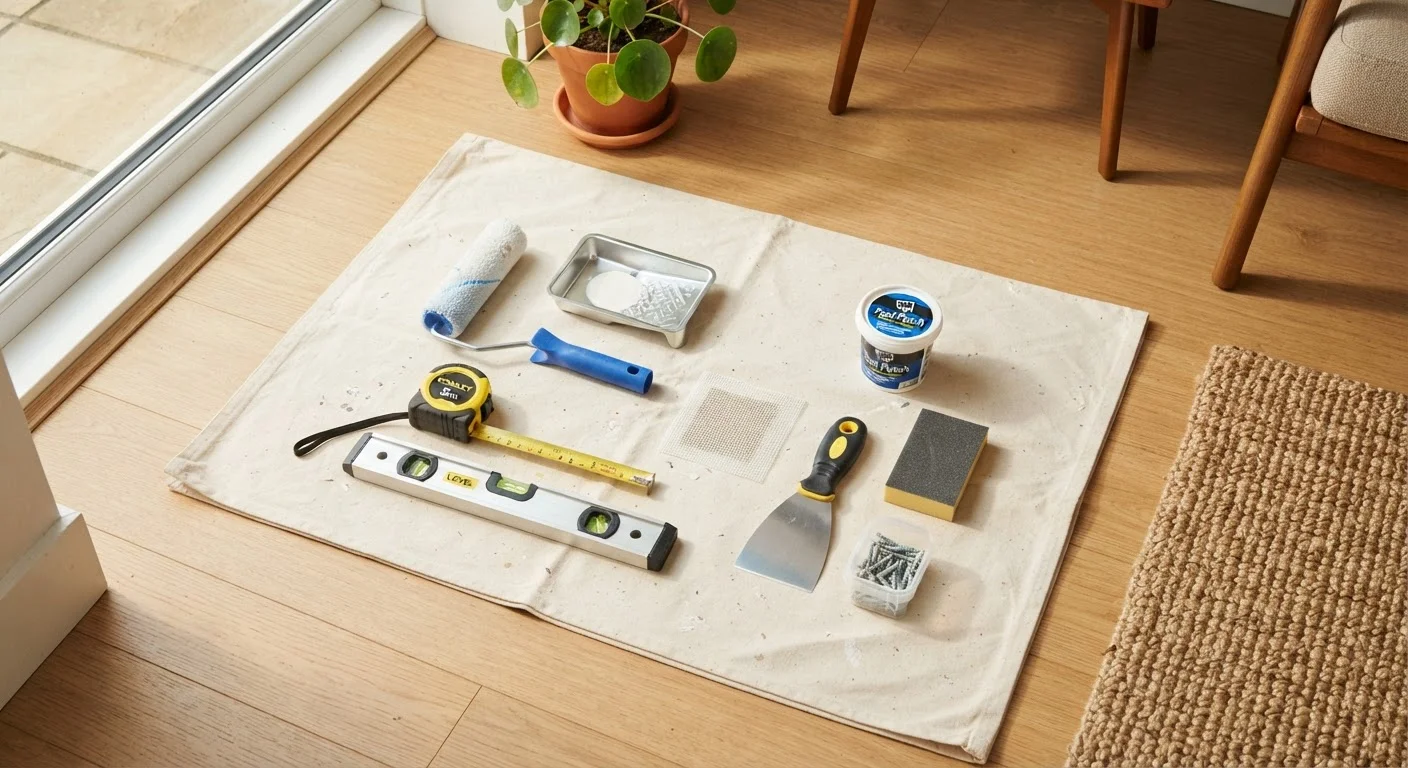
Confirm that every material, tool, and fastener you need is either already on hand or available for same-day pickup before the weekend begins. A single missing item - the right size wall anchor, a specific grit of sandpaper - can stall progress at a critical moment. A Thursday checklist takes 10 minutes and prevents most mid-project hardware runs.
For a structured approach to mapping your tasks and build in buffer time, see the Saturday morning to Sunday evening planning guide.
Skill Fit Matters as Much as Task Scope
A project that takes an experienced DIYer four hours might take a first-timer eight - or might require a technique they haven't developed yet, like feathering a drywall patch or cutting precise tile angles. Weekend-worthiness is not just about the task; it's about the match between the task and the person doing it.
Honest self-assessment is one of the most practical skills in DIY. Ask: have I done this type of task before, or a closely related one? If the answer is no, build in learning time - or choose a simpler version of the project. Installing a pre-hung interior door is beginner-accessible; hanging a door slab in an existing frame requires more precision and experience.
~16 hrs
Realistic productive hours in a typical weekend
Accounting for sleep, meals, setup, and cleanup, most DIYers have roughly 8 usable work hours per day on Saturday and Sunday.
24-72 hrs
Typical cure time for grout and mortar
Most standard tile grout requires at least 24 hours before light use and up to 72 hours before full exposure to water, per common manufacturer guidance.
2-4 hrs
Recoat window for interior latex paint
Most interior latex paints are ready for a second coat within 2-4 hours under normal temperature and humidity conditions.
The right toolkit also shapes whether a task is realistic. Missing a key tool mid-project on a Saturday afternoon, when hardware stores are crowded and rentals may be out, can halt your entire timeline.
Phasing as a Strategy, Not a Compromise
Some upgrades are genuinely valuable but genuinely too large for one weekend. Refinishing hardwood floors across an entire open-plan ground floor, for example, requires furniture removal, sanding, sealing, and multiple coats - easily a four-to-five-day project. That doesn't make it off-limits; it makes it a multi-phase project.
Dividing a large renovation into discrete weekend-sized modules preserves the criteria above while keeping forward momentum. Each phase should produce a finished, usable result on its own - not just "progress." A half-painted room is not a finished result. One fully painted wall with trim complete is. This shift in framing transforms a daunting renovation into a series of achievable wins, and the cumulative effect adds up quickly.
Projects that clear the weekend-worthiness bar consistently also tend to deliver real returns. See which weekend projects add lasting value to prioritize where your time makes the biggest difference. And before you start, it's worth understanding where the real costs hide so your budget matches your scope from day one.
Whether you're tackling DIY decor upgrades indoors or improving your outdoor living space, the same principle holds: a well-scoped weekend project you actually finish is worth far more than an ambitious one you don't.
Frequently Asked Questions
Projects that require inspections, permits, multi-day cure times, or licensed trade work routinely exceed a weekend. Any task with more than two or three sequential hard-stops - steps where you must fully wait before proceeding - will likely spill into the following week.
Many weekend projects - painting, installing shelving, caulking, basic tiling - are beginner-friendly with the right preparation. Avoid any work involving your home's electrical panel, gas lines, load-bearing walls, or main plumbing supply without a licensed professional, regardless of experience level.
Cost and weekend-worthiness are separate considerations. A project can be inexpensive yet still take weeks (e.g., stripping old paint from intricate woodwork), or moderately priced but completely achievable in a weekend (e.g., installing a new vanity). Budget is a separate planning variable.
Permit requirements vary by municipality and project type. Structural changes, electrical work, plumbing modifications, and HVAC alterations commonly require permits in most U.S. jurisdictions. Always check with your local building department before starting any work that alters your home's systems or structure.
Scope creep happens when you open a wall, pull up a floor, or start a task and discover a larger underlying problem that must be fixed first. Reduce the risk by inspecting the full work area before the weekend begins and having a clear decision rule: if a surprise problem appears, defer it rather than expand mid-project.
Phasing is almost always the smarter approach for larger upgrades. Completing one room or one wall section per weekend produces finished results consistently and keeps momentum high, compared to an all-at-once push that often stalls mid-way.
The content on this site is for informational purposes only and is not a substitute for professional advice. Always consult a qualified professional for guidance specific to your situation.