

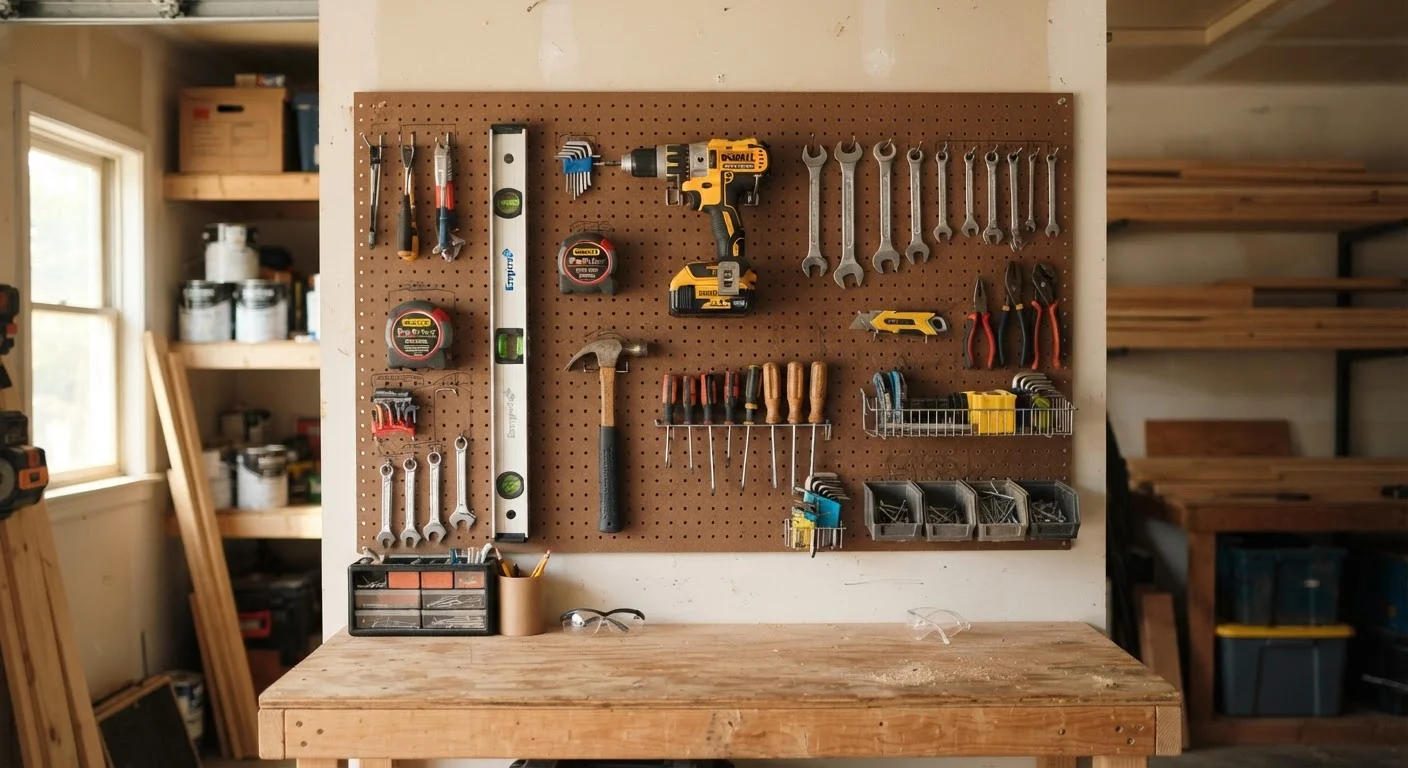
Why Your Tool Strategy Matters as Much as Your Tool List
Most DIYers accumulate tools reactively - one project demands a tile saw, another a random-orbit sander, and suddenly a shelf that cost $40 in lumber is surrounded by $300 in gear. A smarter approach is to build a toolkit around the projects you actually do repeatedly, borrow for the exceptions, and skip the gear that sounds useful but rarely leaves the box.
Before you spend a dollar, it helps to know which category each tool falls into. The framework below - own, borrow, or skip - is based on how often a tool earns its keep across typical weekend renovations: painting, patching, trim work, basic carpentry, and light fixture swaps. For project-planning context, see what separates realistic weekend work from scope creep.
What to Own: The Honest Essentials
These tools earn their shelf space because they appear in nearly every weekend project. Buying decent versions once costs less over time than replacing cheap ones or renting repeatedly.
- Cordless drill/driver (12V-18V): The single most versatile power tool in a home kit. Drives screws, bores holes, and handles light mixing. A mid-range brushless motor holds charge well and outlasts budget models significantly.
- Tape measure (25 ft): Measure twice, cut once - impossible without a reliable tape. A 1-inch-wide blade resists flexing on longer pulls.
- 4-ft level: Essential for shelving, cabinets, and any trim work. A 2-ft level is useful but the 4-ft catches errors over longer spans.
- Utility knife: Scores drywall, cuts flooring underlayment, trims caulk lines. Replace blades freely - dull blades cause more injuries than sharp ones.
- Claw hammer (16 oz): Nails, demo work, and persuading stubborn joints. Heavy enough to drive without fatigue.
- Putty knife set (3-in, 6-in): Patching walls, spreading compound, scraping - used in almost every interior project.
- Paint roller frame + extension pole: Investing in a quality roller frame that accepts standard covers saves more than the covers themselves.
- Stud finder: Hanging anything heavier than a picture frame without one is guesswork. Basic magnetic models work; electronic models with live-wire detection add a useful safety layer.
For a structured audit of what you may already own, run through this toolkit checklist before buying anything new.
What to Borrow: High-Cost, Low-Frequency Tools
Tool libraries, neighborhood sharing apps, and hardware store rental counters exist for exactly this category. These tools are genuinely useful - sometimes indispensable - but using them once or twice a year makes ownership hard to justify.
- Oscillating multi-tool: Ideal for undercutting door casings before laying flooring or making plunge cuts in tight spaces. Renting for a weekend typically costs $25-$40.
- Random-orbit sander: Excellent for refinishing furniture or smoothing rough lumber. Unless you sand regularly, borrowing makes more sense than storing a tool you use once annually.
- Wet tile saw: Necessary for any tile work beyond basic straight cuts. Rental cost is usually $40-$60 per day - far less than purchasing, storing, and maintaining one.
- brad nailer / finish nailer: Speeds up trim and casing installation meaningfully. Rental is widely available; compressor access is sometimes needed too, which can also be rented as a package.
Planning around borrowed tools requires scheduling them into your timeline. Map your weekend renovation around tool pickup and return windows so you're not losing Saturday morning to a rental run.
What to Skip: The Appealing Gear That Rarely Pays Off
Home improvement stores are very good at displaying solutions to problems most homeowners encounter once, if at all. These tools aren't bad - they just tend to underperform relative to their cost and storage footprint for typical weekend work.
- Laser distance measurer: Faster than a tape measure in large, empty rooms. For most trim, carpentry, or shelving work, a standard tape is equally accurate and far cheaper.
- Drywall texture sprayer: Matching existing wall texture is genuinely hard, and a sprayer alone won't close the gap. Most weekend patching work is better handled with a pre-mixed spray can for small areas or a brush-applied texture for larger repairs.
- Reciprocating saw: Powerful for demo work, but if you're not regularly taking out walls or cutting pipe, it's a tool that earns dust. Borrow if a specific job calls for it.
- Shop vacuum (large canister): Useful if you already own one, but a smaller wet/dry vac handles most weekend renovation debris without the bulk.
Avoiding unnecessary purchases is one of the clearest ways to keep renovation costs under control. For related thinking on where renovation budgets quietly erode, see common material waste habits worth changing. And if you're thinking further ahead about building your kit gradually, expanding your toolkit without buying things twice walks through a practical prioritization approach.
This article provides general guidance for informational purposes only. Tool rental prices, availability, and local permit requirements vary by location - verify costs and any applicable codes with local suppliers and authorities before starting a project.
The content on this site is for informational purposes only and is not a substitute for professional advice. Always consult a qualified professional for guidance specific to your situation.