

Why Knowing Your Tools Matters Before the Leak Starts
Most plumbing emergencies feel worse than they are - but only if you know which tool to reach for and how to use it before water is spreading across the floor. Understanding plumbing tools in advance means faster action, fewer mistakes, and more confidence when something goes wrong.
If you're still building familiarity with how your home's water systems are laid out, start with the Homeowner's Introduction to Household Plumbing Systems - it explains how supply lines, drains, and shut-offs connect, which directly shapes which tools apply to which problems.
This reference covers the core tools a DIY homeowner should be able to identify and use for leaks, clogs, and basic fixture work. It is not intended to replace licensed plumbing work; always verify local code requirements before beginning any repair beyond routine maintenance.
| Most-used DIY plumbing tool | Plunger |
| Typical hand auger reach | 15-25 feet |
| PTFE tape direction of wrap | Clockwise (relative to thread direction) |
| Permit often required for | New fixture installation, supply line rerouting, DWV alterations (Verify with local building department) |
| Tongue-and-groove pliers common size range | Adjustable from ~1/2 inch to 2+ inches |
| Pipe cutter suitable materials | Copper, CPVC, PEX tubing |
The Essential Plumbing Toolkit: Tool by Tool
Below are the tools that cover the majority of DIY-friendly plumbing situations. Each entry explains what the tool does, what it's built for, and the most common scenario you'd use it in.
P-trap
The curved pipe section beneath a sink that holds a small amount of water at all times, creating a seal that prevents sewer gases from entering the home. It's also where many small clogs and dropped items get caught.
Compression fitting
A type of pipe connection that uses a threaded nut and a soft ring (ferrule) to create a watertight seal without soldering. Commonly used on shutoff valves and supply lines under sinks.
PTFE tape
Polytetrafluoroethylene tape, widely known as Teflon tape, is a thin white tape wrapped around threaded pipe joints before assembly to fill microscopic gaps and prevent leaks at threaded connections.
Flange plunger
A plunger with an extended rubber flap (flange) that folds out to fit snugly inside a toilet drain opening, creating the suction seal needed for effective toilet unclogging. Not suitable for flat-drain sinks.
Hand auger
A manually operated drain-clearing tool consisting of a coiled steel cable with a corkscrew tip, used to break apart or retrieve blockages deeper in drain lines than a plunger can reach.
Basin wrench
A specialized plumbing wrench with a long shaft and a pivoting, spring-loaded jaw, designed to reach and turn faucet mounting nuts in the confined space behind a sink basin.
Drain-Clearing Tools
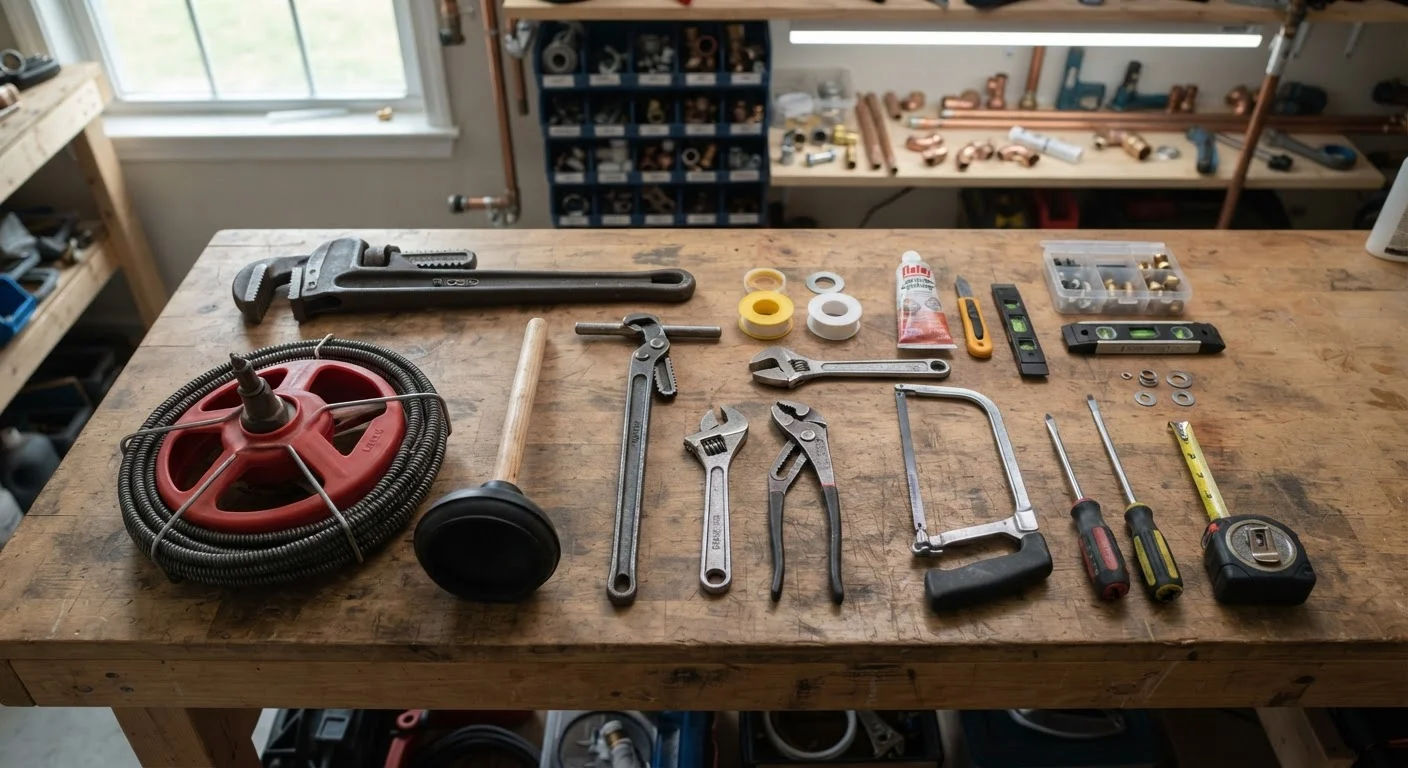
- Plunger (cup and flange types): The cup plunger works on flat surfaces like sinks and tubs; the flange plunger, with its extended rubber sleeve, seals a toilet drain properly. Using the wrong type reduces effectiveness significantly.
- Drain snake (hand auger): A flexible steel cable with a corkscrew tip that breaks up or retrieves clogs deeper than a plunger can reach - typically 15 to 25 feet into a drain line. Operated by hand crank.
- Toilet auger (closet auger): A drain snake variant with a protective sleeve that prevents porcelain scratching inside the toilet bowl. The rigid housing guides the cable at the correct angle for a toilet trap.
Fitting and Connection Tools
- Adjustable wrench: Used on nuts and supply line fittings. The smooth jaw won't damage chrome finishes as readily as a pipe wrench.
- Pipe wrench: A heavier, toothed wrench designed to grip round pipe and fittings. Typically used in pairs - one to hold, one to turn - on galvanized or black iron pipe.
- Basin wrench: A long-handled tool with a pivoting jaw designed specifically to reach the mounting nuts on faucets, which sit behind the sink basin where no other wrench fits comfortably.
- Tongue-and-groove pliers (often called slip-joint or channel-lock pliers): The most versatile grip tool in a plumbing kit. Adjustable jaws handle a wide range of nut and fitting sizes on P-traps, supply lines, and compression fittings.
Sealing and Preparation Tools
- Thread seal tape (PTFE/Teflon tape): Wrapped clockwise around threaded pipe fittings before assembly to prevent leaks. A fundamental supply for any plumbing work involving threaded connections.
- Pipe cutter: A wheeled cutting tool that scores and severs copper, CPVC, or PEX tubing cleanly without the burrs left by a saw. A must for any supply line repair or replacement.
- Deburring reamer: Often built into pipe cutters, this small blade smooths the inside edge of a freshly cut pipe so fittings seat properly and flow isn't restricted.
For a broader overview of the hand tools that support both plumbing and general home repairs, see the hand tools every first-time DIYer actually needs.
When Tools Aren't Enough: Knowing Your Limits
Having the right tool doesn't mean every plumbing problem is a DIY job. Recurring clogs, low water pressure throughout the house, discolored water, or any work touching the main supply line or sewer are situations that typically warrant a licensed plumber. For a clear breakdown of warning signs, see eight signs your plumbing needs professional attention.
Plumbing work that alters supply lines, moves fixtures, or touches drain-waste-vent DWV stacks often requires a permit and inspection in most U.S. jurisdictions. Verify requirements with your local building department before starting any project beyond simple fixture repairs or drain clearing.
Understanding your tools - and their limitations - is exactly what separates a homeowner who resolves a dripping faucet in 30 minutes from one who turns a minor fix into a larger problem. For deeper context on how all these repairs fit within your home's plumbing architecture, the complete supply-line-to-sewer reference provides a thorough foundation.
This article is for informational and educational purposes only. Plumbing repairs involving gas lines, structural changes, or connections to municipal water and sewer systems should be handled by a licensed professional. Always check local building codes and permit requirements before beginning any repair.
The content on this site is for informational purposes only and is not a substitute for professional advice. Always consult a qualified professional for guidance specific to your situation.