

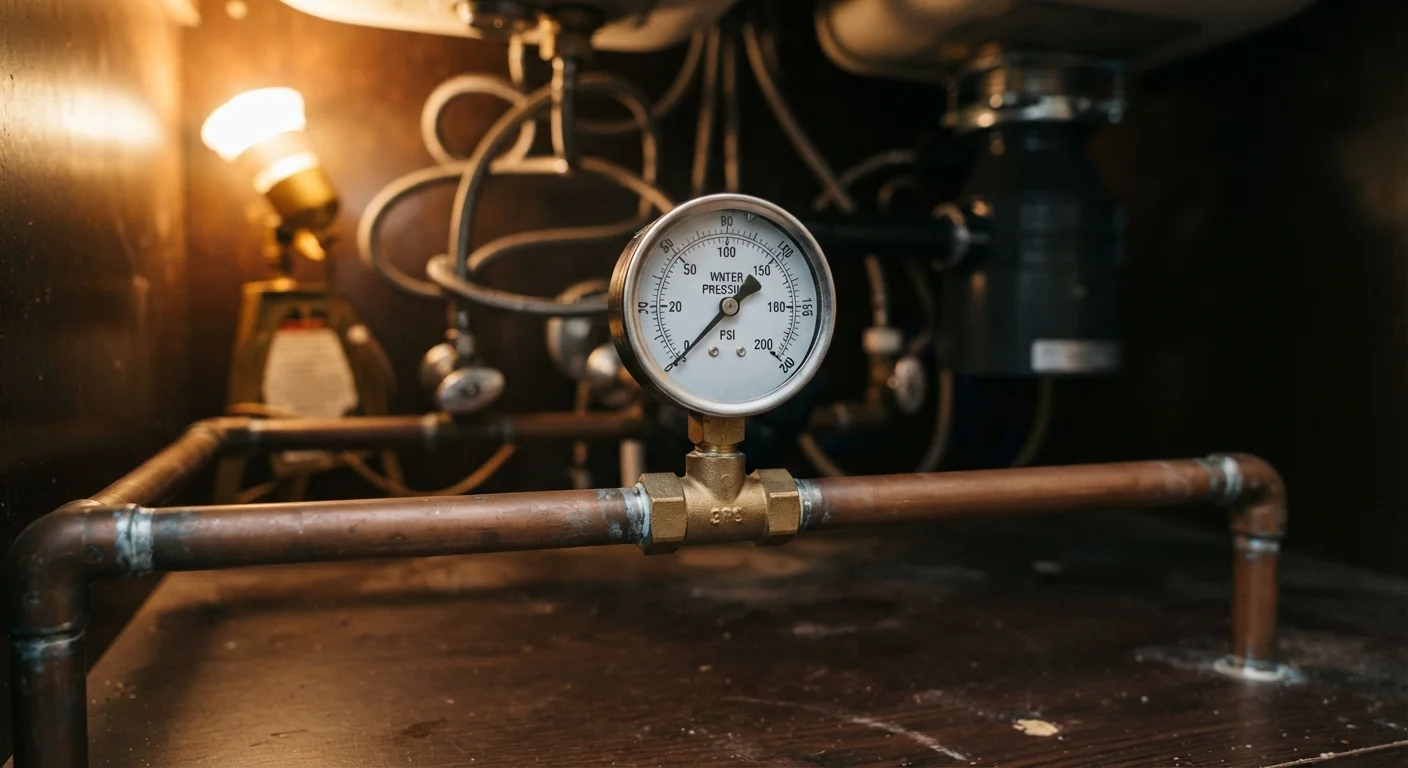
PSI: The Force Behind Your Water
When plumbers mention PSI, they are describing the amount of force the water supply exerts against the walls of your pipes. Think of it like air pressure in a tire - higher pressure means more pushing force, regardless of how much air (or water) actually moves. PSI stands for pounds per square inch, and it tells you how aggressively water is being driven through your system.
A city water main typically delivers water to your home at a pressure somewhere between 50 and 100 PSI. Your home's pressure-reducing valve (PRV) - usually located near where the main supply enters the house - steps that down to a safer working range. Most fixtures, appliances, and supply hoses are engineered for pressures up to 80 PSI. Going beyond that consistently isn't just wasteful; it quietly stresses every joint and seal in your plumbing.
For a deeper look at how your home's supply system connects to the street main, see our introduction to household plumbing systems.
Test Your Home's PSI in Five Minutes
A basic threaded pressure gauge costs just a few dollars at most hardware stores. Thread it onto an outdoor hose bib or laundry room faucet, make sure no other water is running inside the house, and read the dial. That number is your static pressure. If it reads below 40 or above 80 PSI, document it before calling a plumber - it gives them a useful starting point.
Flow Rate: Volume Is Not the Same as Force
Flow rate answers a different question than PSI: not how hard is the water pushed, but how much water arrives at a fixture per minute. It is measured in gallons per minute (GPM). A showerhead rated at 2.0 GPM will use exactly that much water per minute - provided the supply pressure is adequate to push it through.
Here is where homeowners get tripped up: you can have strong pressure at the main line and still experience a trickle at an upstairs bathroom faucet. A clogged aerator (the small screen at a faucet tip), a partially closed shut-off valve, or a corroded pipe reduces the volume of water that actually reaches the fixture - even if the line pressure is fine. Conversely, a faucet delivering a strong-feeling stream isn't necessarily flowing at a high GPM if the aerator is restricting it intentionally.
40-80 PSI
Recommended residential water pressure range
Most U.S. plumbing codes and fixture manufacturers specify this range as the safe operating window for household supply systems.
2.0 GPM
Federal standard for showerhead flow rate
The U.S. Energy Policy Act sets the maximum showerhead flow rate at 2.5 GPM, with WaterSense-certified models capped at 2.0 GPM.
~1 PSI
Pressure lost per 2.3 feet of elevation
A basic principle of hydraulics: water loses approximately 0.433 PSI for every foot it rises vertically, meaning a two-story home can see nearly 5 PSI less pressure on the upper floor.
Understanding this distinction helps you ask the right diagnostic question: Is this a pressure problem or a flow problem? The answer points you toward very different repairs.
Pressure Drop: Why Pressure Changes Throughout the House
Water entering your home at 65 PSI rarely arrives at every fixture at exactly 65 PSI. Pressure drop is the loss of force that happens as water travels through pipe length, changes direction at elbows, passes through valves, and fights gravity on the way up to upper floors. Every foot of pipe, every fitting, and every elevation change subtracts a small amount of pressure.
In older homes with galvanized steel pipes, mineral scale accumulates inside the pipe bore over decades, effectively narrowing the passage and dramatically increasing friction. This is one of the most common causes of progressively worsening pressure in aging houses - and a pressure gauge reading at the hose bib may still look normal even when upstairs fixtures suffer noticeably. Pipe diameter also matters: a ¾-inch supply line serving multiple fixtures maintains pressure far better than a ½-inch line carrying the same load.
Noisy pipes are sometimes a symptom of pressure-related issues as well - our article on diagnosing banging, whistling, and gurgling pipes explains how pressure fluctuations connect to those sounds.
For a comprehensive look at how all of these concepts fit into the full plumbing picture, the complete household plumbing reference covers pipe materials, shut-off locations, and pressure fundamentals in one place.
Putting It Together: Diagnosing Common Pressure and Flow Complaints
Armed with these definitions, you can approach common plumbing complaints more methodically. Weak flow at a single faucet? Start with the aerator - unscrew it, rinse out the screen, and test again before assuming a pipe problem. Weak pressure throughout the entire house? Check your PRV and test the static PSI at an outdoor hose bib. If the reading is well below 40 PSI, the PRV may need adjustment or replacement - a task many homeowners can handle, though a licensed plumber should confirm the diagnosis first.
High pressure causing running toilets or dripping valves? A PRV set too high, or a failed PRV, is a likely culprit. Pressure above 80 PSI is hard on flapper valves and fill valves, which are often the first components to show stress.
Knowing whether your complaint is about force (PSI) or volume (GPM) - and understanding that both can erode along the pipe run - transforms vague frustration into a solvable diagnosis. That is exactly the kind of clarity that makes the difference between an effective repair and a wasted afternoon.
This article is for general educational purposes. Plumbing repairs involving main supply lines, pressure-reducing valves, or code-regulated work should be evaluated by a licensed plumber. Always verify local permit and code requirements before making changes to your home's plumbing system.
Frequently Asked Questions
Most plumbing codes and fixture manufacturers recommend a household water pressure between 40 and 80 PSI. Pressure below 40 PSI often causes weak flow at faucets and showers, while pressure above 80 PSI can strain pipes, valves, and appliances over time.
No - they are related but different problems. Low pressure means the water lacks force, often due to supply issues or a partially closed valve. Low flow rate may result from a clogged aerator, corroded pipe, or undersized supply line, even when pressure readings appear normal.
Attach a simple threaded pressure gauge to any hose bib or laundry faucet when no other water is running. Read the PSI on the dial. This gives you the static pressure - the baseline force when no fixtures are drawing water.
Pressure drops as water travels through longer pipe runs, smaller-diameter pipes, and each fitting or valve it passes through. Mineral buildup inside older galvanized pipes is a common cause of significant pressure loss in older homes.
Yes. Sustained pressure above 80 PSI accelerates wear on washers, valve seats, and supply hose connections, and can contribute to pinhole leaks and water hammer. A pressure-reducing valve (PRV) installed on the main supply line is a standard fix.
The content on this site is for informational purposes only and is not a substitute for professional advice. Always consult a qualified professional for guidance specific to your situation.