

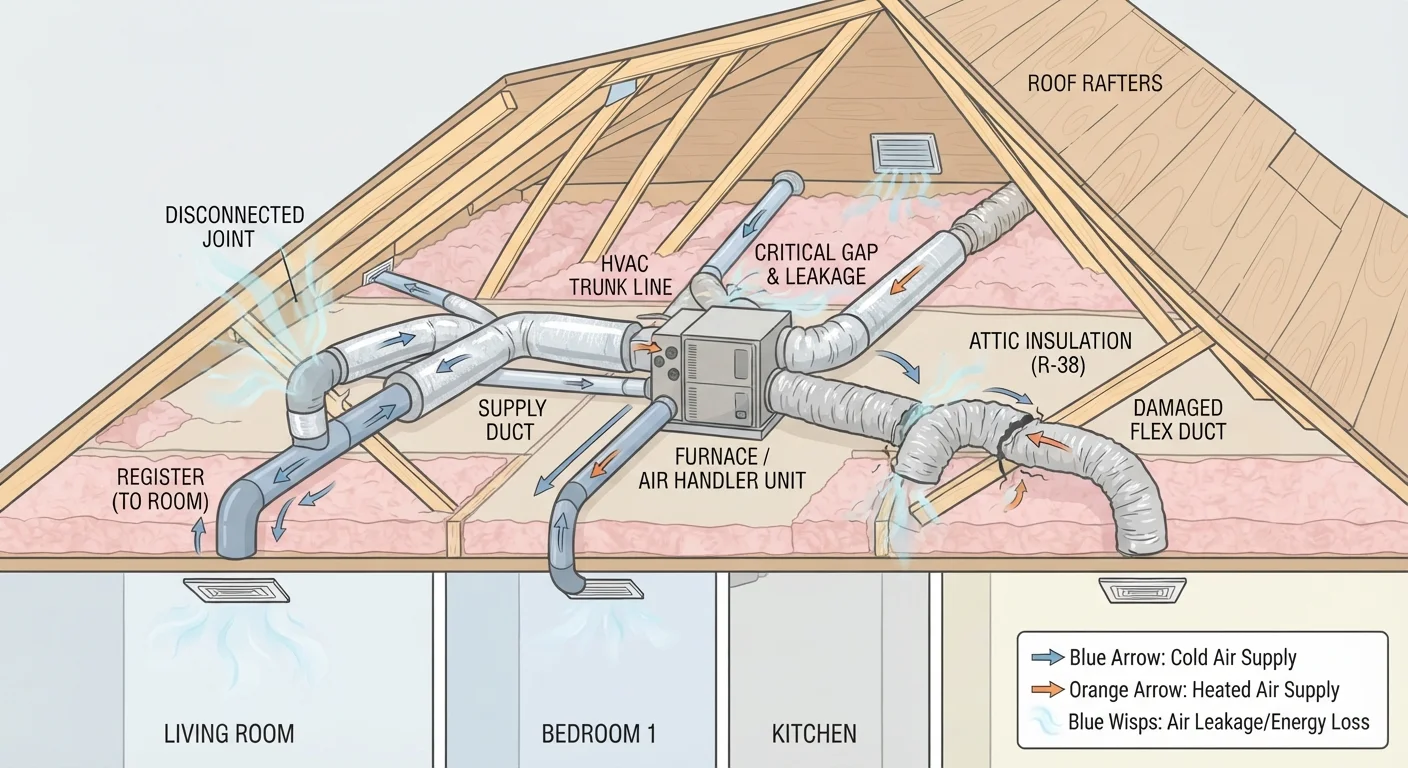
Why Duct Leakage Is So Easy to Overlook
Most of a home's ductwork runs through spaces no one visits: attics baking at summer temperatures, crawlspaces below the floor, and cavities inside walls. Because the leaks are invisible and the air escaping is invisible, duct leakage rarely announces itself the way a dripping faucet does. Instead, it shows up indirectly - a bedroom that never quite reaches the thermostat temperature, an energy bill that seems high for the season, or a system that runs longer than it should.
Forced-air heating and cooling systems depend on the entire air delivery network functioning as a sealed loop. When that loop has gaps, pressure drops, airflow to individual rooms suffers, and the system compensates by running longer cycles. Over time, this compounds energy use and accelerates equipment wear - neither of which is immediately obvious to the homeowner.
If your home also has comfort issues linked to insulation failure warning signs, duct leakage and insufficient insulation may be working against you simultaneously - making both worth investigating at once.
What Causes Ducts to Leak
Ducts develop leaks through several predictable mechanisms:
- Poor installation: Joints between duct sections may have been loosely connected from the start, relying on standard cloth duct tape that degrades rapidly under heat cycling.
- Age and material fatigue: Flexible ducts (the corrugated type common in many homes) can tear, kink, or separate at connection points as they age. Sheet-metal ducts can develop gaps at seams if sealant was never applied or has dried out.
- Physical damage: Pest activity, foot traffic in attics, or settling of the structure can dislodge or puncture duct runs.
- Thermal expansion and contraction: Repeated heating and cooling cycles cause duct materials to expand and contract, gradually loosening connections that weren't robustly sealed.
It's worth noting that many homes were built in eras when duct sealing standards were less stringent. The U.S. Department of Energy notes that duct leakage is one of the most common efficiency problems in existing homes with forced-air systems.
20-30%
Conditioned air potentially lost to duct leakage
The U.S. Department of Energy estimates that leaky ducts can cause forced-air systems to lose a significant share of conditioned air before it reaches living spaces.
~⅔
U.S. homes using forced-air heating or cooling
Forced-air systems are the dominant HVAC type in American homes, making duct performance a widespread efficiency concern.
CFM25
Standard unit for measuring duct leakage
Professionals measure duct leakage in cubic feet per minute at 25 Pascals of pressure, providing a standardized baseline for comparing before and after sealing results.
Finding and Assessing Duct Leaks
Before sealing anything, it helps to understand where and how severely your ducts are leaking. There are two broad approaches:
Visual Inspection
For accessible ductwork in an attic, basement, or crawlspace, a visual inspection is a reasonable first step. Look for:
- Disconnected flex duct sections hanging loose from a fitting
- Gaps at joints where two duct sections meet
- Cracked, peeling, or absent tape at connections
- Holes or tears in flexible duct material
Running the system while you inspect can help - hold your hand near suspected gaps to feel for airflow escaping under pressure.
Professional Duct Blaster Testing
A duct blaster test - performed by a certified home energy auditor or HVAC technician - pressurizes the duct system and precisely measures total leakage. This gives you a baseline and lets you verify improvement after sealing. Consider pairing this with a broader seasonal energy audit to identify all efficiency gaps at once.
How to Seal Accessible Ducts
For ducts you can physically reach, sealing is a manageable DIY task. The key is using the right materials:
- Mastic sealant: A paste-like compound applied with a brush or gloved hand directly over joints and gaps. It remains flexible after curing and is considered the most durable option for duct sealing. For gaps larger than about ¼ inch, embed fiberglass mesh tape in the mastic before it dries.
- Foil-backed metal tape: Pressure-sensitive tape designed for HVAC use. It adheres well to clean, dry metal surfaces and withstands temperature extremes - unlike standard cloth duct tape, which should not be used.
Before applying either product, clean the surface area around the joint with a dry cloth to remove dust and debris - adhesion depends on a clean surface. Work systematically from the air handler outward, addressing every visible joint and seam.
Use Mastic on Irregular Gaps
Foil tape works well on clean, flat metal surfaces, but mastic sealant is more forgiving on irregular or textured joints - especially where flexible duct meets a fitting. Apply it generously, work it into the gap, and smooth the edges. A single tube or small tub goes a long way on a typical duct system.
After sealing, consider whether your attic ducts would also benefit from insulation wrapping - and whether the attic itself needs attention. Our guide on insulating a draughty attic without calling a contractor explains how these improvements work together.
When to Bring in a Professional
Not all duct leakage is DIY-accessible. Ducts buried in finished walls or ceilings, systems with extensive damage throughout, or situations where the full scope of leakage is unclear all call for professional involvement. Licensed HVAC technicians can also perform aerosol-based duct sealing - a process where a sealant mist is injected into the pressurized system and deposits itself onto leak sites from the inside, reaching places no hand tool can.
If you're considering a broader efficiency push, duct sealing pairs naturally with sealing air leaks in your building envelope - both address the same underlying problem of conditioned air going where you don't want it. A home energy auditor can help you prioritize which improvements will have the greatest impact for your specific home.
This article is for informational and educational purposes only. HVAC systems vary widely by home, age, and design. Always verify local building codes and permit requirements before undertaking system modifications, and consult a licensed HVAC professional for system-specific advice.
Frequently Asked Questions
Common signs include rooms that are consistently harder to heat or cool than others, higher-than-expected energy bills, and excessive dust accumulation near vents. If your system seems to run constantly without reaching the thermostat setpoint, leaky ducts may be a contributing factor. A professional duct leakage test provides a definitive measurement.
Accessible duct joints - those you can reach in basements, crawlspaces, or partially open attics - can often be sealed by a capable DIYer using mastic sealant or foil-backed metal tape. Ducts buried in walls or encapsulated in finished ceilings typically require professional access and equipment.
Use foil-backed metal tape (sometimes called HVAC tape) or mastic sealant - not standard cloth duct tape, which degrades quickly in temperature extremes and loses adhesion over time. Mastic is particularly durable for irregular gaps and can be reinforced with fiberglass mesh on larger openings.
The U.S. Department of Energy estimates that duct leakage can account for 20-30% of a forced-air system's conditioned air being lost. Actual savings vary significantly by home size, existing leakage rate, climate, and energy prices, so treat published figures as a range rather than a guarantee.
It can. Ducts running through attics or crawlspaces may draw in unconditioned air containing dust, insulation particles, or moisture when operating under negative pressure. This pulled-in air then circulates through the living space, potentially affecting air quality and comfort.
If your ducts are inaccessible, if you suspect extensive damage or disconnection throughout the system, or if you want a verified measurement of leakage before and after repairs, a licensed HVAC technician is the right call. Professionals can also perform aerosol-based duct sealing for systems where physical access is limited.
The content on this site is for informational purposes only and is not a substitute for professional advice. Always consult a qualified professional for guidance specific to your situation.