

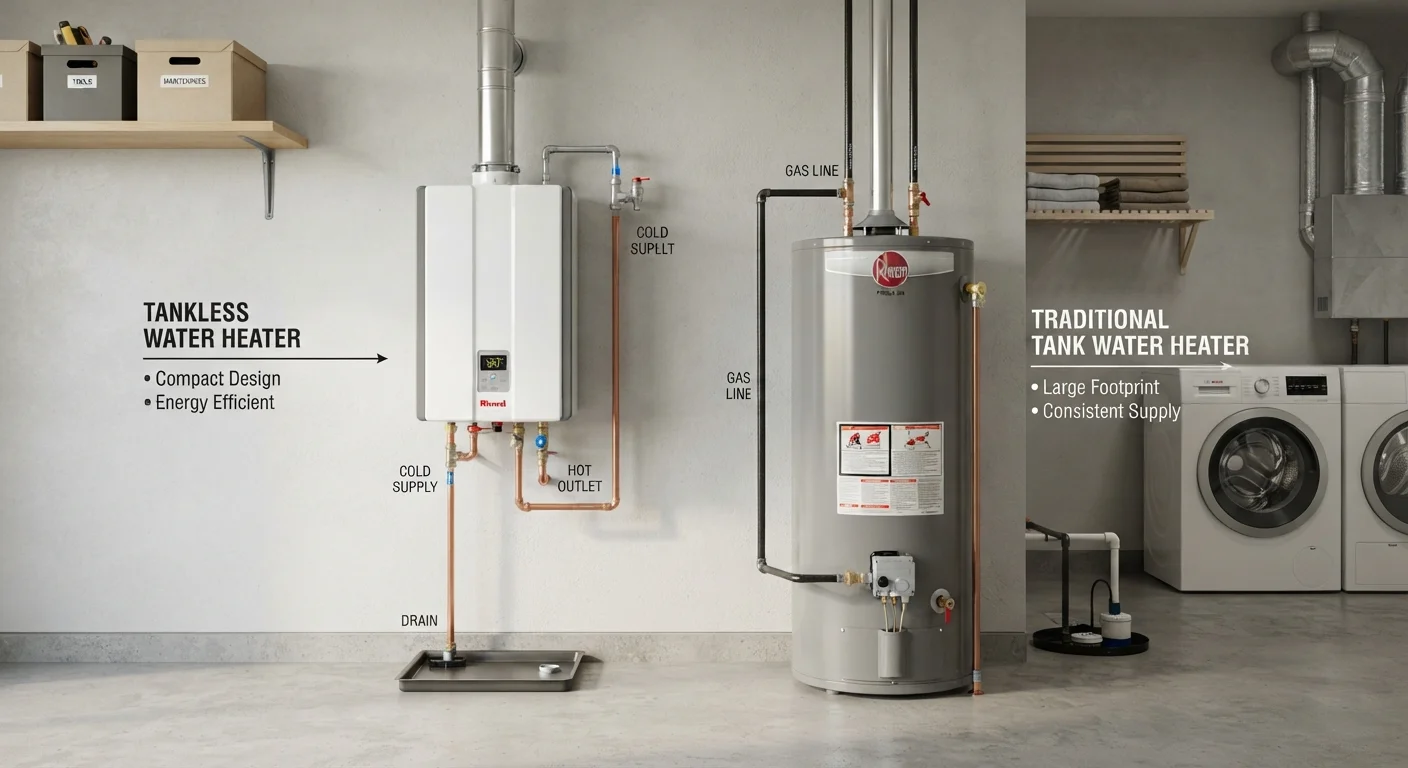
Option A
Tankless Water Heater
The on-demand, energy-efficient upgrade.
Best for: Households wanting long-term energy savings and are comfortable with a higher upfront investment.
Option B
Storage Tank Water Heater
The reliable, lower-cost conventional choice.
Best for: Households prioritizing lower installation costs and straightforward, widely understood maintenance.
How Each System Works
Understanding the core difference between these two systems makes every other trade-off easier to evaluate.
A storage tank water heater keeps a large reservoir of water - commonly 40 to 80 gallons - continuously heated to a set temperature. Whenever hot water is drawn from a faucet or appliance, cold water enters the tank from the bottom to replace it, and the heating element or burner cycles on to maintain temperature. This constant reheating, even when no hot water is being used, is called standby heat loss - and it's the central efficiency disadvantage of the storage tank design.
A tankless water heater (also called an on-demand or instantaneous heater) has no storage reservoir. When a hot water tap opens, cold water flows through a heat exchanger - powered by gas or electricity - and is heated immediately before it reaches the fixture. Once the tap closes, the unit shuts off entirely. This eliminates standby heat loss, but it also means the unit must deliver enough heating capacity to meet the full flow rate demanded at any given moment.
Water heating is one of the largest energy costs in a typical US home. For a broader look at how it compares to other major systems, see Your Home's Three Biggest Energy Systems Explained.
Cost, Efficiency, and Lifespan Compared
| Criterion | Tankless Water Heater | Storage Tank Water Heater |
|---|---|---|
| Typical installed cost | $1,000-$3,000+ | $500-$1,500 |
| Energy efficiency | Higher - no standby heat loss | Lower - constant standby loss |
| Average lifespan | 20+ years | 10-15 years |
| Hot water supply | Continuous, flow-rate limited | Limited by tank capacity |
| Space required | Minimal - wall-mounted | Significant floor space |
| Installation complexity | Often higher - may need upgrades | Generally straightforward |
| Maintenance | Annual descaling recommended | Annual flush + anode rod check |
The upfront cost gap between systems is significant. A storage tank unit - including installation - typically runs between $500 and $1,500, depending on size and fuel type. A tankless unit, by contrast, often costs $1,000 to $3,000 or more installed, partly because retrofitting one into an existing home may require upgrading gas lines or electrical panels - work that must be performed by a licensed professional and may require permits.
On the efficiency side, the U.S. Department of Energy has noted that tankless heaters can be 24-34% more energy efficient than storage models for homes using 41 gallons or less of hot water daily. That gap narrows for heavier users. Over a lifespan of 20-plus years for tankless versus 10-15 years for storage tanks, the math can favor tankless - but only if installation costs don't consume all projected savings.
Changing how your household uses hot water can also reduce costs regardless of which system you have. Hot Water Habits Worth Changing at Home offers practical behavioral adjustments worth considering alongside any hardware upgrade.
Flow Rate and Household Demand
One practical limitation of tankless heaters is flow rate capacity - measured in gallons per minute (GPM). A standard gas tankless unit may deliver 5-8 GPM, which is typically enough for one shower and a dishwasher running simultaneously. But if your household regularly runs multiple showers, a washing machine, and kitchen appliances at the same time, a single unit may fall short.
Cold incoming water temperatures - more common in northern US climates - also reduce effective flow rate, since the unit needs more energy to raise the water to the target temperature. Some households address this by installing multiple tankless units or a point-of-use unit near high-demand fixtures, though this adds to cost and complexity.
Storage tank heaters sidestep this problem: as long as the tank hasn't been depleted, they deliver hot water to multiple outlets simultaneously without any flow rate constraint. The trade-off is that once the tank is exhausted, recovery time - how long it takes to reheat a full tank - can be 20 minutes to over an hour depending on the unit.
24-34%
Potential energy savings with tankless
According to the U.S. Department of Energy, tankless heaters can be 24-34% more efficient for homes using 41 gallons or less of hot water daily.
10-15 yrs
Typical storage tank lifespan
With regular maintenance including anode rod replacement, most storage tank water heaters last between 10 and 15 years.
~18%
Share of home energy used for water heating
The U.S. Department of Energy estimates water heating accounts for roughly 18% of a typical home's total energy use.
Maintenance, Safety, and What to Ask a Professional
Both systems require routine maintenance, though the specifics differ. Storage tank heaters benefit from annual flushing to remove sediment buildup and periodic inspection of the anode rod - a sacrificial metal rod that slows tank corrosion. Tankless units need descaling (removing mineral buildup from the heat exchanger), particularly in areas with hard water.
Safety note: Any work involving gas connections, venting, or your home's electrical service panel carries serious risk and is regulated in most US jurisdictions. Always hire a licensed plumber or HVAC technician for installation, and verify that permits and inspections are completed as required by your local building code. Do not attempt to self-install either system type if it involves modifying gas lines or panel capacity.
When consulting a professional, useful questions include: What size unit does my household's usage pattern require? Will my current gas line or electrical service support a tankless upgrade? Are there rebates or incentive programs available in my area for high-efficiency water heaters?
If you're thinking systematically about home energy improvements, the Home Energy Efficiency Complete Walkthrough covers how water heating fits alongside HVAC and lighting decisions. For a similar efficiency comparison in another area of the home, see LED vs. Incandescent: What the Energy Numbers Actually Mean.
This article is for general informational and educational purposes only. Installation requirements, costs, energy savings, and code compliance vary by location. Always consult a licensed professional and verify local permit requirements before replacing or modifying any water heating system.
The content on this site is for informational purposes only and is not a substitute for professional advice. Always consult a qualified professional for guidance specific to your situation.