

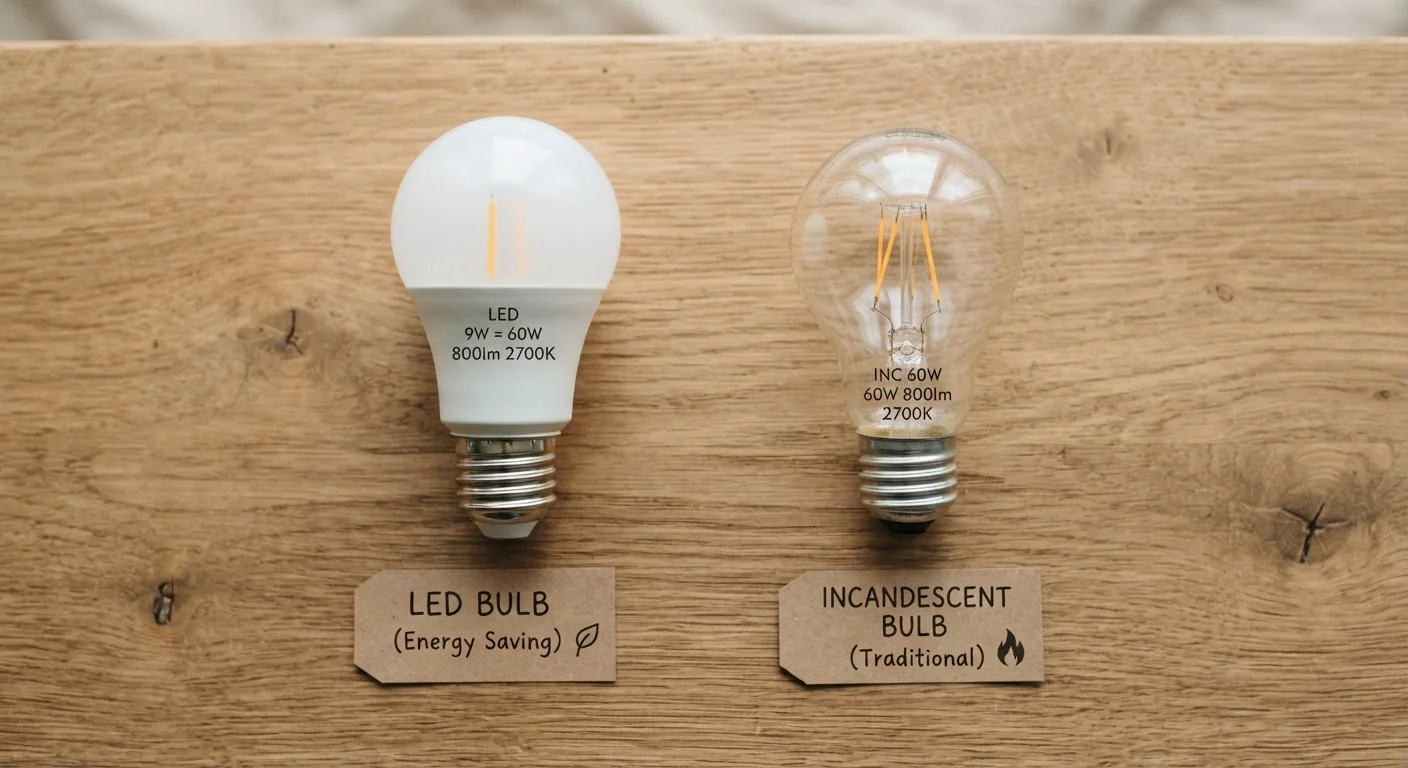
Option A
LED Bulbs
The high-efficiency, long-life modern standard.
Best for: Homeowners who want lower electricity bills, minimal bulb replacements, and consistent light quality across any room.
Option B
Incandescent Bulbs
The familiar, low-upfront-cost traditional option.
Best for: Situations requiring immediate, inexpensive replacement in rarely used fixtures where long-term savings are less of a priority.
Wattage vs. Lumens: Understanding What You're Actually Buying
One of the most persistent sources of confusion when switching bulb types is conflating wattage with brightness. Wattage measures how much electrical power a bulb consumes - it says nothing about how much light it produces. Lumens measure light output. A 60-watt incandescent and a 9-watt LED can both produce roughly 800 lumens of light; the LED simply does it using about 85% less electricity.
This distinction matters when you're shopping. Instead of looking for a "60-watt replacement," look for the lumen count on the package. For general living spaces, 800 lumens is a common reference point. For task lighting like a kitchen counter, you may want 1,000 lumens or more. For a bedside table, 450-500 lumens is often sufficient.
Understanding this also helps you decode your electricity bill, where your total consumption is measured in kilowatt-hours (kWh) - a unit that reflects wattage over time, not brightness.
| Criterion | LED Bulbs | Incandescent Bulbs |
|---|---|---|
| Power draw (800 lumen equivalent) | ~8-10 watts | ~60 watts |
| Annual energy cost (4 hrs/day, $0.16/kWh) | ~$2-3 | ~$14 |
| Rated lifespan | 15,000-25,000 hours | ~1,000 hours |
| Heat output | Low | Very high (~90% of energy) |
| Upfront purchase cost | Higher per bulb | Lower per bulb |
| Long-term total cost | Significantly lower | Significantly higher |
| Light quality options | Wide range (warm to daylight) | Warm white only |
The Real Cost of Running Each Bulb Type
Let's ground the numbers in a realistic household scenario. Assume you have a lamp used four hours per day, 365 days a year - that's 1,460 hours of annual use. At a U.S. average electricity rate of around $0.16 per kWh (rates vary significantly by region and over time - check your own bill for accuracy):
- A 60-watt incandescent consumes 87.6 kWh per year → roughly $14 annually per bulb.
- A 9-watt LED consumes 13.1 kWh per year → roughly $2.10 annually per bulb.
That's approximately $12 in savings per bulb, per year. Multiply that across 20 light fixtures in a typical home, and the annual saving potential is substantial - without changing any behavior, just the bulb type. For a deeper look at how lighting fits into your home's overall energy picture, see how your home's three biggest energy systems compare.
75-80%
Less electricity used by LEDs vs. incandescents
According to the U.S. Department of Energy, LED bulbs use significantly less energy to produce equivalent light output.
25x
Longer lifespan of LEDs vs. incandescents
The U.S. Department of Energy notes that LED bulbs can last up to 25 times longer than traditional incandescent bulbs.
~15%
Share of U.S. home energy used by lighting
The U.S. Energy Information Administration estimates that lighting accounts for roughly 15% of residential electricity consumption.
Lifespan: Why Replacement Frequency Changes the Equation
An incandescent bulb typically lasts around 1,000 hours. At our four-hours-per-day example, that's less than nine months before it needs replacing. A quality LED, by contrast, is typically rated for 15,000 to 25,000 hours - meaning the same bulb could last over 17 years under the same usage pattern.
This lifespan gap means the upfront price difference between an LED and an incandescent is almost never an apples-to-apples comparison. Over the life of a single LED, you might buy 15 to 25 incandescent replacements. When bulb purchase costs and energy costs are combined, LEDs consistently come out ahead - usually within the first one to two years of use.
Once you've made the switch, the next question is choosing the right LED for each space. Our guide to LED lighting by room - colour temperature, lumens, and placement walks through exactly that.
Where to Prioritize Your Switch
Not every bulb in your home offers the same return. Focus your first replacements where lights run the longest each day:
Check Fixture Compatibility First
Most standard LED bulbs fit the same E26 medium base used by common incandescents in the U.S. However, dimmer switches, enclosed fixtures, and recessed cans can affect LED performance and lifespan. Check the bulb packaging for 'enclosed fixture rated' or 'dimmable' labels if either applies to your situation. Using a non-dimmable LED on a dimmer circuit can cause flickering or shorten the bulb's life.
- Kitchen and living areas - these are typically lit for 4-8 hours daily and offer the highest per-bulb savings.
- Outdoor security and porch lights - often left on all night, making them disproportionately expensive with incandescents.
- Bathroom vanity fixtures - multiple bulbs in a single fixture multiplies the impact of switching.
Low-priority candidates include infrequently used spaces like garages, attics, or storage rooms where lights may run fewer than 30 minutes a day - the payback period is longer and the urgency lower.
Lighting is just one part of a broader efficiency picture. If you're evaluating where to invest next, a complete walkthrough of your home's major energy systems can help you prioritize systematically.
The content on this site is for informational purposes only and is not a substitute for professional advice. Always consult a qualified professional for guidance specific to your situation.