

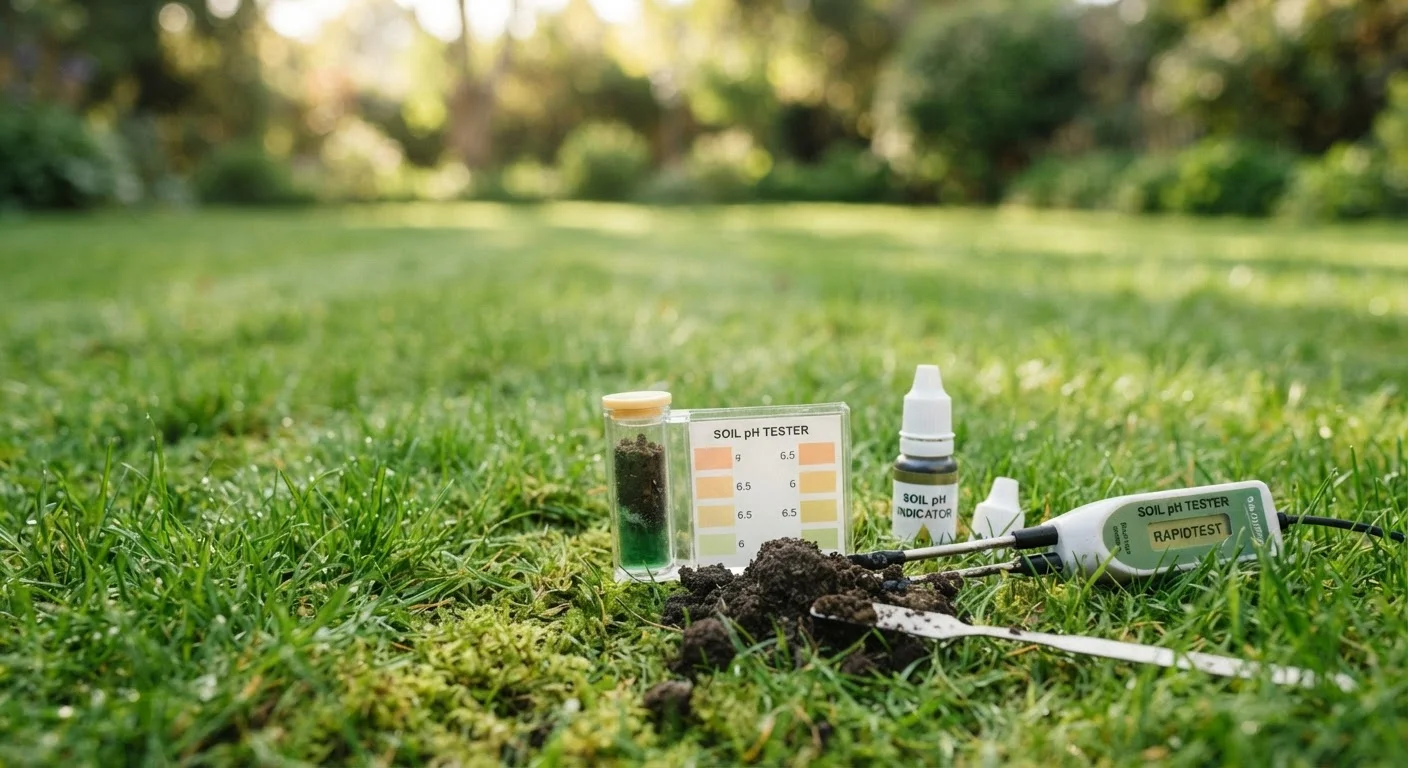
Why Soil pH Matters More Than Most Gardeners Realize
Homeowners spend money on fertilizer, overseed bare patches, and water faithfully - yet the lawn still underperforms. In many cases, the culprit isn't what's being applied but whether the soil can actually use it. That's where soil pH comes in.
Think of pH as a gatekeeper. Grass roots depend on nutrients dissolving into the soil water around them before uptake is possible. When pH drifts too far from the optimal range, key nutrients - particularly phosphorus, iron, and manganese - become chemically bound in the soil and unavailable to roots, regardless of how much fertilizer you've added. You can be feeding a lawn that's essentially starving.
This is why pH correction is often the single most cost-effective step a homeowner can take. Bringing pH back into the 6.0-7.0 range can unlock nutrients already present in the soil, reducing how much supplemental feeding your lawn actually needs. If you're also working through fertilizer basics, understanding pH is the logical first step.
How to Test Your Lawn's Soil pH
Before treating anything, you need an accurate baseline. Guessing your pH - or assuming it's fine because the lawn looks reasonable - is a common and costly mistake.
Your Testing Options
- Cooperative extension soil tests: Most U.S. state cooperative extension services offer affordable lab-based soil testing. Results typically include your pH reading plus a specific lime or sulfur recommendation calibrated to your soil type. This is the most reliable approach for homeowners serious about results.
- Home test kits: pH test strips or liquid reagent kits from garden centers give a quick ballpark reading. They're useful for a rough check but less precise than a lab test.
- Digital pH meters: Probe-style meters inserted directly into moist soil give fast results. Quality varies widely between models, so treat readings as approximate.
How to Take a Good Soil Sample
Pull soil from several spots around your lawn - at least 5-10 locations - to a depth of about 3-4 inches. Mix the cores together in a clean bucket, then send or test a combined sample. This averaging approach accounts for the natural variation across your yard and gives a more representative result than a single-spot reading.
Test Zone by Zone for Accuracy
If your lawn has distinct zones - heavy shade under a tree, a sunny slope, a low wet area - test each zone separately. Different microclimates can produce meaningfully different pH readings, and a single composite sample may mask a problem in one part of the yard.
If your lawn has distinct zones - heavy shade under a tree, a sunny slope, a low wet area - test each zone separately. Different microclimates can produce meaningfully different pH readings.
Raising pH: When and How to Apply Lime
If your soil test shows pH below 6.0, your lawn is too acidic. This is the more common problem in the eastern and southeastern United States, where rainfall naturally leaches calcium and magnesium from the soil over time.
Ground agricultural limestone (calcitic or dolomitic) is the standard corrective. Dolomitic lime also supplies magnesium, which is useful if your soil test indicates a deficiency. Lime should be applied evenly using a broadcast or rotary spreader and then watered in.
Timing: Fall is generally ideal, as lime works slowly and benefits from winter moisture to activate. Spring application is also effective. Avoid applying immediately before or after seeding a lawn - lime takes time to integrate and won't benefit freshly sown seed right away.
Rate: Never estimate the amount by eye. Follow your soil test recommendation. A typical lawn may need 25-50 lbs of lime per 1,000 sq ft to raise pH by approximately one unit, but this varies significantly with soil texture - clay soils have higher buffering capacity than sandy ones and require more lime for the same pH shift.
Retest soil 3-6 months after application. It's easy to over-lime, which pushes pH too high and creates a new set of nutrient availability problems.
Lowering pH: When Sulfur May Be Needed
Alkaline lawns - those with a pH above 7.5 - are more common in arid western states and areas with limestone-rich parent soil or hard irrigation water. When pH climbs too high, iron and manganese become unavailable, often producing yellowing between leaf veins (chlorosis). If your lawn shows this symptom, a pH test is a helpful first diagnostic step before assuming it's a nutrient deficiency or watering problem.
Elemental sulfur is the primary amendment used to lower soil pH. Soil bacteria convert sulfur into sulfuric acid over several months, gradually acidifying the soil. Like lime, the correct rate depends on your starting pH, your target pH, and your soil type - a soil test report will specify an appropriate rate.
Important note: Lowering pH in soils with high free calcium carbonate (common in arid western soils) is genuinely difficult and may require ongoing treatment. If you're in this situation, consulting your local cooperative extension office is worthwhile before investing in repeated amendments.
6.0-7.0
Optimal soil pH range for most lawn grasses
According to U.S. cooperative extension guidelines, this range maximizes nutrient availability for common cool- and warm-season turf grasses.
3-6 months
Time for lime to shift soil pH noticeably
Extension soil science resources consistently note that ground limestone reacts gradually; results are typically measured at the next seasonal retest.
5-10 spots
Soil cores recommended per composite sample
Sampling guidelines from state cooperative extension services recommend this range to capture natural pH variation across a typical residential lawn.
Fitting pH Management Into Your Overall Lawn Care Routine
Soil pH doesn't exist in isolation - it interacts with drainage, aeration, and organic matter levels. Compacted soil, for example, often has poor air circulation that affects microbial activity and indirectly influences pH balance over time. If you haven't looked at lawn aeration recently, it's worth considering alongside any pH work.
Similarly, understanding your soil type helps you predict how quickly amendments will work and how often you may need to retest. Sandy soils shift pH faster but also revert faster; clay soils are more stable but require larger amendment quantities.
For new homeowners, pH testing should be one of the first steps - before spending on fertilizers or overseeding. Our ground-level lawn care guide walks through how pH fits into a broader first-year care plan.
Test, amend, wait, retest. That patient, methodical approach consistently outperforms guesswork - and often costs less in the long run.
Frequently Asked Questions
Most common lawn grasses perform best between pH 6.0 and 7.0 - slightly acidic to neutral. Within this range, essential nutrients like nitrogen, phosphorus, and potassium remain most available to grass roots. Warm-season grasses such as Bermuda and Zoysia can tolerate the upper end of this range comfortably.
You can use an inexpensive pH test kit from a garden center, a digital soil meter, or send a sample to your local cooperative extension service. Extension-based tests are more comprehensive and often include amendment recommendations. Collect samples from several spots in your lawn and mix them together for a representative reading.
The correct lime rate depends on your current pH, your target pH, and your soil type - clay soils need more lime than sandy soils to shift by the same amount. Always follow the rate on your soil test report rather than guessing; over-liming can cause its own nutrient problems. Broadcast lime in fall for best results.
Lime typically takes 3-6 months to noticeably shift pH, since it reacts gradually with soil chemistry. Finely ground lime acts faster than pelletized forms. Sulfur also works over several months. Patience is essential - test again before applying a second treatment to avoid overshooting.
Yes. When pH is too low or too high, grass can't absorb iron and other micronutrients, producing yellowing between leaf veins - a condition called chlorosis. If your lawn is yellowing despite regular feeding, a pH problem may be the underlying cause. See our guide on <a href="/garden-outdoors/lawn-care/why-grass-goes-yellow-and-what-its-actually-telling-you">why grass goes yellow</a> for a full diagnosis framework.
Moss can thrive in acidic conditions, but it's rarely caused by pH alone. Poor drainage, shade, soil compaction, and low fertility all contribute. Correcting pH helps, but you'll likely need to address those other factors too. Our <a href="/garden-outdoors/lawn-care/reading-your-lawn-a-troubleshooting-guide-for-common-problems">lawn troubleshooting guide</a> covers moss and other common lawn problems.
The content on this site is for informational purposes only and is not a substitute for professional advice. Always consult a qualified professional for guidance specific to your situation.