

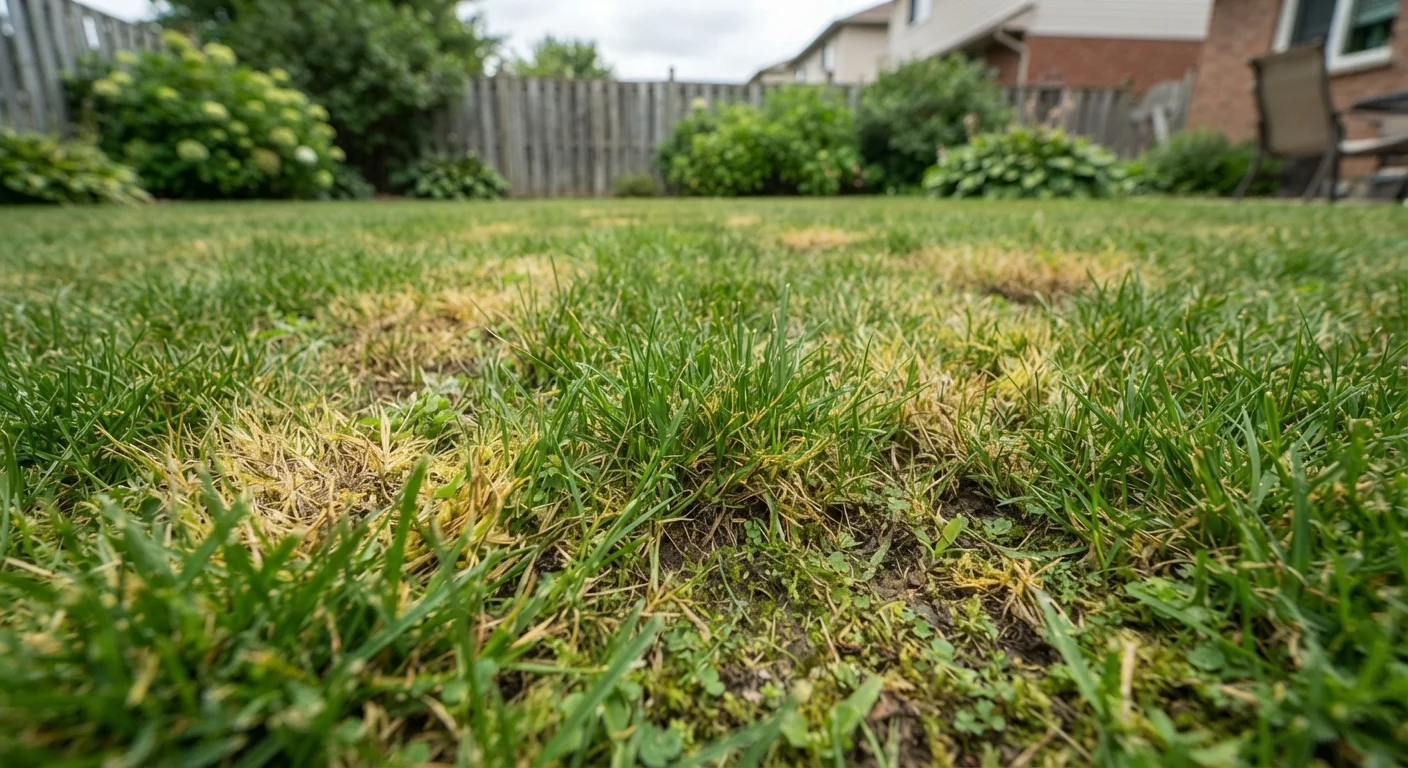
Reading the Pattern: Your First Diagnostic Step
Before reaching for a bag of fertilizer or a garden hose, stop and observe. The pattern of yellowing is one of the most reliable clues to its cause. Uniform yellowing across the entire lawn suggests a widespread issue - typically a nutrient deficiency or soil pH problem. Scattered, irregular patches often point to localized causes: pests, animal urine, or a fungal disease.
Circular or ring-shaped yellow areas frequently signal a fungal condition such as dollar spot or brown patch. Yellowing that tracks your mowing or fertilizer application lines suggests mechanical or chemical causes. Patches near trees or structures may indicate shade stress or root competition - worth exploring alongside our guide to shade-tolerant grass varieties.
Walk the affected area, check whether blades are simply discolored or actually dying, and take note of the shape and distribution before diagnosing further. For a broader overview of what lawn symptoms can reveal, see Reading Your Lawn: A Troubleshooting Guide.
The Most Common Causes of Yellow Grass
Nitrogen deficiency is the leading culprit behind general lawn yellowing. Nitrogen is central to chlorophyll production, and grass depletes it quickly through growth and rainfall leaching. The telltale sign: older, lower blades yellow first while new growth at the tip stays greener. A balanced lawn fertilizer applied at appropriate seasonal rates typically resolves this - but confirm nitrogen is actually the problem before applying.
Soil pH imbalance is frequently overlooked. Grass may sit in nitrogen-rich soil and still yellow because a pH below 6.0 or above 7.5 locks nutrients into forms roots can't absorb. An inexpensive soil test - available through most cooperative extension services - reveals your pH and guides any lime or sulfur amendments needed.
Test Before You Treat
A basic soil test - typically available through your local cooperative extension service for a small fee - tells you your pH, nitrogen levels, and key nutrient availability. Applying lime, sulfur, or extra fertilizer without knowing your starting point can easily make yellowing worse rather than better. Make soil testing your first step whenever yellowing is widespread or persistent.
Iron deficiency produces a specific pattern called interveinal chlorosis, where the area between leaf veins turns yellow while the veins themselves remain green. It's common in high-pH soils, particularly in the West and Midwest. Soil acidification or chelated iron applications can help, but always test first.
Drought stress causes grass to yellow and eventually go dormant - a survival mechanism, not death. Blades will feel dry and the lawn will lose its springy footprint recovery. Most cool-season grasses can survive 4-6 weeks of drought dormancy and green up again with rain or irrigation.
Pest damage, particularly from grubs feeding on roots, creates yellow or brown patches that feel spongy and detach easily from the soil surface. Peel back a small section of affected turf and check for white C-shaped larvae. Our lawn troubleshooting guide walks through how to assess pest pressure before deciding whether treatment is warranted.
When Yellowing Is Normal - and When to Act
Not every instance of yellow grass signals a problem requiring intervention. Cool-season grasses like Kentucky bluegrass and tall fescue naturally go dormant - and yellow - during prolonged summer heat. Warm-season grasses such as Bermuda and zoysia do the same in winter. This dormancy is a biological adaptation, and green-up typically occurs on its own when temperatures and moisture return to suitable levels.
Post-mowing yellowing of blade tips (called tip burn) is also common and usually indicates the mower blade is dull rather than any soil or pest issue. A clean cut allows grass to heal quickly; a torn cut leaves ragged edges that dry out and discolor. It's one of those widely misunderstood lawn situations - worth checking against common lawn myths that mislead homeowners.
Act when yellowing is spreading, doesn't follow a seasonal pattern, or is accompanied by thinning, bare patches, or a foul odor from the soil (which can indicate anaerobic conditions from overwatering). If you're unsure, a soil test is always a productive first move - it removes the guesswork and prevents the common mistake of treating the wrong problem.
6.0-7.0
Ideal soil pH range for most lawn grasses
According to university extension guidelines across multiple US states, nutrient availability drops significantly when lawn soil pH moves outside this range.
~50%
Of lawn problems linked to soil compaction or pH
Turf management research consistently shows that soil physical and chemical conditions - not pest or disease pressure - underlie the majority of common lawn health complaints.
4-6 weeks
Typical dormancy window for cool-season grasses in drought
Most cool-season turfgrasses can survive short-term drought dormancy and recover fully when adequate moisture returns, according to cooperative extension turfgrass resources.
For related symptoms beyond grass - including yellowing leaves on garden plants - the guide to signs your plants are telling you something is wrong applies the same diagnostic thinking across the broader garden.
Frequently Asked Questions
Over-fertilizing, especially with high-nitrogen products, can burn grass roots and cause blades to yellow or brown - a condition called fertilizer burn. It typically appears as streaky or uniform yellowing that follows your application pattern. Water the area thoroughly to help flush excess salts through the soil.
In many cases, yes. If the cause is corrected - whether that's watering, fertilizing, pH adjustment, or pest treatment - grass can recover and regain its green color within a few weeks. Severely damaged or dead grass may need reseeding, but most drought or nutrient stress is reversible.
Drought stress tends to affect the lawn uniformly or in the most sun-exposed areas, and grass blades will fold or feel crisp underfoot. Disease usually creates distinct shapes - circles, irregular patches, or rings - and may show discoloration at blade tips or bases. Check the pattern carefully before acting.
Most common lawn grasses thrive at a pH between 6.0 and 7.0. Outside this range, nutrients like iron, nitrogen, and manganese become chemically unavailable to roots, causing yellowing even if those nutrients are physically present in the soil. A simple soil test will reveal your current pH.
Only if drought stress is the confirmed cause. Overwatering can cause just as much yellowing as underwatering by suffocating roots and promoting fungal disease. Press a screwdriver into the soil - if it goes in easily to 6 inches, moisture is adequate and you should look for another cause.
Grubs (the larvae of beetles like Japanese beetles and June bugs) feed on grass roots below the surface, causing irregular yellow or brown patches that feel spongy and can be pulled up like a mat. Chinch bugs are another common culprit, particularly in warm-season grasses during summer heat.
The content on this site is for informational purposes only and is not a substitute for professional advice. Always consult a qualified professional for guidance specific to your situation.