

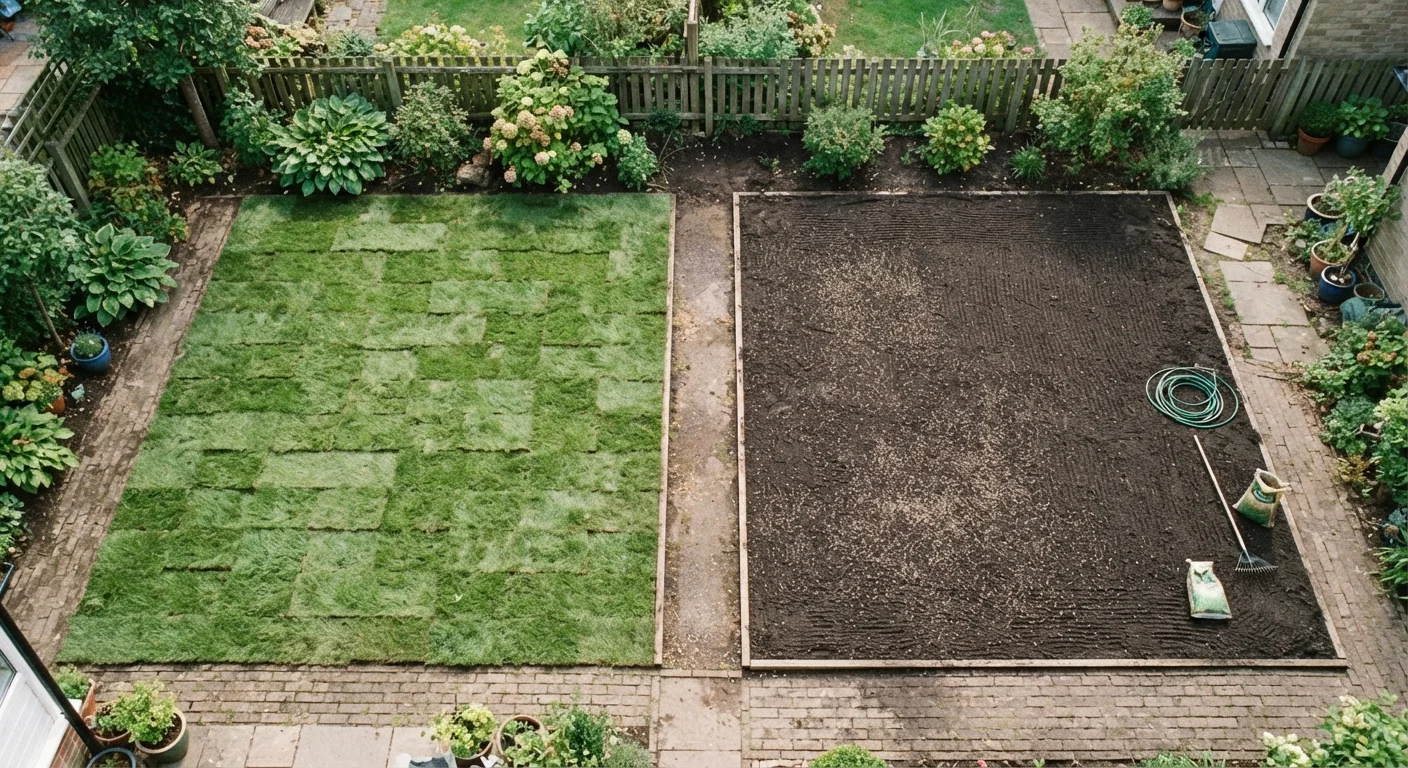
Option A
Grass Seed
The patient, budget-friendly foundation builder.
Best for: Homeowners with flexible timing, a tight budget, and the willingness to wait several weeks for results.
Option B
Turf (Sod)
The fast-track solution for an instant usable lawn.
Best for: Homeowners who need a functional lawn quickly, especially before a deadline like a landscaping project or seasonal event.
The Core Difference: Time Versus Money
Starting a lawn from bare ground means making one foundational decision before anything else: do you seed it yourself, or do you lay pre-grown turf? The right answer depends less on which method produces better grass - both can yield an excellent lawn - and more on your budget, schedule, and how much hands-on effort you're prepared to invest.
Grass seed is the economical choice. Seeding a 1,000-square-foot area typically costs a fraction of turfing the same space, and for large yards the difference can be substantial. The catch is time: from sowing to a lawn that tolerates regular foot traffic, expect eight to twelve weeks under good conditions. During that window, the area is largely off-limits and vulnerable to washout, birds, and drying out.
Turf (sod) compresses that timeline dramatically. Rolls of pre-grown grass are harvested with a thin layer of roots and soil intact, and once laid and watered in, they begin bonding with your ground within days. Most turf is safe for cautious use within two to three weeks. That speed comes at a price - both financially and logistically, since rolls must be installed within 24-48 hours of delivery before they deteriorate.
Think of it as a straightforward trade-off: seed trades money for time, turf trades money for immediacy. Neither is inherently superior; your circumstances determine which makes sense. For a broader look at how starting from scratch applies to garden planting generally, see Starting a Garden From Bare Ground.
Soil Preparation: The Step Neither Method Can Skip
Regardless of which approach you choose, the quality of your soil preparation will have more influence on the final result than the method itself. Both seed and turf need firm, level, well-draining soil that has been cleared of weeds, rocks, and debris.
The standard process involves removing existing vegetation, loosening compacted soil to a depth of four to six inches, incorporating organic matter if the soil is very sandy or clay-heavy, then grading the surface to a slight slope (roughly one inch per ten feet) to encourage drainage away from structures. Rake the surface until it's level and firm - turf needs a flat base to avoid air pockets beneath the rolls, while seed needs good soil contact to germinate reliably.
| Criterion | Grass Seed | Turf (Sod) |
|---|---|---|
| Upfront cost | Low - fractions of turf cost | High - material and delivery |
| Time to usable lawn | 8-12 weeks | 2-3 weeks |
| Installation effort | Moderate - raking, sowing | High - heavy rolling, speed required |
| Species selection | Wide range of mixes available | Limited to supplier's stock |
| Erosion resistance | Low until established | Immediate surface coverage |
| Best planting window | Fall or early spring | Spring through early fall |
| Watering demand | Frequent light watering early on | Deep watering from day one |
One important distinction: turf is slightly more forgiving of minor surface imperfections because the existing mat smooths things out visually. Seeded lawns reveal every dip and bump as the grass fills in. Take extra care with surface leveling if you're seeding.
Timing, Watering, and the Establishment Window
Both methods share an ideal planting window: early fall is generally best for cool-season grasses (fescues, bluegrass, ryegrass) across the northern US, while late spring to early summer suits warm-season grasses (Bermuda, zoysia, St. Augustine) across the South. Avoid establishing a new lawn in the height of summer or during frost periods - heat stress and freezing both impede root development.
7-21 days
Typical grass seed germination window
Germination speed varies by species - perennial ryegrass sprouts fastest, while Kentucky bluegrass can take up to three weeks under ideal conditions.
2-3 weeks
Turf root bonding timeframe
Under adequate watering, most cool- and warm-season turf varieties develop sufficient root contact for light foot traffic within this window.
4-6 inches
Recommended soil loosening depth
Horticultural guidance consistently recommends tilling to this depth before establishing either seed or turf to improve root penetration and drainage.
Watering requirements diverge noticeably during establishment. Freshly seeded areas need light, frequent watering - sometimes twice daily - to keep the surface consistently moist without washing seed away. Once germination is underway (typically seven to twenty-one days depending on species), you can shift to deeper, less frequent sessions. New turf needs thorough soaking immediately after installation, then daily watering for the first week or two. Lift a corner of a roll after ten days: if roots resist pulling away, establishment is progressing well.
Whichever route you choose, be prepared for weeds to appear during establishment. See our lawn weed identification guide for help recognizing what's coming up alongside your grass. If your yard includes shaded areas, the grass species you choose matters enormously - our guide to shade-tolerant grass varieties covers which options cope best with low light.
Once your lawn is established, Ground-Level Lawn Care for New Homeowners provides a practical introduction to the ongoing routine of mowing, feeding, and watering.
The content on this site is for informational purposes only and is not a substitute for professional advice. Always consult a qualified professional for guidance specific to your situation.