

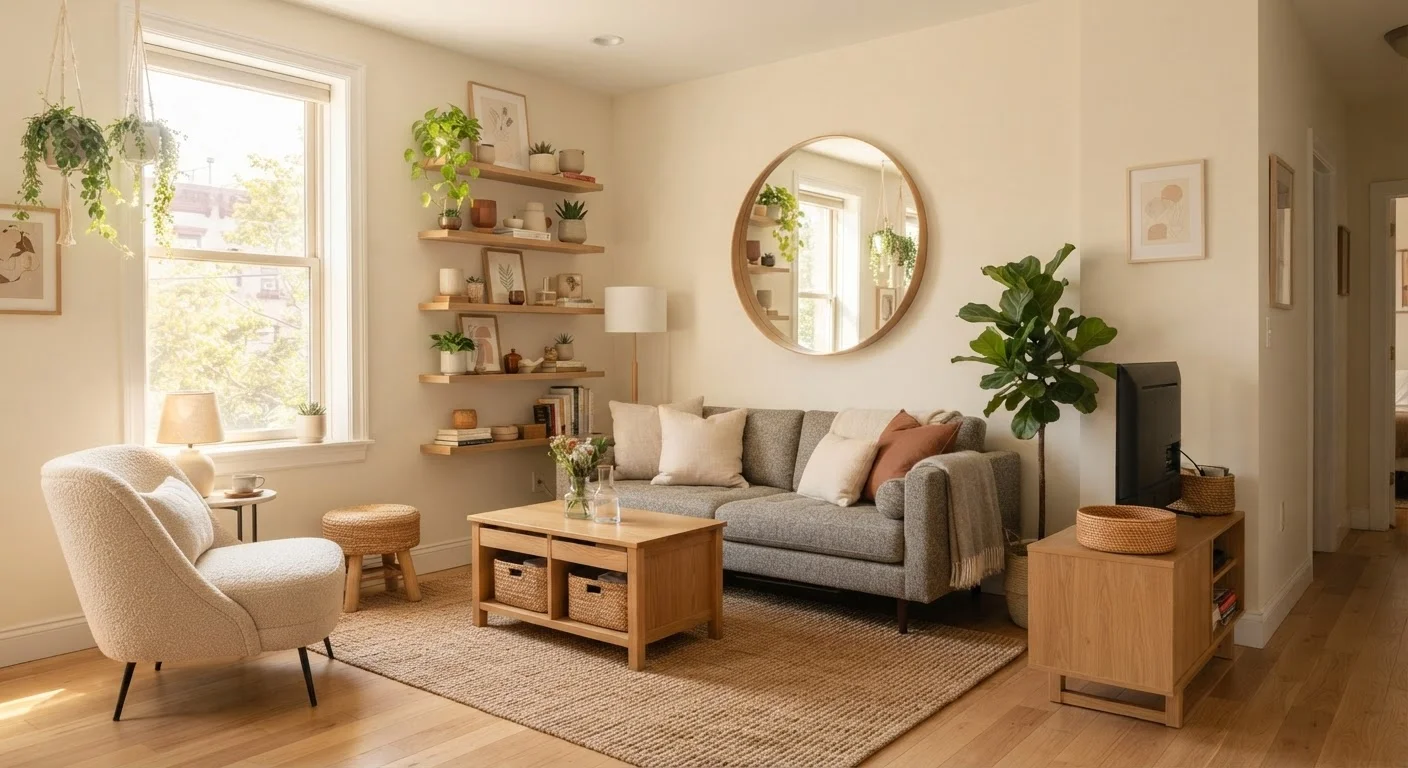
Why Small Rooms Deserve Big Attention
Compact rooms come with real constraints - but they're also an incredible design opportunity. When every square foot counts, intentional styling choices carry far more weight than they would in a sprawling space. The good news? Most of the techniques that make small rooms feel larger, calmer, and more cohesive cost little or nothing to implement.
Whether you're tackling a studio apartment, a narrow bedroom, or a snug living area, the principles below are grounded in how our eyes and brains perceive space. If you want to brush up on the vocabulary you'll encounter throughout this guide, our plain-English decor glossary is a handy companion. Ready to make your compact room work harder? Let's dig in.
Right-Size Your Furniture First
Oversized furniture is one of the most common culprits in a cramped-feeling room. A sectional sofa that overwhelms a modest living room, or a king bed shoved against three walls of a small bedroom, immediately signals "too full" to the eye. The fix isn't necessarily buying new pieces - it's auditing what you have.
Look for furniture with exposed legs, which allows light to pass underneath and creates a visual sense of lift. Opt for pieces that serve the room's primary function without doubling its footprint. When in doubt, one well-chosen piece anchors a room better than several competing ones - a principle explored in our guide to styling around a hero furniture piece.
Exposed-leg furniture lets light flow and makes any room feel instantly less crowded.
Claim Your Vertical Space
Most people decorate from the floor up to about eye level - and then stop. In a small room, that unused wall space above eye level is prime real estate. Floor-to-ceiling shelving draws the eye upward, making ceilings feel taller and the overall room feel larger. Even a simple stack of floating shelves above a desk or sofa adds storage while directing attention vertically.
Curtains hung close to the ceiling (rather than just above the window frame) amplify this effect significantly. Our room-by-room storage framework has detailed ideas for incorporating vertical storage throughout every room in your home.
Hanging curtains near the ceiling - not just above the window - visually stretches room height.
Use Mirrors Strategically, Not Decoratively
Mirrors are a genuine spatial tool, not just a decorating cliché - but placement matters enormously. A mirror positioned to reflect a window bounces natural light deep into the room, while one facing a blank wall simply doubles the blank wall. The goal is to reflect something worth seeing: a light source, a garden view, or a well-styled vignette.
Leaning a large mirror against a wall rather than hanging it can feel more casual and modern, and it avoids the need for wall anchors. For more on how visual tricks affect perceived space, see our article on spatial illusions that actually work.
A mirror facing a window doubles natural light - far more effective than facing a bare wall.
Anchor With a Rug - the Right Size
A too-small rug is one of the most widespread styling mistakes in compact rooms. Rather than defining a zone, an undersized rug makes a room feel disjointed and actually appears to shrink the space. The general principle: at least the front legs of major seating pieces should sit on the rug, creating a unified conversation area.
In a bedroom, a rug that extends 18-24 inches beyond the sides and foot of the bed grounds the room without overwhelming it. Get the full picture on sizing and layering in our guide to anchoring a room with rugs.
An undersized rug actually makes a small room look smaller - scale up for a unified feel.
Choose a Restrained, Cohesive Palette
In a small room, too many competing colors fragment the eye and make the space feel busier than it is. A cohesive palette of two to three tones - ideally with variations in texture rather than hue - creates visual calm that reads as spaciousness. Light, mid-tone, and near-neutral palettes tend to open rooms up, but don't rule out deeper shades entirely.
Counterintuitively, a single dark, saturated wall can actually make a small room feel more considered and intentional rather than cave-like. Our article on dark walls and perceived room size breaks down exactly when this works - and when it doesn't.
Two to three cohesive tones with varied textures create calm that reads as more space.
Create One Clear Focal Point
Small rooms suffer most when the eye has nowhere to land. Competing focal points - a bold gallery wall, a large TV, a statement headboard, and a colorful bookshelf all fighting for attention - exhaust the senses and make a space feel chaotic. Choosing one intentional focal point and letting everything else support it brings instant order.
That focal point might be an artful gallery wall in a narrow hallway (our gallery wall layouts for awkward spaces guide covers this brilliantly) or simply a well-dressed window. The discipline of editing everything else to secondary status is what makes the chosen focal point sing.
One confident focal point calms a small room more than multiple decorative statements ever can.
Balance Visual Weight Thoughtfully
Every piece of furniture and decor carries visual weight - the sense of heaviness or lightness it projects regardless of its actual mass. Dark, bulky, or highly patterned pieces carry more visual weight; light-colored, slender, or translucent pieces carry less. In a small room, an imbalance - all the heavy pieces clustered on one side - creates a subtle but nagging sense that something is "off."
Distributing visual weight evenly around the room, and keeping the overall load on the lighter side, produces a room that feels balanced and airy. For a deeper dive into this principle, our article on visual weight and room balance is well worth a read.
Even distribution of visual weight - not just physical furniture - is what makes a room feel settled.
Bringing It All Together
None of these strategies requires a full renovation or a big budget - most simply ask you to look at your space differently. The most effective small-room transformations tend to stack several of these techniques at once: scale-appropriate furniture arranged to open sightlines, vertical storage pulling the eye upward, and a restrained palette unified by one confident focal point.
If you want to go deeper on spatial illusions, our companion piece on spatial tricks that hold up separates the genuinely effective moves from the overhyped ones. And for a completely free starting point, revisiting your furniture arrangement alone can be transformative. Small rooms reward creativity - and now you have the toolkit to use yours confidently.
Start With One Room, One Strategy
Trying to implement all seven strategies at once can feel overwhelming and expensive. Pick the single technique most relevant to your space's biggest pain point - usually furniture scale or rug sizing - and tackle that first. Once you see results, layering in the next strategy becomes much easier and more motivating.
The content on this site is for informational purposes only and is not a substitute for professional advice. Always consult a qualified professional for guidance specific to your situation.