

Why the Entryway Deserves a Storage Strategy
The entryway is your home's hardest-working transitional zone - coats land on chairs, shoes pile near the door, and keys disappear into bags. Yet it's often the last room to receive a deliberate storage plan. Getting it right means identifying exactly which categories of clutter show up daily (footwear, outerwear, bags, mail) and matching each to a storage type that fits your space.
This reference covers every major entryway storage solution - from the simplest wall hook to full built-ins - with guidance on where each works best. For a broader framework covering storage room by room, see the complete home organisation framework.
Storage Solutions from Minimal to Built-In
Solutions are organized here from lowest commitment to highest, so you can stop at whichever level suits your budget and available space.
Wall Hooks
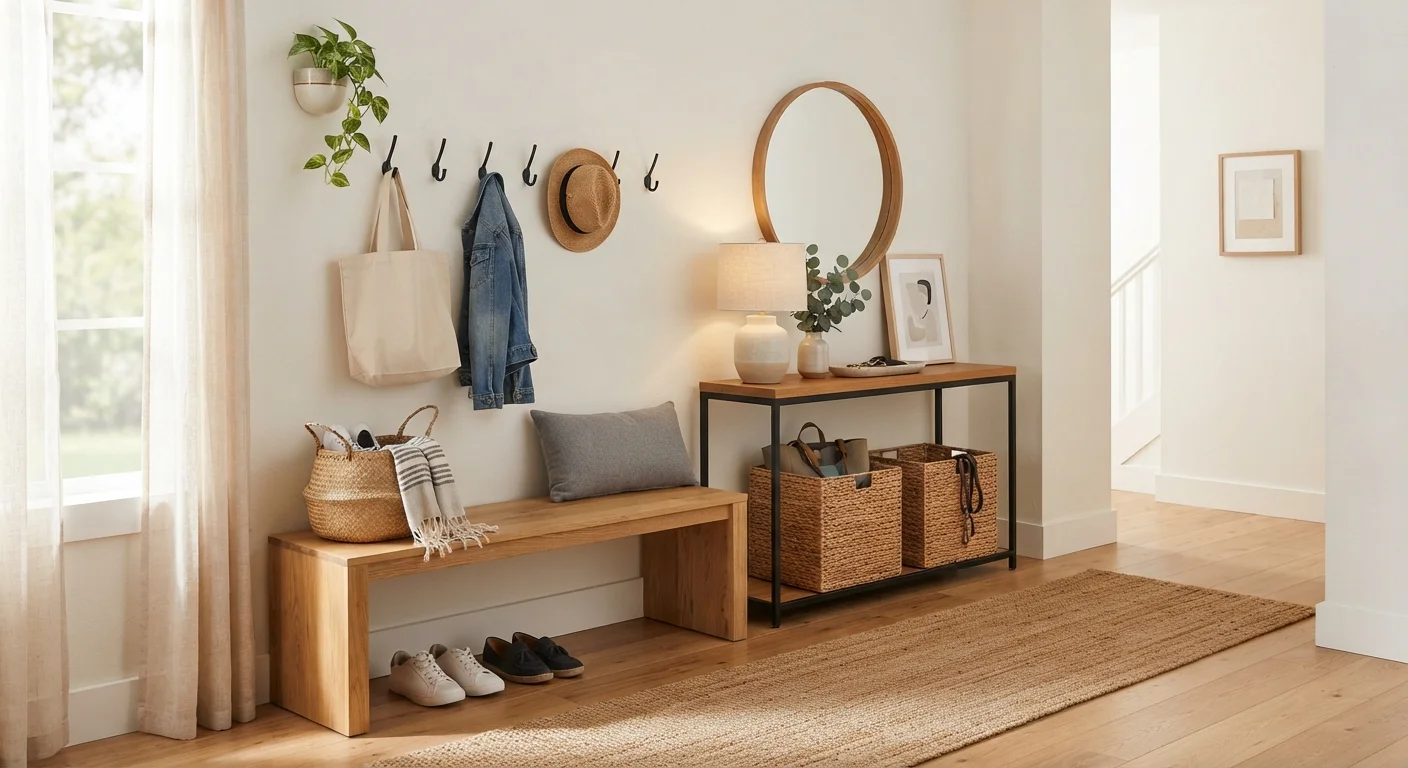
The fastest win in any entryway. A single row of sturdy hooks handles coats, bags, umbrellas, and dog leashes. Position them at a height accessible to all household members. Over-door hook bars require no drilling and suit renters. For renters or those avoiding wall damage, adhesive hook systems rated for heavier loads are a viable short-term option - verify the weight rating before hanging anything heavier than a light jacket.
Shoe Racks and Shoe Cabinets
An open tiered rack is inexpensive and holds several pairs without restricting airflow. Closed shoe cabinets conceal footwear and reduce visual clutter, though they require more floor space. Bench-style shoe cabinets double as seating, which is valuable in narrow entries. If floor space is extremely limited, an over-door shoe organizer on a closet door near the entry is worth considering.
Storage Benches
A bench with an interior compartment or open cubbies below serves dual purposes: seating for putting on shoes and storage for footwear, sports gear, or seasonal items. Upholstered versions add comfort; wooden slatted bases improve ventilation for shoes. Dimensions matter - measure your available width carefully before purchasing or building.
Console Tables and Shelving
A narrow console table with a lower shelf provides a drop zone for bags and mail while the shelf holds baskets or bins. Floating wall shelves above the console create additional vertical storage without occupying floor space. This combination works especially well in medium-width hallways where a bench would feel too bulky.
Freestanding Hall Trees
A hall tree consolidates hooks, a bench, and side storage into one freestanding unit. It's a strong choice when you want an all-in-one solution without committing to built-ins, but verify that the unit is stable - some freestanding hall trees benefit from being anchored to the wall for safety, particularly in households with young children.
Built-In and Semi-Built-In Storage
Mudroom-style built-ins - cubbies with hooks above and bench seating over drawers - offer maximum capacity and a custom fit. These are the most labor-intensive option and often require carpentry skills or professional help. A semi-DIY approach: assemble open shelving units side by side, then add a plywood top to create a built-in look at a fraction of the cost. If you're comfortable with basic woodworking, building a wall-mounted entryway organizer from scrap wood is a practical starting point.
Hall tree
A freestanding furniture unit that combines coat hooks, a bench seat, and sometimes side storage or shelving into a single piece. It functions as an all-in-one entryway organizer.
Mudroom
A transitional room or zone between the outdoors and the main living area, designed to contain outerwear, footwear, and outdoor gear. Can be a dedicated room or a defined section of a hallway.
Console table
A narrow, typically shallow table designed to stand against a wall. In entryways, it serves as a drop zone for keys and mail while the lower shelf holds baskets or additional storage.
Cubby
An individual open compartment within a shelving or storage unit, often sized to hold a single pair of shoes, a bag, or a small basket. Cubbies are a defining feature of mudroom-style built-ins.
Choosing the Right Combination for Your Space
Most entryways benefit from layering two or three solutions rather than relying on one. A common starting configuration is: wall hooks for daily outerwear + a narrow shoe rack or bench for footwear + one basket or bin for miscellaneous items like gloves and scarves.
For households with children, lower hooks at child height paired with labeled cubbies dramatically reduce the after-school drop-zone problem. For apartments with no dedicated entry area, a behind-door organizer plus a small console table can create a functional zone without altering the space significantly. You'll find additional inspiration for repurposing household items as entryway storage in the guide to unexpected DIY organizer components.
Whatever combination you choose, keep a one-in-one-out rule for seasonal items - rotating winter boots to a closet when summer arrives keeps the entry from becoming a long-term storage overflow area. For more hands-on project guidance across every room, the DIY organisers start-to-finish resource covers materials, joinery, and wall anchoring in detail.
The content on this site is for informational purposes only and is not a substitute for professional advice. Always consult a qualified professional for guidance specific to your situation.