

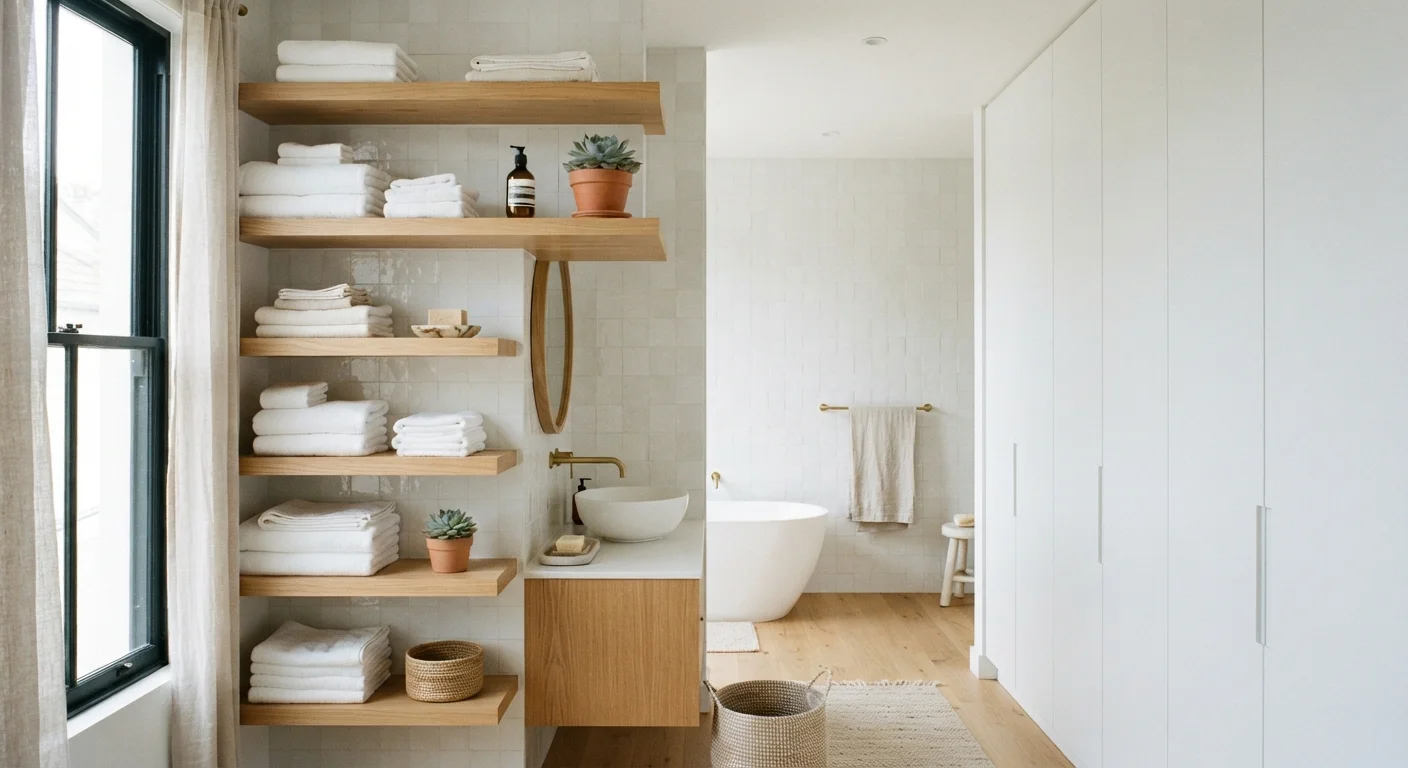
Option A
Open Shelving
The visually expansive, grab-and-go option.
Best for: Bathrooms with low humidity, curated storage habits, and a desire for an airy, styled look.
Option B
Closed Cabinets
The concealing, clutter-proof workhorse.
Best for: High-traffic bathrooms with mixed-use storage needs and occupants who prefer a tidy, concealed aesthetic.
Why Bathroom Storage Is Different From Every Other Room
The bathroom presents storage challenges that no other room quite replicates. Humidity from showers and baths cycles through the space multiple times a day, surfaces collect product residue, and the range of items stored - from daily-use toiletries to infrequently needed medications - demands different levels of accessibility and protection.
That environmental reality is what makes the open shelving vs. closed cabinet decision more consequential here than in, say, a living room. For a broader look at how that trade-off plays out beyond the bathroom, see Open Shelving vs. Closed Storage: What Works Best in Living Spaces. In the bathroom specifically, your ventilation setup, household size, and daily habits should drive the decision more than aesthetics alone.
| Criterion | Open Shelving | Closed Cabinets |
|---|---|---|
| Moisture protection | Low - items fully exposed | High - doors buffer humidity |
| Accessibility | Immediate - no doors to open | One extra step to retrieve items |
| Visual effect | Airy, open, styled | Clean, concealed, uniform |
| Clutter tolerance | Low - everything is visible | High - clutter hidden behind doors |
| DIY installation | Generally simpler | More complex, varies by type |
| Privacy for personal items | None | Full when doors are closed |
| Best storage candidates | Towels, daily-use products | Medications, backup supplies, packaging |
The Case for Open Shelving
Open shelves earn their place in bathrooms where ventilation is reliable and the household is genuinely disciplined about tidiness. Their primary advantage is instant visibility - you can reach for a product without opening a door, and nothing gets forgotten behind a closed panel. Visually, they prevent a small bathroom from feeling boxed in, especially when shelves are mounted high or spaced generously.
They're also typically simpler to install. A floating shelf bracket anchored securely into wall studs or with appropriate wall anchors can be a manageable weekend project. That said, the installation still requires careful anchoring - an overloaded or improperly mounted shelf is a safety hazard regardless of how light it looks. For a practical comparison of the build effort involved, DIY Shelving: Open Shelves vs. Closed Cabinet Units for a One-Weekend Build walks through the differences in detail.
The key limitation is exposure. Products left on open shelves accumulate dust and are subject to humidity fluctuations. Cardboard packaging degrades, and items stored near the shower may experience accelerated moisture damage. Limit open shelving to items used frequently - towels, daily-use products - and keep it away from direct shower spray zones.
The Case for Closed Cabinets
Closed cabinets solve problems that open shelving cannot: they conceal clutter, protect products from moisture exposure, and create a visual boundary that makes even a fully stocked bathroom look calm and organized. For households where multiple people share the space, a cabinet absorbs the visual chaos of differing routines.
From a practical standpoint, cabinets are better suited for storing items that don't need daily access - backup supplies, medications, first-aid materials, and products with cardboard packaging vulnerable to humidity. They also offer a measure of privacy for personal care products, which matters in shared or guest bathrooms.
Installation varies significantly by cabinet type. A recessed medicine cabinet requires cutting into the wall (and verifying there are no wires or pipes behind the drywall - consult a professional if uncertain). A surface-mounted cabinet avoids that complexity but adds visual bulk. Freestanding units are the most accessible option but consume floor space, which is often the scarcest resource in a bathroom. For fast, affordable approaches to bathroom storage that bridge both worlds, Bathroom Storage on a Tight Timeline: What Actually Works covers practical options across a range of budgets and timelines.
Making a Hybrid Layout Work
Most bathrooms benefit from a deliberate combination: closed storage for the essentials that need protection or privacy, and open shelving for the items that are genuinely decorative or high-frequency. A common and effective pattern is a closed cabinet under or around the sink paired with one or two open shelves above the toilet or beside the mirror.
When planning a hybrid layout, assign storage by item type rather than by location. Ask: does this item benefit from being visible and reachable quickly? If yes, it's a shelf candidate. Does it need protection from moisture, or would it look cluttered on display? If yes, it belongs in a cabinet. Applying this logic room by room - not just in the bathroom - is a principle covered more broadly in Kitchen Storage From Counter to Cabinet: A Room-by-Room Primer.
Whatever configuration you choose, prioritize ventilation. A bathroom exhaust fan that vents to the exterior (not just into an attic or wall cavity) is the single most effective way to protect any storage solution - open or closed - from long-term moisture damage.
~50%
Relative humidity in active bathrooms
Bathroom humidity during and after showers can spike to 90-100% RH, settling around 50% or higher in poorly ventilated spaces - well above the 30-50% range recommended for general interior storage.
2-3×
Faster product degradation in humid storage
Packaging, adhesives, and paper labels on products stored in humid open environments can degrade significantly faster than those stored in enclosed, lower-humidity spaces.
The content on this site is for informational purposes only and is not a substitute for professional advice. Always consult a qualified professional for guidance specific to your situation.