

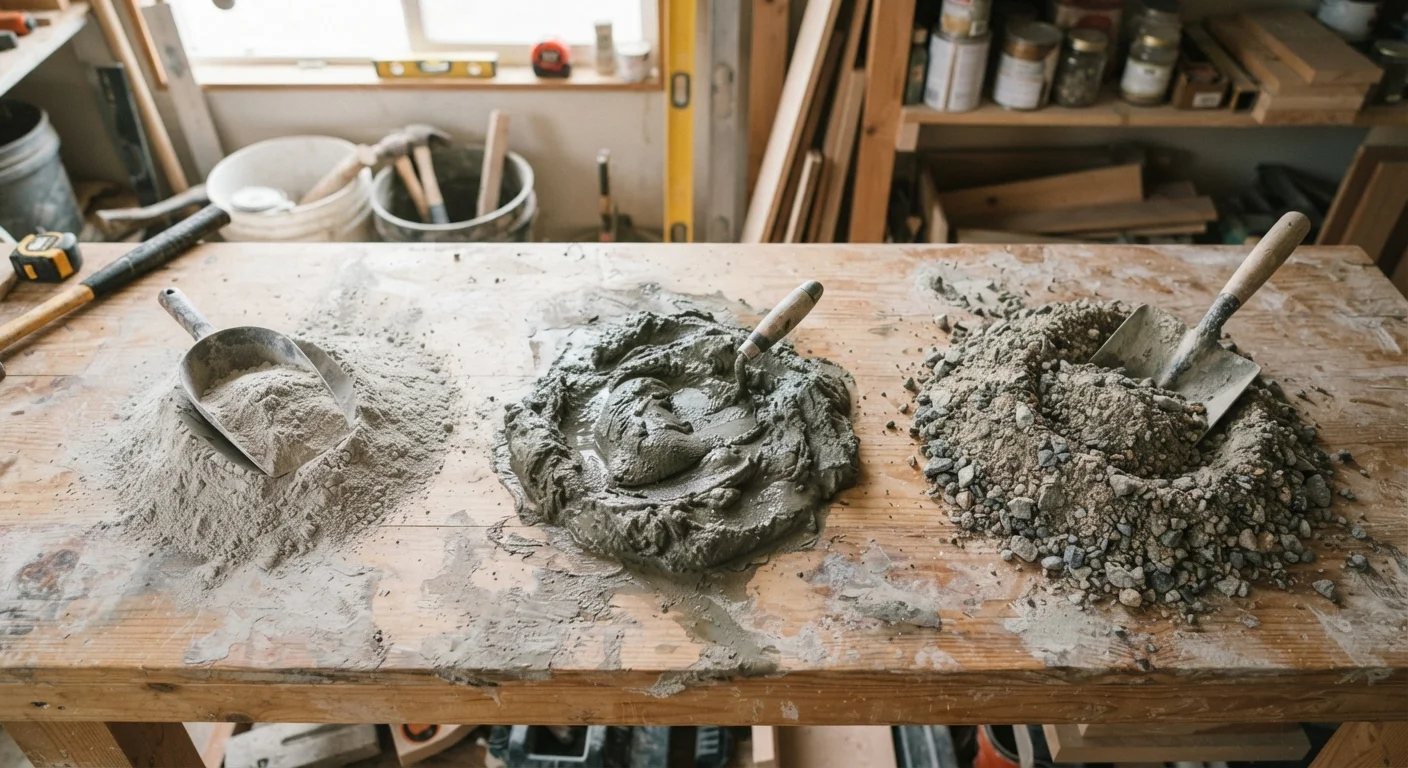
Option A
Cement (Portland Cement)
The foundational binder — the ingredient, not the finished product.
Best for: Mixing into mortar or concrete; never used alone as a structural or bonding material.
Option B
Concrete & Mortar
The two working materials made from cement — each built for a different job.
Best for: Concrete for structural slabs and footings; mortar for bonding masonry units like brick and block.
Why the Confusion Exists — and Why It Costs DIYers
Walk into any hardware store and you'll hear the words cement, concrete, and mortar used as if they're the same thing. They're not — and reaching for the wrong one on a project can lead to crumbling joints, failed slabs, or wasted materials. The confusion is understandable: all three are gray, powdery or paste-like, and harden with water. But their formulas and functions are genuinely different.
Think of it this way: cement is an ingredient, like flour in baking. Concrete and mortar are the recipes — different combinations built for different purposes. You can't use flour on its own to bake a cake, and you shouldn't use bare cement to build a wall or pour a foundation.
Getting this distinction right from the start is one of the most important steps toward working confidently with masonry materials. It also helps you read project specifications, buy the right bag at the store, and avoid costly do-overs. For projects involving brickwork or block walls, see our guide to masonry materials for how these mixes fit into broader structural choices.
Cement: The Binder at the Core
Portland cement is the most common type of cement used in construction and DIY projects. It's a finely ground powder made primarily from limestone, clay, and other minerals that have been heated in a kiln to extremely high temperatures. When mixed with water, it undergoes a chemical reaction called hydration that causes it to harden and bind other materials together.
On its own, cement is too brittle and prone to cracking for almost any structural application. It needs aggregate (sand, gravel, or both) to give the finished mix durability and working properties. This is why you'll never correctly say "pour some cement" when you mean a concrete slab — you're describing only one ingredient of a multi-component mix.
Cement comes in different types, including standard Type I/II (general purpose) and specialty variants like Type III (faster setting) or sulfate-resistant formulas. For most DIY projects — garden walls, patio footings, basic repairs — standard Type I/II is the right starting point.
| Criterion | Concrete | Mortar |
|---|---|---|
| Key ingredients | Cement + sand + gravel + water | Cement + sand + water |
| Primary purpose | Structural slabs, foundations, footings | Bonding masonry units (brick, block, stone) |
| Coarse aggregate | Yes — gravel or crushed stone | No — fine sand only |
| Compressive strength | High (2,500–5,000+ psi typical) | Moderate (750–2,500 psi typical) |
| Workability in joints | Poor — too coarse for narrow joints | Excellent — spreads and packs cleanly |
| Flexibility / movement tolerance | Lower — more rigid | Higher — allows minor settling |
| Typical DIY use cases | Post holes, patio slabs, fence footings | Brick laying, repointing, stone veneers |
Concrete vs. Mortar: Different Jobs, Different Mixes
Concrete is cement + sand + coarse aggregate (gravel or crushed stone) + water. The gravel is the key differentiator — it gives concrete its compressive strength and makes it suitable for structural uses: foundations, footings, driveways, slabs, retaining wall bases, and posts. A standard DIY mix ratio is roughly 1 part cement : 2 parts sand : 3 parts gravel by volume, though pre-mixed bags simplify this for smaller jobs.
Mortar is cement + sand + water — no coarse aggregate. That finer texture makes it workable as an adhesive between masonry units. It spreads cleanly, fills joints completely, and creates a slightly flexible bond that accommodates the minor movement all structures experience. Mortar is used for laying brick, block, and stone, as well as repointing deteriorating joints. It is not a structural material in its own right — it holds masonry units together, but the strength of the wall comes from the units themselves and their arrangement.
~0.45
Ideal water-to-cement ratio for durable concrete
Civil engineering guidelines generally recommend a w/c ratio of 0.40–0.50 for structural concrete; higher ratios reduce strength significantly.
7 days
Time for concrete to reach ~70% design strength
Under normal curing conditions, concrete continues to gain strength for weeks — full cure is typically measured at 28 days.
3:1
Typical sand-to-cement ratio for standard mortar
A 3 parts sand to 1 part cement mix by volume is a common starting point for general masonry mortar; specific applications may require adjustment.
One common beginner mistake: using concrete mix to repoint brick joints. The coarser aggregate makes it nearly impossible to pack neatly into narrow joints, and the higher strength can actually damage softer brick by preventing the natural movement that mortar is designed to allow. Likewise, using mortar to fill a post hole or form a footing is a recipe for structural failure. For your next outdoor project, consider reading our breakdown of patio surface materials to see how concrete fits within the wider landscape of outdoor surface choices.
Water Ratios, Curing, and Practical Tips
Both concrete and mortar are only as good as their mix — and water is where most DIYers go wrong. Adding too much water makes mixing easier but weakens the final product significantly. A stiffer mix is harder to work with but produces a stronger, more durable result. Follow the water recommendations on pre-mixed bags precisely, or use a measured water-to-cement ratio (w/c ratio) if mixing from scratch.
Curing matters just as much as mixing. Concrete reaches roughly 70% of its design strength within 7 days under typical conditions, but continues to cure for weeks. Keep freshly poured concrete damp (misting or wet burlap works well) and protect it from freezing temperatures during the first 48 hours. Mortar joints should be kept slightly moist for the first day or two to prevent too-rapid drying, which causes surface cracking.
For any masonry work that involves drilling into cured concrete or block, make sure you're using the correct tool — our guide to drills and hammer drills explains why a standard drill won't cut it in masonry.
Always follow local building codes and obtain required permits before undertaking structural concrete work such as foundations, retaining walls over a certain height, or load-bearing elements. Consult a licensed professional if you're uncertain about the structural requirements of your project.
The content on this site is for informational purposes only and is not a substitute for professional advice. Always consult a qualified professional for guidance specific to your situation.