

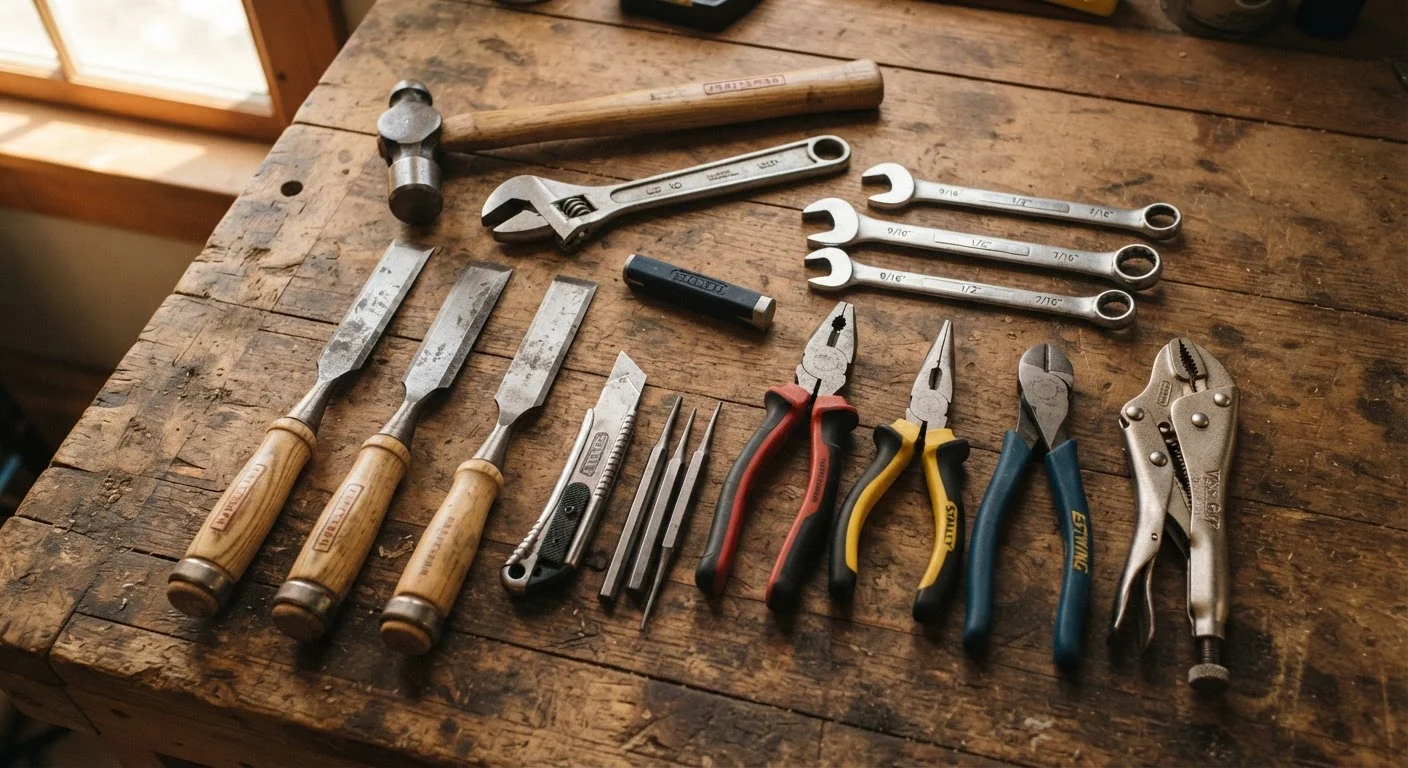
Why Tool Labels Matter
Pick up any hand tool at a hardware store and the packaging will hit you with terms like chrome-vanadium, drop-forged, or bi-material grip. These aren't just marketing words - they describe real manufacturing choices that affect how long a tool lasts, how comfortable it is to use, and whether it's worth the price difference over a cheaper alternative.
For a beginner building out a first toolkit, the label is often the only information you have. Knowing what the terms actually mean turns that label from noise into a genuine buying signal. If you're also sorting out which tools to prioritize, our guide to hand tools vs. power tools is a useful companion read.
Chrome-vanadium (Cr-V)
A steel alloy containing chromium and vanadium. Chromium adds corrosion resistance; vanadium adds hardness and toughness. The standard material for quality wrenches, sockets, and screwdrivers.
Drop-forged
A manufacturing process in which heated metal is shaped by a heavy press or hammer. Produces a denser, stronger grain structure than casting, making tools more resistant to cracking under load.
Bi-material grip
A handle made from two materials - typically a rigid plastic core with a soft rubber or TPE overmold. Combines efficient force transfer with improved comfort and wet-weather grip.
Heat-treated
A controlled heating and cooling process applied to steel to increase hardness and durability. Through-hardened tools are hardened throughout; case-hardened tools are hardened only at the surface.
Chrome-molybdenum (Cr-Mo)
A steel alloy (also called chrome-moly) with higher impact resistance than chrome-vanadium. Commonly used in impact sockets and heavy-duty striking tools.
Investment cast
A manufacturing method where molten metal is poured into a precision mold. Allows complex shapes but may contain internal voids, making cast tools generally less strong than drop-forged equivalents.
High-carbon steel
Steel with a higher carbon content than standard mild steel. It can be hardened to a sharper, more durable cutting edge, making it common in chisels, plane blades, and saw teeth.
Fiberglass handle
A tool handle made from fiberglass composite. Lighter than wood, resistant to moisture and vibration, and less likely to split - but can crack under extreme lateral force.
Metal and Alloy Terms Decoded
The steel a tool is made from largely determines its strength, hardness, and resistance to corrosion. Here's what the most common alloy labels mean in practical terms:
- Chrome-vanadium (Cr-V) steel - An alloy that combines chromium for corrosion resistance and vanadium for hardness and toughness. It's the most common material for quality wrenches and sockets. A chrome-vanadium tool generally holds an edge or shape under repeated stress better than plain carbon steel.
- Chrome-molybdenum (Cr-Mo) steel - Slightly more impact-resistant than Cr-V, making it common in impact sockets and heavy-duty pry bars. You'll see this called chrome-moly on packaging.
- High-carbon steel - Used widely in cutting tools like chisels and hand saws. The higher carbon content allows the metal to be hardened to a sharper, more durable edge - but it can be more prone to rust if not properly maintained.
- Stainless steel - Highly corrosion-resistant but generally softer than Cr-V, which is why it's reserved for tools that need to stay clean rather than withstand heavy force - think trowels or garden hand tools.
| Most common alloy for quality hand tools | Chrome-vanadium (Cr-V) steel |
| Preferred manufacturing method for strength | Drop-forged |
| Best handle material for shock absorption | Hickory wood or fiberglass composite |
| Grip type for wet or extended-use conditions | Bi-material (hard core + soft overmold) |
| Steel type suited to corrosion resistance (light-duty) | Stainless steel |
| Steel type for impact sockets and pry bars | Chrome-molybdenum (Cr-Mo) |
For tips on protecting any of these metals from rust and wear after purchase, see our article on keeping your hand tools in working order.
Manufacturing Process Terms
Beyond the alloy, how a tool is shaped matters just as much as what it's made from.
- Drop-forged - The metal is heated and then hammered into shape under a heavy press (the 'drop'). This aligns the steel's grain structure, producing a tool that's denser and stronger than one simply cast in a mold. Drop-forged wrenches and hammers resist cracking under load.
- Investment cast - Molten metal is poured into a precision mold. Allows complex shapes but can result in internal voids that reduce strength. Often found in lower-cost tools.
- Machined - Material is cut away from a solid billet using lathes or mills. Precision machining is a mark of quality on sockets and precision screwdrivers where tight tolerances matter.
- Heat-treated / through-hardened - The tool has been heated and cooled in a controlled way to harden the steel throughout. Contrast with case-hardened, where only the outer surface is hardened - useful for some applications but not ideal for tools expected to flex or absorb impact.
If you'd like to compare how manufacturing specs appear on power tools, our power tool terminology glossary covers the equivalent label language for that category.
Handle and Grip Terms
A tool's handle affects fatigue, control, and safety - especially during repetitive tasks. Labels use a few standard terms:
- Bi-material grip - Two materials combined, typically a rigid plastic core with a softer rubber or thermoplastic elastomer (TPE) overmold. The hard core transfers force efficiently; the soft outer layer cushions your hand and improves grip when wet.
- Ergonomic handle - A shaped grip designed to reduce strain during extended use. The term is used broadly, so look for specific design features (contoured palm swell, non-slip zones) rather than relying on the label alone.
- Fiberglass handle - Common on hammers and axes. Lighter than wood, highly resistant to vibration transmission, and won't absorb moisture. A fiberglass handle won't split like wood, but it can crack under extreme lateral stress.
- Hickory handle - Traditional wood choice for striking tools. Hickory absorbs shock well and can be replaced if it breaks - a genuine advantage for long-term ownership.
Understanding grip materials also applies when you're decoding craft and decor project tools. Our DIY decor toolkit glossary extends this language into adhesives, substrates, and finishes used in home decor work.
Armed with these definitions, you can read any tool label with confidence - comparing what you're actually getting rather than guessing from the price or the packaging design alone.
This article provides general educational information about tool materials and terminology. Always follow the manufacturer's guidelines for safe tool use, and consult a qualified professional for any task beyond your experience level.
The content on this site is for informational purposes only and is not a substitute for professional advice. Always consult a qualified professional for guidance specific to your situation.