

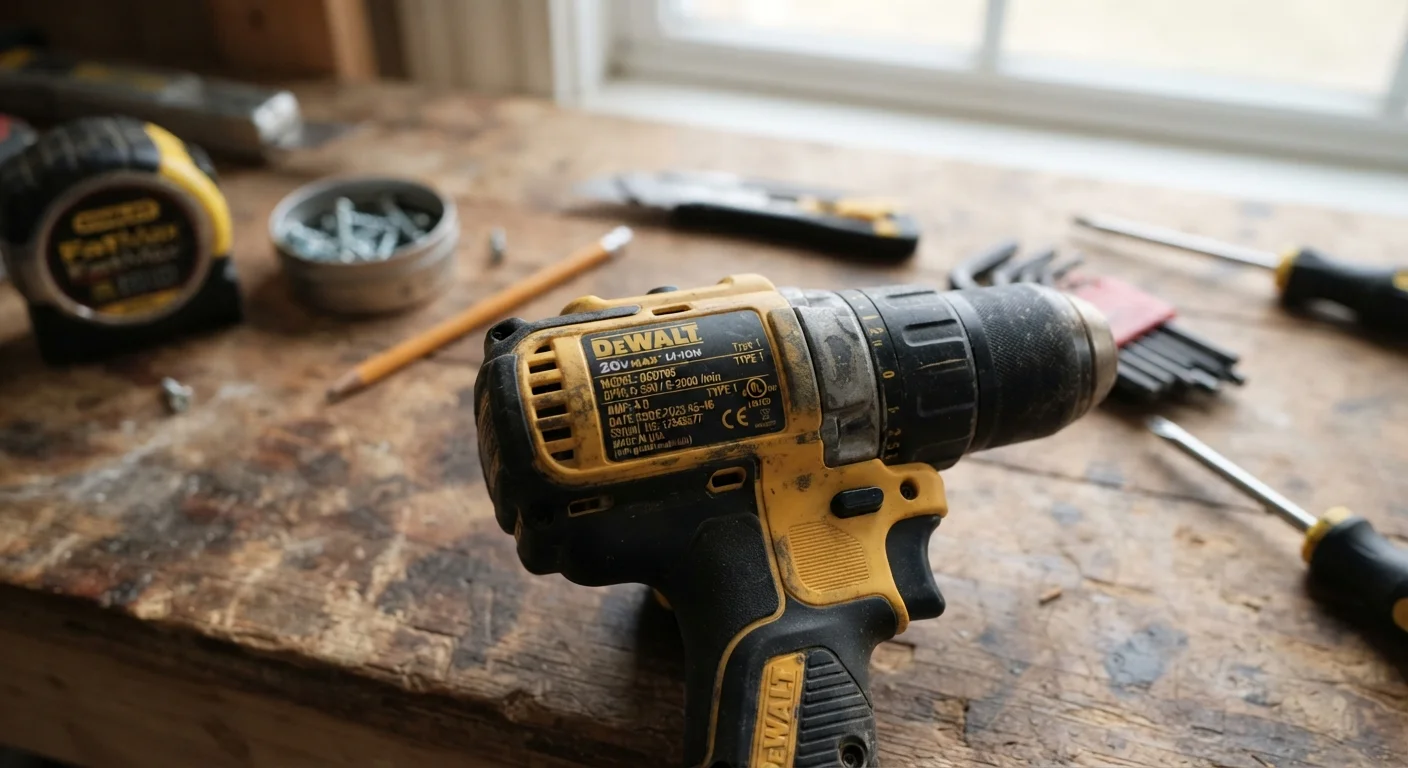
Why Terminology Matters Before You Buy
Standing in front of a wall of power tools - or scrolling through spec pages online - can feel like reading a foreign language. Amps, volts, RPM, chuck size, orbital action: each term carries real meaning that directly affects whether a tool will do your job well or frustrate you from the first use.
This glossary exists to close that gap. Once you know what the numbers and labels actually describe, you can make informed decisions rather than guessing by price or size. For a broader look at how these tools function before diving into terminology, see Power Tools Demystified - it pairs well with this reference.
The terms below are grouped by theme: electrical specs first, then mechanical specs, then cutting-specific language. Use the glossary card as your quick-reference lookup.
Amperage (Amps)
A measure of how much electrical current a corded power tool draws. Higher amps generally indicate more sustained power under load - useful for demanding cuts or drilling into hard materials.
RPM (Revolutions Per Minute)
The number of times a tool's bit, blade, or disc completes a full rotation each minute. Higher RPM suits finishing work; lower RPM with higher torque is better for driving fasteners or drilling.
Torque
The rotational force a tool produces. When driving screws or drilling into dense material, torque matters more than raw speed - it's what prevents the tool from stalling.
Chuck
The clamping mechanism at the front of a drill that holds the bit in place. Chuck size (typically 3/8 inch or 1/2 inch) determines the maximum bit shank diameter the tool can accept.
Kerf
The width of material removed by a saw blade during a cut. A wider kerf wastes more material; a thinner kerf requires less power but may sacrifice blade durability.
No-Load Speed
The RPM a tool reaches when running freely with no resistance. This figure appears on packaging but real-world speed under load will always be lower - treat it as a ceiling, not a guarantee.
Voltage (V)
In cordless tools, voltage indicates the battery's potential energy. Higher voltage (e.g., 18V vs. 12V) generally means more power available, though actual performance also depends on battery cell quality.
Ah (Amp-Hours)
A rating for cordless tool batteries that describes how much charge the pack holds. A 4Ah battery will run roughly twice as long between charges as a 2Ah battery at the same voltage.
Clutch
An adjustable mechanism on drills and drivers that disengages the drive when a set torque level is reached. It prevents overdriving screws and protects both the workpiece and the tool.
Orbital Action
A side-to-side or elliptical movement added to a tool's primary motion. On a jigsaw, orbital action speeds up cutting in wood; on a random-orbital sander, it reduces visible scratches.
Arbor
The central shaft or spindle on which a blade or disc mounts - most commonly referenced with circular saws and angle grinders. Arbor size must match the blade's center hole.
Depth of Cut
The maximum depth a saw blade can cut in a single pass. This spec determines whether a tool can cut through a given material thickness, and it often varies depending on the bevel angle set.
Reading Electrical Specs: Amps, Volts, and Amp-Hours
Electrical specs describe where a tool gets its energy and how much of it the tool can access. For corded tools, amperage is the key number. A circular saw rated at 15 amps will sustain heavier cuts through thick lumber without bogging down the way a 12-amp model might. Think of amps as the width of the pipeline delivering power.
For cordless tools, voltage and amp-hours (Ah) work together. Voltage sets the ceiling for power potential; amp-hours determine runtime. A 4Ah pack on an 18V drill will outrun a 2Ah pack in the same platform - but neither changes the tool's peak power capability. When you see "20V max" on a label, that's the peak open-circuit voltage; nominal working voltage is typically 18V.
No-Load Speed vs. Real-World Performance
Spec sheets always list no-load speed - the RPM the tool hits when spinning freely in the air. Once you're cutting or drilling actual material, resistance drops that number significantly. When comparing tools, look at both the RPM and the amperage or voltage together; neither figure alone tells the full story.
If you're ready to apply these specs to an actual purchase decision, reading what the specs on the box actually mean is a logical next step.
Mechanical Specs: RPM, Torque, and the Clutch
Mechanical specs describe how the tool moves and how much force it delivers. RPM is straightforward - higher is faster - but faster isn't always better. Drilling into masonry calls for low speed and high torque. Sanding a cabinet door calls for higher speed with lighter pressure. Match the speed range to the task, not the highest number on the dial.
Torque is the rotational muscle behind every turn. A driver with high torque won't stall when sinking a long screw into hardwood. The clutch is what keeps that torque from becoming destructive: dial it down when driving into softwood or thin materials to avoid stripping screw heads or cracking surfaces.
For comparison with non-powered alternatives, understanding the trade-offs between hand tools and power tools covers where manual control still wins.
| Common drill chuck sizes | 3/8 inch (light duty) and 1/2 inch (heavy duty) |
| Typical cordless tool voltages | 12V, 18V, and 20V (nominal) are the most widely used |
| What amps indicate | Sustained power draw; most corded drills range from 5A to 10A |
| Clutch settings | Usually numbered 1-20+; lower numbers = less torque before disengaging |
| Arbor sizes (circular saw) | 5/8 inch is the most common standard in the US |
| Battery Ah range | Consumer packs typically range from 1.5Ah to 6Ah |
Cutting-Specific Terms: Kerf, Arbor, and Depth of Cut
Saw specs introduce their own vocabulary. Kerf affects material waste and cut quality - thin-kerf blades demand less from the motor and are well-suited to smaller saws, while full-kerf blades are more stable in heavy ripping applications. Neither is universally superior; the right choice depends on the material and saw.
The arbor is simply the mounting spindle - check that any replacement blade matches your saw's arbor diameter before purchasing. Depth of cut tells you the thickest material the saw can handle in one pass at 90 degrees; that number decreases when you tilt the blade for bevel cuts.
If you work across both power and hand tools, the language of hand tools follows its own logic - what the labels on hand tools actually mean and the anatomy of a hand saw are useful companion references. For decor-focused projects where tools overlap with craft materials, The DIY Decor Toolkit covers the material side of the equation.
The content on this site is for informational purposes only and is not a substitute for professional advice. Always consult a qualified professional for guidance specific to your situation.