

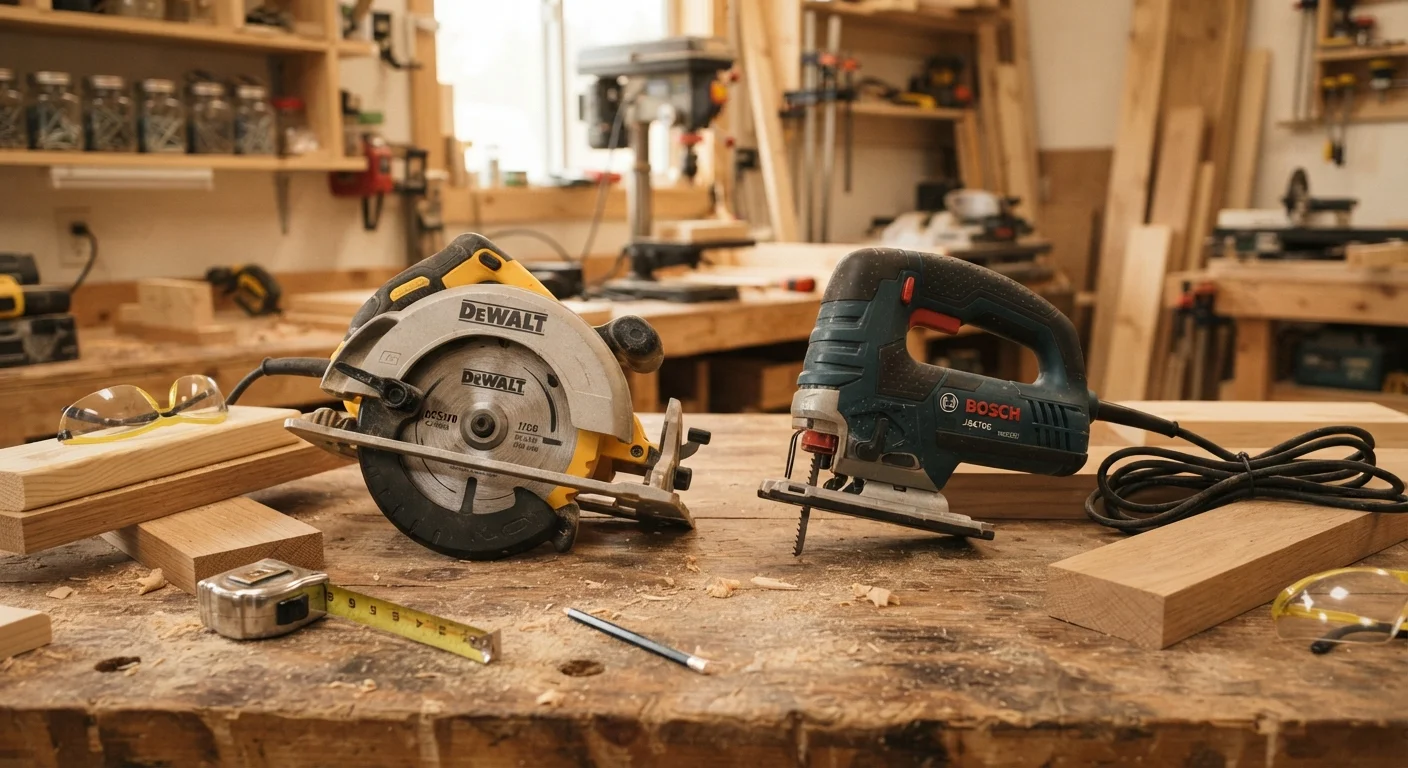
Option A
Circular Saw
The workhorse for fast, straight cuts through sheet goods and lumber.
Best for: Making long, straight cuts in plywood, dimensional lumber, and other flat stock quickly and accurately.
Option B
Jigsaw
The nimble cutter built for curves, cutouts, and confined spaces.
Best for: Cutting curves, circles, irregular shapes, and interior cutouts in wood, laminate, and thin metals.
How Each Blade Actually Moves - and Why That Matters
Understanding power saws starts with understanding blade motion. Before you even think about which one to buy or borrow, get familiar with how power tools work in general - it makes the differences below much easier to grasp.
A circular saw spins a toothed disc at high RPM. That rotation generates considerable cutting force across the full diameter of the blade, which is why it slices through 2-inch lumber so efficiently. The blade is mounted in a fixed orientation - it cuts in a straight line as you push the saw forward along your workpiece. Blade depth is adjustable so the teeth just barely exit the bottom of the material, reducing tear-out and keeping the cut controlled.
A jigsaw works on an entirely different principle. Its short, narrow blade moves up and down rapidly - a motion called reciprocation. The blade cuts on the upstroke (in most standard blades), which means the cleanest face of the cut is typically on the bottom of your workpiece. Because the blade is narrow and unsupported at its tip, you can steer the saw through curves simply by rotating your wrist as you move forward.
That physical difference - rotational vs. reciprocating - is the core reason these two tools exist. One is built for straight-line power; the other is built for directional flexibility.
Cut Types: Where Each Saw Excels
| Criterion | Circular Saw | Jigsaw |
|---|---|---|
| Blade motion | Rotating disc | Reciprocating blade (up/down) |
| Best cut type | Straight cuts (rips and crosscuts) | Curves, circles, irregular shapes |
| Interior cutouts | Not possible | Yes, with plunge-start blade |
| Edge quality on straight cuts | Smooth with proper blade | Rougher, tends to wander |
| Ease of use for beginners | Moderate - kickback risk to manage | Lower barrier to entry |
| Material versatility | Wood, engineered lumber, some masonry | Wood, thin metal, laminate, tile (with blade) |
| Typical blade count options | 16-80 teeth depending on application | Blade types by material, not tooth count alone |
| Plunge cutting capability | No | Yes |
The circular saw dominates any task involving long, straight cuts. Ripping a sheet of plywood along its length, crosscutting a 2x6 to length, or trimming a door down to size - these are its native terrain. When paired with a straightedge guide clamped to the workpiece, it produces cuts that rival a table saw in accuracy. See our guide to making straight cuts with a circular saw for a practical walkthrough of that technique.
The jigsaw shines wherever the cut path changes direction. Cutting a sink opening into a countertop, shaping a decorative bracket, scribing a baseboard to an uneven wall, or cutting a notch around a pipe - these are tasks the circular saw simply cannot do. The jigsaw can also plunge-cut (start a cut in the middle of a panel without a pre-drilled hole) when fitted with a plunge-start blade, opening up even more interior cutout possibilities.
One important caveat: jigsaws are slower and produce rougher edges on straight cuts than circular saws. Using a jigsaw to rip plywood is technically possible but practically frustrating - the blade tends to wander, and the process takes far longer. Use each tool where it was designed to perform.
Blade Selection, Safety, and Beginner Pitfalls
Both saws are governed heavily by blade choice. For circular saws, a higher tooth count (more teeth per inch) produces smoother cuts in plywood and sheet goods; a lower tooth count removes material faster in framing lumber. For jigsaws, blade selection spans wood, metal, and laminate variants - always match the blade material and tooth geometry to what you're cutting. Understanding tooth geometry and kerf from hand saws transfers surprisingly well to powered saw blades.
Circular saw safety priorities:
- Always set blade depth so the blade extends just past the workpiece thickness - no more than about ¼ inch beyond.
- Support both sides of the cut so the offcut doesn't pinch the blade and cause kickback - the most common and dangerous circular saw hazard.
- Keep the base plate (shoe) flat on the workpiece throughout the cut; lifting the heel mid-cut can bind the blade.
Jigsaw safety priorities:
- Clamp the workpiece securely - the reciprocating action vibrates the material and can cause it to shift if unsupported.
- Keep the base plate pressed flat against the surface; lifting it mid-cut can snap the blade.
- Allow the blade to stop fully before lifting the saw away from the cut.
Kickback: The Key Circular Saw Hazard
Kickback occurs when a circular saw blade binds in a cut and the saw is violently thrown back toward the operator. It most often happens when the offcut side of the workpiece sags and pinches the spinning blade. Always support your workpiece on both sides of the cut line, and never stand directly behind the saw while cutting. Most modern circular saws include a blade guard and an electric brake - make sure both are functioning before you start.
Regardless of which saw you use, eye protection and hearing protection are non-negotiable. Both saws launch fine particles at speed, and both operate at noise levels that can cause hearing damage with repeated unprotected exposure. If you're new to power tools generally, the trade-offs between hand tools and power tools are worth reviewing before committing to either saw for a project.
The content on this site is for informational purposes only and is not a substitute for professional advice. Always consult a qualified professional for guidance specific to your situation.