

Start here
How Power Tools Actually Work
Next
The Core Types Every Beginner Should Know
Then
Corded vs. Cordless: A Plain-Language Comparison
Go deeper
Reading a Power Tool's Specs
Before you begin
Safety Fundamentals Before You Switch Anything On
How Power Tools Actually Work
Every power tool - regardless of what it does - follows the same basic principle: an electric motor converts electrical energy into rotational or reciprocating (back-and-forth) mechanical motion. That motion is then directed through gears, a chuck, a blade, or a sanding pad to do useful work on a material.
Understanding this helps in two ways. First, it demystifies the tool - there's no magic, just controlled physics. Second, it explains why matching the tool to the task matters. A motor spinning at the wrong speed for the material you're cutting doesn't just perform poorly; it can be dangerous.
If you're coming from hand tools, think of it this way: a power tool does the same job your hand would, just faster and with far more consistent force. For a detailed look at what hand tools still do better, see our guide to essential hand tools for first-time DIYers.
Electric motor
The component inside a power tool that converts electricity into spinning or back-and-forth motion to do mechanical work.
Chuck
The clamping mechanism at the front of a drill that holds and releases drill bits or driver bits.
Torque
The rotational force a tool produces. More torque makes it easier to drive large fasteners or work in dense materials.
Variable speed
A feature that lets the operator control how fast a tool's moving parts spin, usually by adjusting pressure on the trigger.
RPM
Revolutions per minute - the number of times a tool's bit, blade, or pad completes a full rotation each minute.
Safety guard
A physical barrier built into a tool that shields the operator from moving blades or parts during normal use. Never remove or disable it.
The Core Types Every Beginner Should Know
You don't need every tool in the store. Most beginner home projects are covered by a handful of categories:
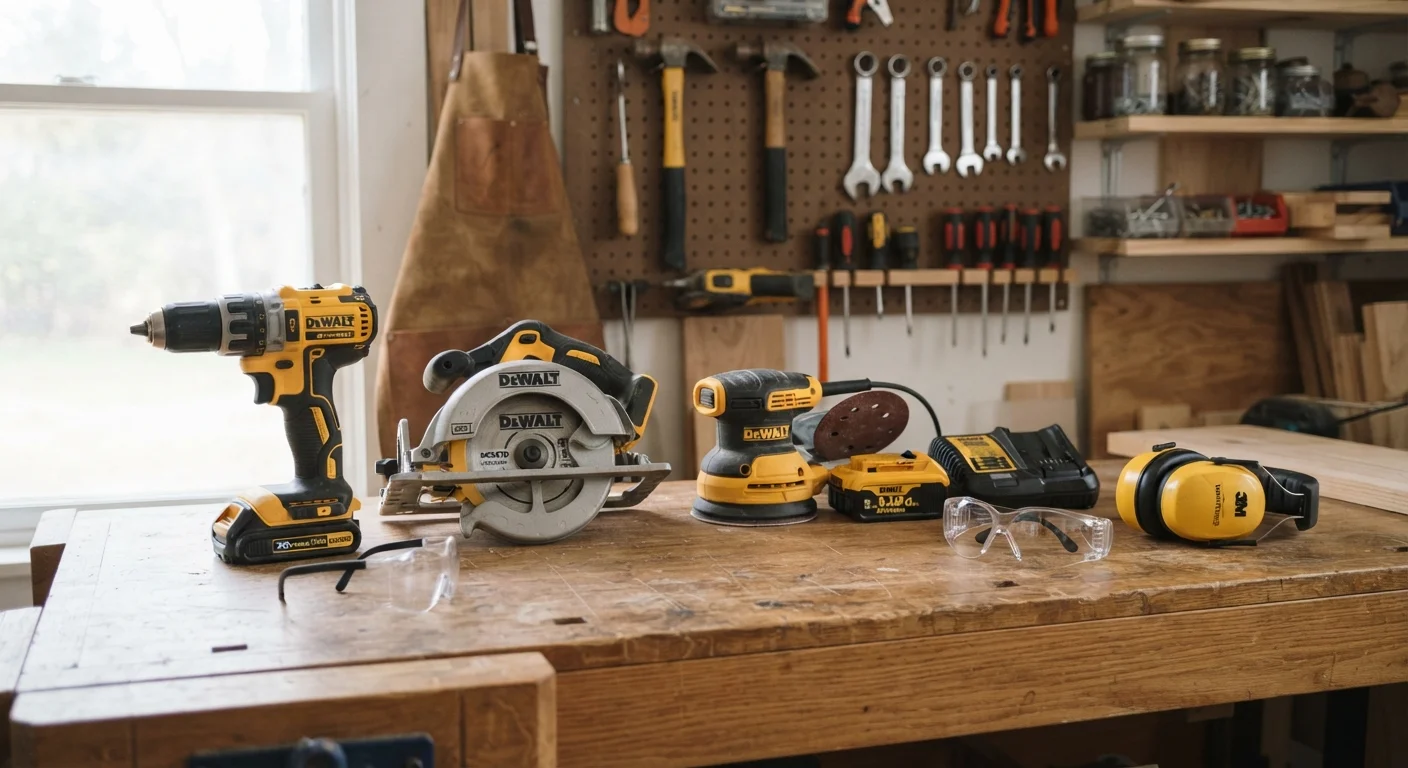
- Drill/Driver: Drills holes and drives screws. The most versatile starting tool for almost any project.
- Circular Saw: Makes straight cuts in sheet goods and lumber. Requires careful technique and workpiece support.
- Orbital Sander: Smooths surfaces quickly and evenly. Lower risk profile than cutting tools, great for finishing work.
- Jigsaw: Cuts curves and irregular shapes in wood, plastic, and thin metal. More controlled than a circular saw for freehand work.
Each of these tools has a distinct use case. Buying one you don't yet need - because it seems impressive - is one of the most common beginner spending mistakes. Start with what your first two or three projects actually require, then add tools as real needs emerge.
Corded vs. Cordless: A Plain-Language Comparison
This is one of the first decisions beginners face, and the marketing around it isn't always honest. Here's the practical reality:
| Factor | Corded | Cordless |
|---|---|---|
| Power consistency | Steady throughout use | Can fade as battery depletes |
| Mobility | Limited by cord length | Fully portable |
| Upfront cost | Generally lower | Higher (includes battery) |
| Maintenance | Minimal | Battery care required |
| Best for | Stationary, sustained work | Moving around, tight spaces |
Battery voltage (18V, 20V, etc.) is a rough indicator of power class, but it doesn't tell the whole story. For a much deeper breakdown of how to match tool type to specific tasks, see our article on corded vs. cordless power tools.
Reading a Power Tool's Specs
The label on any power tool contains useful information - once you know what to look for. The most common specs you'll encounter are:
- Amps (A)
- Measures how much current a corded tool draws. Higher amps generally means more sustained power for tough tasks.
- Volts (V)
- On cordless tools, voltage reflects the battery platform's power class. It's comparable within a category but not across different tool types.
- RPM
- Revolutions per minute - how fast the bit, blade, or pad spins. Variable-speed tools let you adjust this for different materials.
- Torque
- Rotational force. High torque matters for driving large fasteners or working in dense materials.
Specs only make sense in context. A high RPM drill isn't inherently better - some materials require slower speeds to avoid burning or cracking. For a full glossary of power tool terminology, our power tool language guide is worth bookmarking. And if you've heard that more power is always better, our piece on common power tool myths addresses that directly.
Safety Fundamentals Before You Switch Anything On
Power tools are safe when treated with consistent respect - not fear. These habits matter most:
Never Disable a Safety Guard
Every built-in guard on a power tool exists because testing showed it prevents real injuries. Removing or bypassing guards - even briefly - significantly increases the risk of contact with moving blades or parts. If a guard seems to be interfering with your work, stop and re-evaluate your technique or workpiece setup instead.
- Wear appropriate PPE: Safety glasses are non-negotiable for any cutting, drilling, or sanding task. Hearing protection is recommended for sustained use. Dust masks protect against fine particles from sanding or cutting engineered wood.
- Secure your workpiece: A piece that moves unexpectedly is a leading cause of power tool injuries. Clamp work to a stable surface before cutting or drilling.
- Inspect before use: Check cords for damage, blades and bits for dullness or cracks, and guards for proper function. Never operate a tool with a disabled safety guard.
- Read the manual: Each tool has specific operating instructions. Ten minutes with the manual prevents the most common mistakes.
For work involving your home's electrical system, gas lines, structural elements, or main plumbing, always engage a licensed professional. These are not projects where self-teaching carries acceptable risk, and many require permits and inspections under local building codes. Verify requirements with your local authority before starting any such work.
This article is for general educational purposes only. Always follow manufacturer instructions and consult a qualified professional for any work that is hazardous, regulated, or requires permits in your area.
Frequently Asked Questions
Yes, when used correctly and with appropriate protective equipment. Start with lower-risk tools like a drill or orbital sander, read the manual before operating, and never bypass safety guards. Confidence comes from understanding the tool, not from skipping precautions.
Either works for most beginner projects. Cordless tools offer more flexibility and are easier to handle in tight spaces, while corded tools deliver consistent power without battery management. Your choice should depend on your workspace and the types of tasks you plan to tackle.
RPM stands for revolutions per minute - it tells you how fast the moving part (bit, blade, or pad) spins. Higher RPM doesn't always mean better; different materials and tasks call for different speeds.
A cordless drill/driver is the most versatile starting point for most DIYers. It handles drilling holes and driving screws across wood, drywall, and light metal, covering a wide range of common home projects.
It depends on the tool. Gloves are appropriate for some tasks but should never be worn near rotating bits or blades, where fabric can catch and pull your hand into the cutting surface. Always check tool-specific guidance.
Permits are typically required for structural, electrical, plumbing, and HVAC work - not the use of the tools themselves. Always check your local building code before starting any project that changes the structure or systems of your home.
The content on this site is for informational purposes only and is not a substitute for professional advice. Always consult a qualified professional for guidance specific to your situation.