

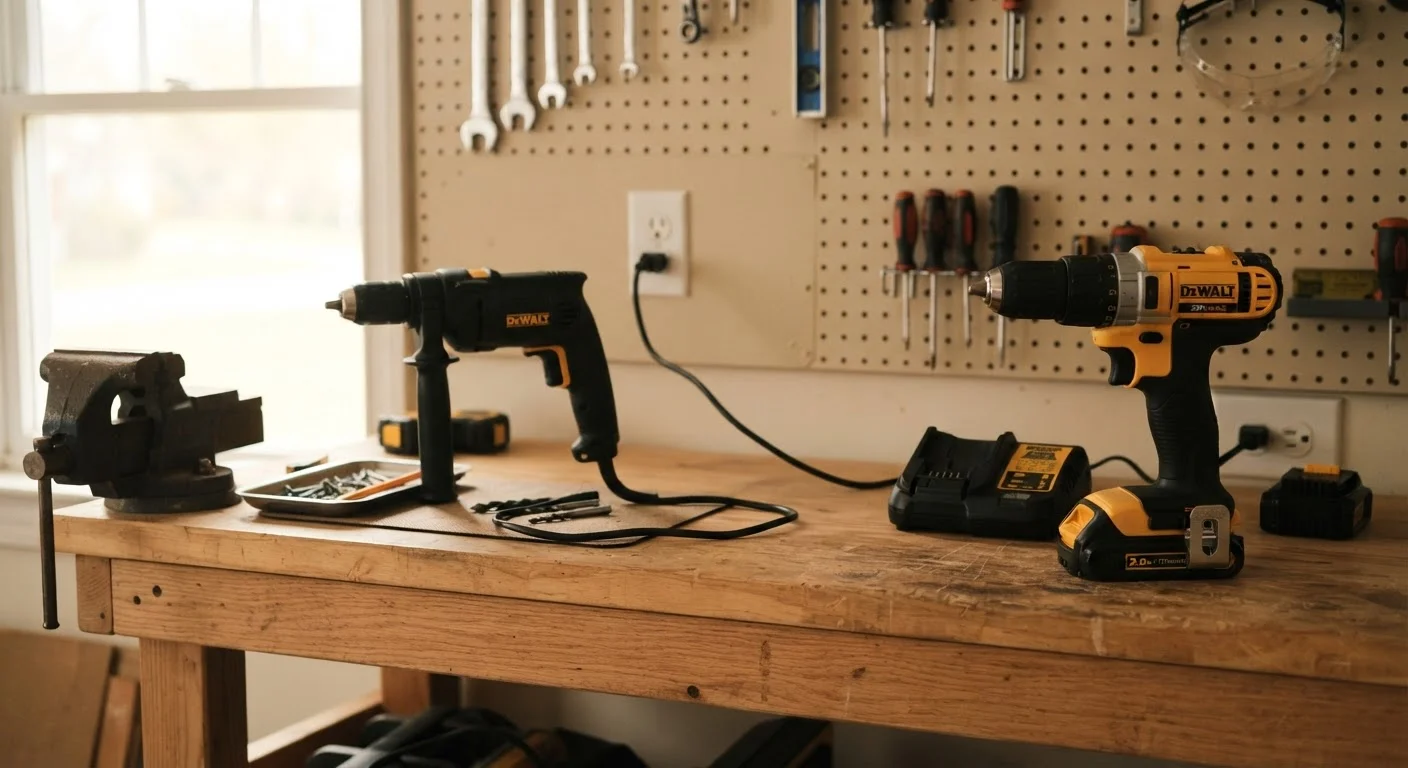
Option A
Corded Power Tools
The consistent, high-output workhorse.
Best for: Extended indoor sessions where a power outlet is nearby and sustained performance matters more than portability.
Option B
Cordless Power Tools
The flexible, go-anywhere option.
Best for: Outdoor projects, tight spaces, and tasks that require moving around freely without managing a trailing cable.
What Actually Separates These Two Tool Types
At the most basic level, corded tools draw electricity directly from a wall outlet while cordless tools run on rechargeable battery packs. That distinction sounds simple, but it creates a ripple of real-world differences in power delivery, runtime, weight, and where you can realistically use them.
Corded tools supply a continuous, steady stream of power. As long as the outlet works, the tool works - there's no gradual performance drop as energy depletes. Cordless tools, by contrast, use lithium-ion batteries that deliver strong initial power but can fade as the charge decreases, particularly under heavy load. Understanding this helps explain why professionals often keep both types on hand rather than committing entirely to one. For a broader foundation on how these tools work, see our beginner's guide to power tools.
Power, Weight, and Runtime Trade-Offs
Corded tools generally produce higher sustained power output for their size. A corded circular saw, for example, can run continuously through dozens of cuts without any concern for battery life. Cordless equivalents have improved dramatically with modern 20V and 40V battery platforms, but a single battery charge still imposes a finite runtime that varies based on the task's demand.
Weight is the other side of that equation. Batteries add meaningful mass - a cordless tool often weighs noticeably more than its corded counterpart. Over long sessions, that extra weight can cause fatigue, particularly overhead or in tight quarters. However, the absence of a cord eliminates the mental overhead of managing cable length and avoiding trip hazards, which is a real safety benefit. If you're planning your workspace layout, our guide on setting up a safe home workshop covers cord and cable management in detail.
| Criterion | Corded Tools | Cordless Tools |
|---|---|---|
| Power consistency | Constant, no drop-off | Strong, may fade at low charge |
| Portability | Limited by cord and outlet | Use anywhere, fully mobile |
| Weight | Generally lighter (no battery) | Heavier due to battery pack |
| Runtime | Unlimited while plugged in | Finite - depends on battery Ah |
| Upfront cost | Often lower (no battery cost) | Higher - battery adds cost |
| Cord/cable hazard | Trip hazard to manage | No cord, cleaner workspace |
| Best environment | Workshop or indoor with outlets | Outdoor, multi-location, cramped spaces |
Matching Tool Type to Common DIY Tasks
The right choice often comes down to three factors: proximity to power, duration of use, and how much you'll move around during the job.
- Drilling and driving fasteners: Cordless drills shine here. Most household drilling and driving tasks are short bursts - hanging shelves, assembling furniture, installing hardware - where a fully charged battery comfortably lasts the whole job. For a detailed look at which drill type handles different materials, see our article on choosing between a drill, driver, and hammer drill.
- Cutting sheet goods or ripping lumber: Corded saws are typically preferred here. Extended, high-resistance cuts draw significant power, and a corded tool won't slow down mid-cut the way a depleted battery sometimes can.
- Outdoor landscaping and deck work: Cordless tools are the practical choice when outlets are far away or nonexistent.
- Finish work like sanding or trim routing: Either type works, but cordless offers easier repositioning without dragging a cord across freshly finished surfaces.
Neither type dominates every scenario. Many experienced DIYers own a corded tool for high-demand tasks and a cordless set for general flexibility.
A Note on Voltage Ratings
Voltage numbers on cordless tools reflect the battery's nominal charge, not a direct measure of real-world performance. Two tools with identical voltage ratings can perform quite differently depending on motor design and electronics. Use voltage as a general power-class guide rather than a precise comparison metric between different manufacturers.
Battery Platforms and Long-Term Value
If you lean toward cordless, battery ecosystem compatibility deserves careful thought. Many manufacturers design their batteries to work across an entire family of tools - one battery fits a drill, a circular saw, a reciprocating saw, and more. Investing in tools from the same battery platform can reduce long-term cost since you share batteries rather than buying separate packs for each tool.
Battery voltage (typically 12V, 20V, or 40V+) indicates the tool's power class, while amp-hour (Ah) rating tells you how long a charge lasts. A 5.0Ah battery runs longer than a 2.0Ah battery on the same charge, though it also weighs more. For light tasks, a smaller battery keeps the tool nimble. For sustained work, the larger pack is worth the extra weight.
Corded tools sidestep battery costs entirely, which is one reason they can be more economical upfront. But if your projects take you anywhere without reliable outlet access, that savings evaporates the moment you can't plug in.
The content on this site is for informational purposes only and is not a substitute for professional advice. Always consult a qualified professional for guidance specific to your situation.