

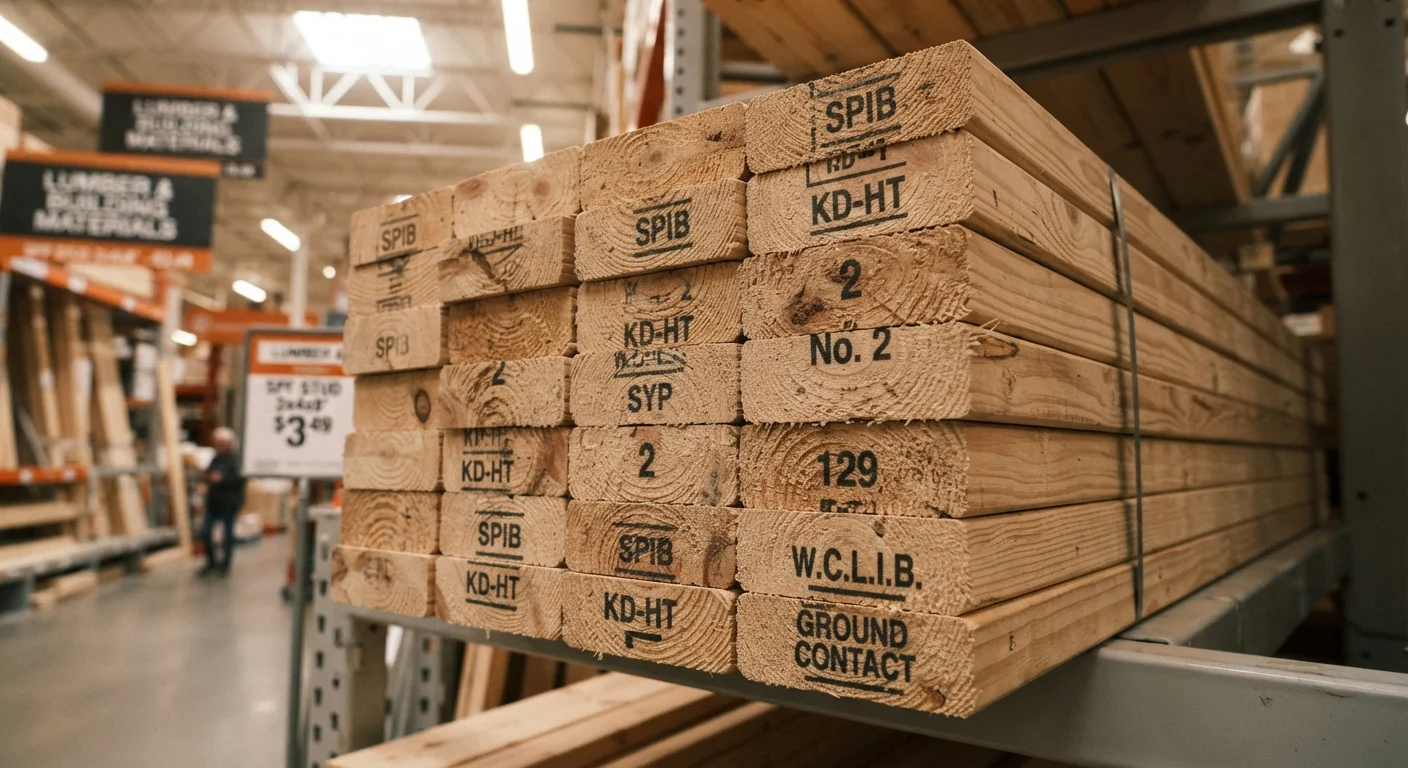
Two Separate Grading Systems - and Why That Matters
Softwood lumber (pine, fir, spruce - the dimensional lumber you find in framing aisles) is graded under two parallel systems: structural grades and appearance grades. These are not interchangeable, and mixing them up is one of the most common ways DIYers either overspend or choose the wrong board for the job.
Structural grades - also called stress grades - rank lumber by its load-bearing capacity. The main categories, from highest to lowest quality, are: Select Structural, No. 1, No. 2, and No. 3. A fourth category, Stud grade, is specifically optimized for vertical wall framing. No. 2 is the sweet spot for most residential framing; it's widely stocked, priced reasonably, and meets span requirements for standard wall, floor, and roof applications.
Appearance grades cover lumber used where the surface will be visible - trim, shelving, paneling, furniture. These are labeled with terms like Clear, Select, No. 1 Common, and No. 2 Common. Clear lumber has virtually no knots; Common grades allow increasing amounts of knots and character marks. For a painted shelf, No. 2 Common is often fine. For stained or natural-finish cabinetry, you'd move up to Select or better.
For a deeper look at how grading applies to sheet goods, see our comparison of plywood and OSB - those products follow their own rating systems based on face veneer and structural panel standards.
Reading the Grade Stamp: What Each Code Tells You
Every piece of dimensional lumber should carry a grade stamp from the certifying mill. It looks dense at first glance, but each element carries useful information:
- Mill number - identifies the sawmill that produced the board.
- Certifying agency - the inspection bureau that verified the grade (e.g., WWPA, SPIB, NLGA).
- Grade designation - the actual grade: "No. 2," "STUD," "SELECT STR," etc.
- Species or species group - such as "HEM-FIR" (hemlock-fir mix) or "S-P-F" (spruce-pine-fir). Different species have different strength values, which matters for structural spans.
- Moisture content - S-DRY or KD-19 means dried to 19% or less; KD-15 means dried to 15%. S-GRN means green (undried).
For a full breakdown of what each stamp code means on the board itself, see our guide to lumber stamp markings.
~80%
Of framing lumber sold is No. 2 grade
No. 2 dimensional lumber is the dominant grade stocked at U.S. lumber yards and home centers, making it the baseline reference point for structural pricing.
15-30%
Typical price premium for No. 1 over No. 2
The cost difference between No. 1 and No. 2 structural grades varies by species, region, and market conditions; for concealed framing, this premium rarely provides meaningful benefit.
19%
Maximum moisture content for S-DRY lumber
The American Lumber Standard requires kiln-dried or S-DRY softwood lumber to be at or below 19% moisture content at time of surfacing.
Matching Grade to Application: Where to Spend and Where to Save
The practical goal is simple: buy the minimum grade that reliably does the job. Here's how to think through common project types:
Framing and Structural Work
No. 2 grade is the standard choice for wall studs, floor joists, and roof rafters in typical residential construction. No. 3 can be used in some non-critical applications like blocking and bracing but check with your local code - span tables and load calculations assume specific minimum grades. Note: Any structural changes to load-bearing walls, floors, or roofs may require a permit and inspection. Verify local requirements before starting.
Rough Carpentry and Hidden Structure
Blocking, nailers, ledger boards, and other concealed elements are good candidates for lower structural grades or even utility-grade lumber. You're buying strength and dimensions, not appearance.
Finish Carpentry, Trim, and Shelving
This is where appearance grade earns its price premium. For painted trim, No. 2 Common pine can work with good surface prep. For stained or clear-coated pieces, budget for Select or better - knots and voids will telegraph through even quality finish coats.
Furniture and Decorative Projects
Consider hardwood appearance grades (sold by the board foot) or explore lower-cost alternatives. Reclaimed wood can offer visual character at a lower price point, though it requires thorough inspection before use. Engineered alternatives are also worth evaluating - our field guide to engineered wood products covers the options available in most lumber aisles.
Ask the Yard to Pull From the Back
Lumber that's been sitting on top of an outdoor stack can weather, warp, or absorb moisture. When hand-selecting boards at a lumber yard, ask staff if they can pull from deeper in the stack or from an indoor storage bay. The boards underneath are often straighter and drier, with no difference in price.
Budget Decisions at the Lumber Yard
A few habits at the point of purchase make a meaningful difference to your material costs and project outcome:
- Hand-select your boards. Prices within a grade are the same, but individual boards vary. Take time to pull boards, sight down the edge for bow and twist, and check both faces for defect location. A No. 2 board with a single small knot near one end is often more useful than one with knots centered on every face.
- Buy to length strategically. Cutting waste adds up. Map out your cut list before buying, and choose lengths that minimize offcuts. Buying a 16-foot board to get two 7-foot pieces often beats buying two 8-foot boards.
- Check the moisture content. Wet or green lumber is often cheaper, but significant shrinkage and movement after installation can cause callbacks on finish work. For interior projects, kiln-dried lumber (KD or S-DRY) is worth the modest premium.
- Understand what grade variation looks like in person. Spend ten minutes at the lumber yard comparing No. 1 and No. 2 boards side by side. The difference in a given stack is sometimes negligible; other times, it's obvious. That firsthand calibration helps you make smarter calls on future purchases.
For context on how grading decisions fit into larger material choices, explore our building materials hub for related explainers.
Frequently Asked Questions
No. 2 is the most common structural grade sold for framing and construction. It permits more knots and minor defects than No. 1 but is considered structurally sound for most residential applications including wall studs, floor joists, and rafters. It is generally the most cost-effective choice for hidden structural work.
Not necessarily. Appearance grades like Select or Clear prioritize visual quality - tight grain, few knots, smooth surface - but this doesn't translate to greater structural strength. For load-bearing applications, always choose lumber graded for structural use, not just appearance.
You can use lower structural grades for decking framing, but visible deck boards benefit from a higher appearance grade to minimize warping and splintering. Species selection and proper sealing matter as much as grade for outdoor durability. Always confirm local building codes for deck construction requirements.
Stamps marked "S-DRY" or "KD" (kiln-dried) indicate the board was dried to 19% moisture content or less, reducing shrinkage and warping after installation. "S-GRN" (surfaced green) means the wood was milled before drying and will continue to dry in place, which can cause more movement over time.
Many structural projects - including adding walls, decks, or modifying framing - require building permits. Permit requirements vary by municipality, project scope, and whether work affects load-bearing elements. Always check with your local building department before starting structural work.
The content on this site is for informational purposes only and is not a substitute for professional advice. Always consult a qualified professional for guidance specific to your situation.