

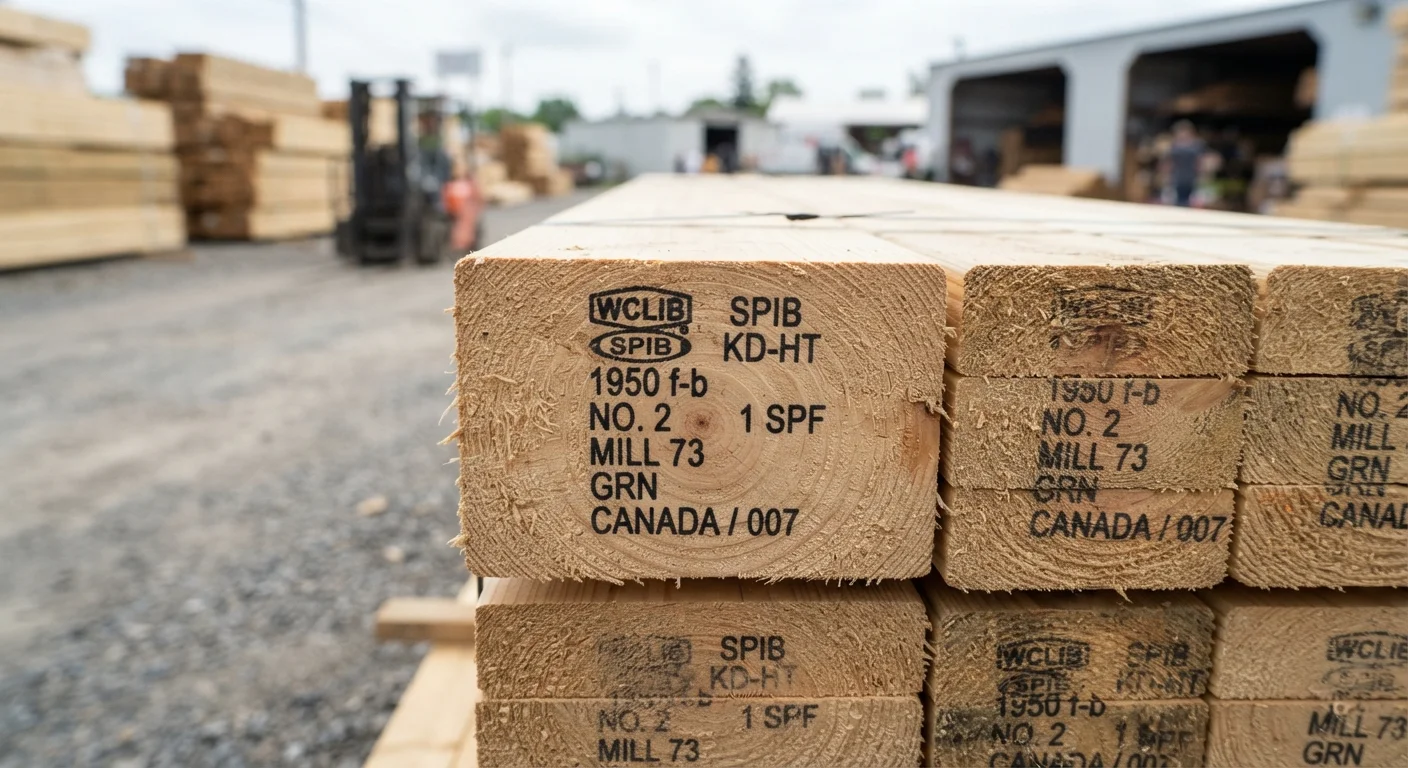
Why Lumber Stamps Exist - and Why They Matter to You
Walk into any lumber yard and you'll find boards marked with cryptic ink stamps: numbers, abbreviations, agency logos, and species codes all crammed onto a two-inch mark. Most DIYers ignore them. That's a mistake - those stamps are the fastest quality-control tool available at the point of purchase.
The U.S. lumber grading system exists to create a shared language between mills, builders, inspectors, and buyers. Without it, every board purchase would require a structural engineer's assessment. With it, a grade stamp gives you reliable, standardized information about what a board can do and where it belongs.
Just as reading a plant label reveals a plant's care needs at a glance, reading a lumber stamp tells you exactly what a board is designed to handle before you haul it home.
The Five Elements Every Stamp Contains
A standard softwood dimension lumber stamp typically includes five distinct pieces of information. Understanding each one is the foundation of smart lumber selection.
- Certifying Agency: The logo or name of the grading agency - such as WWPA, SPIB, or WCLIB - that certified the grade. This confirms the stamp is legitimate and the grading followed recognized standards.
- Mill Number: A number identifying the specific sawmill. Useful for traceability but rarely relevant for DIY purchasing decisions.
- Grade: The most actionable piece of information. In structural softwood lumber, this is typically expressed as Select Structural, No. 1, No. 2, or No. 3 - with Select Structural being the highest and No. 3 the lowest. Higher number = lower quality - a point that trips up many first-time buyers.
- Species or Species Group: The wood type, such as HEM-FIR (hemlock-fir), SPF (spruce-pine-fir), or SYP (southern yellow pine). Different species have different strength values, and building codes may specify minimum species requirements for certain structural applications.
- Moisture Content: Expressed as S-DRY (19% or less), MC15 (15% or less), or S-GRN (unseasoned, above 19%). This tells you how much the board may move after installation. Kiln-dried lumber (KD) offers the most dimensional stability.
19%
Maximum moisture content for S-DRY lumber
Per American Lumber Standard Committee (ALSC) grading rules, lumber stamped S-DRY must be dried to 19% moisture content or below before stamping.
5
Key data points on every grade stamp
Agency, mill number, grade, species group, and moisture content are the five standardized elements found on every conforming softwood dimension lumber stamp.
No. 2
Most common framing lumber grade sold in the U.S.
No. 2 dimension lumber meets minimum code requirements for most residential framing applications and represents the majority of framing stock stocked at U.S. lumber yards.
Structural Grades vs. Appearance Grades: Two Separate Systems
One of the most common lumber-buying errors is conflating two entirely different grading systems. Structural grades evaluate strength - the board's ability to carry load. Appearance grades evaluate visual quality - the board's suitability for trim, cabinetry, or other exposed applications.
Structural softwood lumber uses the numbered system (Select Structural, No. 1, No. 2, No. 3, Utility). Appearance and finish lumber uses a letter-based system: grades like B&BTR (virtually clear), C Select, and D Select indicate increasing amounts of visible character and defects.
A No. 2 stud is fine behind drywall. It would look rough as a mantel shelf. Conversely, a C Select pine board is beautiful for painted trim but was never evaluated for load-bearing capacity - don't use it as a joist.
If your project involves wood movement problems down the road, moisture content markings are often the first clue about what went wrong at the selection stage.
Matching Grade to Application
Choosing the right grade isn't about buying the best - it's about matching performance to purpose. Here's a practical framework:
- Framing studs and joists (hidden work): No. 2 or Stud grade is appropriate for most residential framing. Building codes typically set No. 2 as the minimum for load-bearing applications, though always verify local requirements.
- Decking and outdoor structures: Look for species rated for ground contact or above-ground exposure, and check that pressure-treatment retention levels match the application - a stamp topic unto itself.
- Visible interior woodwork: Select appearance grades (B&BTR through D Select) for painted or stained trim. Clear grades minimize knots; lower appearance grades are suitable where paint will cover minor defects.
- Shelving and shop projects: Hand-select No. 2 boards for cleaner faces, or step up to appearance grades when the surface will be seen.
For a deeper look at how engineered alternatives fit alongside solid lumber, see our field guide to engineered wood products. And if budget is a primary driver, choosing the right grade without overspending explores how to get structural performance without paying for unnecessary quality.
Scan the Stamp Before You Stack
Before loading boards onto your cart, flip each one to find the grade stamp - usually on the face or end. Confirm the grade matches your application and check the moisture code (S-DRY vs. S-GRN) before purchase. Two minutes at the yard can save hours of rework at home.
Practical Tips for Reading Stamps at the Lumber Yard
Stamps are often faint, smudged, or located on the end of the board. Bring a flashlight if you're shopping in a dim yard. When buying in bulk, pull boards from the middle of a bundle where stamps are more consistently visible and boards are often better protected from handling damage.
Don't rely solely on the stamp - inspect each board physically. Look down the length for crown (a slight bow along the face), check for large loose knots, and feel for excessive moisture in S-GRN stock. A grade stamp confirms minimum acceptable quality for that grade; it doesn't guarantee a perfect board. Within any grade, there's a range, and a careful eye at the yard is still your best tool.
This article is for general educational purposes. Structural framing, load-bearing modifications, and any work governed by local building codes may require permits and inspections. Always consult your local building department and, where required, a licensed professional before beginning structural projects.
Frequently Asked Questions
No. 2 is a structural softwood grade indicating the board is suitable for general framing - studs, joists, rafters - where it will be covered and not seen. It allows more knots and defects than No. 1 but still meets structural load requirements defined by building codes. It's the most commonly sold framing grade in U.S. lumber yards.
S-DRY means the lumber was kiln- or air-dried to 19% moisture content or less before stamping. S-GRN (green) means it was not dried and may contain significantly more moisture. Green lumber is cheaper but will shrink and potentially warp as it dries in place, which can be an issue for finish work or tight tolerances.
Technically yes, but results vary. Construction grades prioritize structural strength over appearance, so knots, pitch pockets, and grain irregularities are common. For visible surfaces, select boards from the pile individually, looking for cleaner faces. Finish-grade or 'Select' lumber is a better starting point if appearance matters.
The mill number identifies the specific sawmill that produced and stamped the board. It's primarily a quality-control and traceability tool used by inspectors and contractors, not something most DIYers need to act on. However, if you ever receive a large batch of defective lumber, the mill number helps trace the source.
No - these are different grading systems. 'Select Structural' is the top grade within the structural softwood system, indicating high strength with minimal defects. 'Select' in finish lumber grading (such as B&BTR or C Select) refers to appearance quality for trim, molding, and cabinetry. Always confirm which system is being referenced.
In most U.S. jurisdictions, structural framing work - including interior load-bearing walls and exterior walls - requires a building permit and inspection. Requirements vary significantly by municipality. Always check with your local building department before starting any structural project, regardless of the lumber grade you plan to use.
The content on this site is for informational purposes only and is not a substitute for professional advice. Always consult a qualified professional for guidance specific to your situation.