

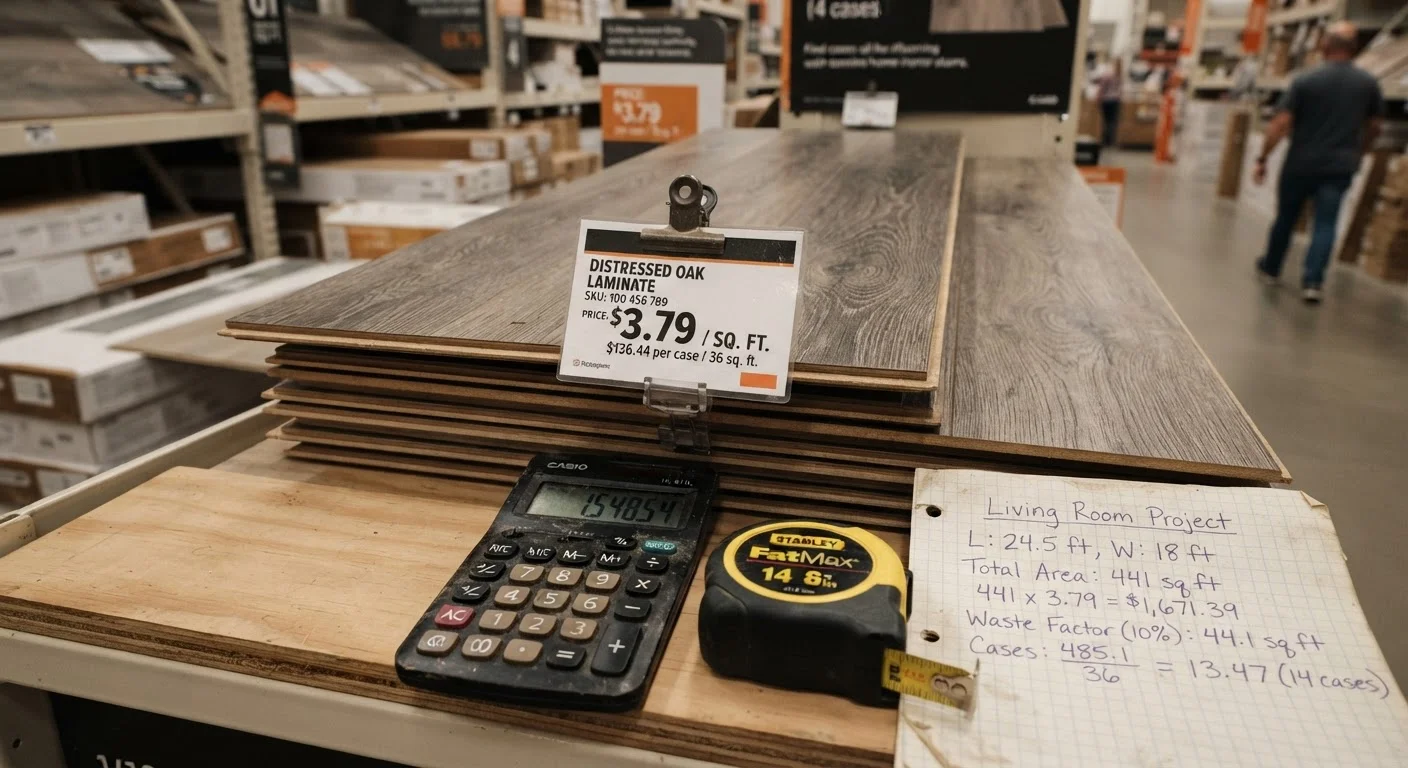
Why the Tag Price Is Just the Starting Point
Walk through any flooring aisle and the pricing looks straightforward: $2.49 per square foot for luxury vinyl plank, $4.75 for engineered hardwood. Multiply by your room size, add a little buffer, and you have a budget. Except that math is routinely off by 50% or more before the first plank hits the floor.
The per-square-foot figure is a raw material cost - nothing else. Every other item required to complete the installation is priced and sold separately. This isn't a hidden conspiracy; it's just how the building materials industry prices product. The problem is that many first-time renovators don't realize how much those additional line items add up, and they're left scrambling for budget mid-project.
Understanding exactly what's excluded - and building a complete cost picture before you purchase - is the single most effective way to keep a flooring project on budget. It also makes it easier to honestly compare two different materials, since a cheaper per-square-foot price on the tag doesn't always mean a cheaper finished floor. For a broader look at renovation cost myths worth questioning, see common decor cost assumptions that don't hold up.
The Line Items That Don't Appear on the Tag
Here's what the shelf price routinely excludes:
- Waste overage: No room installs to exactly its measured square footage. Cuts, mistakes, and pattern matching mean you need more material than the room dimensions suggest. Standard practice is 10% overage for straight layouts; 15-20% for diagonal or patterned installs.
- Underlayment: Many flooring types - especially laminate and floating engineered hardwood - require an underlayment layer for sound dampening, moisture control, or cushioning. This runs $0.25-$0.80 per square foot depending on type, and is rarely included with the flooring itself.
- Adhesive or fasteners: Glue-down vinyl, nail-down hardwood, and mortar-set tile all require bonding materials that are purchased separately. Mortar and grout for tile alone can add $1.00-$1.50 per square foot.
- Transition strips and moldings: Door thresholds, T-molding between rooms, stair nosing, and base shoe molding are all separate purchases. In a home with multiple doorways, these can easily total $100-$300.
- Delivery and haul-away: Heavy materials like tile or stone often carry a delivery surcharge. If you're removing existing flooring, disposal fees may apply.
- Subfloor preparation: If the subfloor needs leveling, patching, or moisture treatment before installation, that cost is entirely separate - and skipping it risks the entire installation. Our article on why subfloor shortcuts backfire explains what's at stake.
10-20%
Typical waste overage needed beyond room square footage
Industry standard guidance for flooring installation recommends 10% overage for straight layouts and up to 20% for diagonal or pattern cuts.
1.5x-2.5x
Installed cost multiplier over raw material price
Flooring industry professionals commonly estimate that installed cost runs between 1.5 and 2.5 times the per-square-foot shelf price once all supplies and labor are factored in.
$1-$3
Per-square-foot supply cost added beyond material price
Underlayment, adhesive or mortar, grout, and fasteners typically add $1 to $3 per square foot depending on material type and installation method.
How to Calculate True Installed Cost
Before purchasing any material, build a line-item estimate. Use this framework:
- Measure your space accurately - length × width in square feet, accounting for closets and alcoves.
- Add your waste factor - multiply by 1.10 for straight lay, 1.15-1.20 for pattern or diagonal.
- Price out every supply item - underlayment, adhesive or fasteners, grout if applicable, transitions, and molding.
- Add prep costs - assess whether your subfloor needs repair, leveling compound, or moisture barrier.
- Account for tool rental - tile saws, floor nailers, and pneumatic staplers are often rentable by the day.
- Total everything, divide by original square footage - this is your true cost per square foot.
When you run this exercise side-by-side on two competing materials, the rankings sometimes flip entirely. A luxury vinyl option at $3.50/sq ft with minimal underlayment requirements may land cheaper than a $2.80/sq ft laminate that needs a thicker pad, has higher waste due to pattern matching, and requires more transition pieces.
This comparison method is especially useful when evaluating hardwood options - see engineered vs. solid hardwood cost differences for a practical breakdown. The same logic applies to tile - porcelain vs. ceramic true cost comparison works through installed cost differences between two commonly confused options.
Applying This to Your Next Project
Getting comfortable with installed-cost thinking changes how you shop. Instead of filtering by price per square foot, you start asking: what else does this material require? A product that needs no underlayment, installs with a floating click-lock system, and generates minimal cut waste may offer genuinely lower total cost even at a higher shelf price.
Write out your cost estimate before setting foot in a store, and update it with actual prices once you're there. If the total comes in over budget, the line-item format makes it easy to see where adjustments are possible - a less expensive underlayment grade, buying transition pieces separately rather than as a bundle, or adjusting the scope of which rooms get the upgrade first.
For anyone planning a full floor replacement or dealing with damage, the complete flooring repair guide covers how to sequence the work and avoid the most common cost overruns from diagnosis through completion.
Material prices and cost ranges cited in this article reflect general US market conditions and will vary by region, supplier, and project specifics. Always obtain local quotes and verify current pricing before finalizing your budget.
Frequently Asked Questions
It covers only the raw flooring material - the planks, tiles, or rolls themselves. Underlayment, adhesive, transition strips, fasteners, waste overage, delivery, and any subfloor prep work are all sold or charged separately.
For straight-lay installations, budget 10% overage. For diagonal, herringbone, or other pattern cuts, plan for 15-20% extra. Complex room shapes with many cuts can push that figure even higher.
Installed cost is the total price to have a material fully in place - raw material, all supplies, labor, and prep work combined. Multiply the square footage of your space by the per-square-foot material price, then add supply costs and either a labor estimate or the value of your own time and tool rentals.
Yes, significantly. An uneven, damaged, or unsuitable subfloor requires repair or leveling before new flooring goes down. These prep costs are separate from material pricing and can add several hundred dollars to a mid-size room project. See our guide on <a href="/budget-renovations/materials-savings/why-cheap-subfloor-material-usually-becomes-the-most-expensive-decision">why subfloor quality matters</a> for more detail.
For most installations, yes. Transition strips cover gaps between flooring types or rooms, and base molding conceals expansion gaps at walls. Skipping them creates both aesthetic and structural problems over time.
List every line item for each option: material, overage, underlayment, adhesive or fasteners, transitions, delivery, and subfloor prep. Total each column and divide by your room's square footage to get a true apples-to-apples cost per square foot.
The content on this site is for informational purposes only and is not a substitute for professional advice. Always consult a qualified professional for guidance specific to your situation.