

Why Simple Maintenance Tasks Go Wrong
Changing an air filter or swapping out a thermostat seems straightforward enough - and for the most part, it is. But these are also tasks where predictable, avoidable errors happen constantly, quietly driving up energy bills, shortening equipment life, or creating safety risks that go unnoticed for months.
Understanding why these mistakes occur is just as useful as knowing what they are. Most stem from skipped steps, misread labels, or assumptions carried over from a previous home or system. Getting these details right takes only a few extra minutes and can meaningfully protect your equipment investment. See also how errors like these connect to signs your HVAC system is working harder than it should.
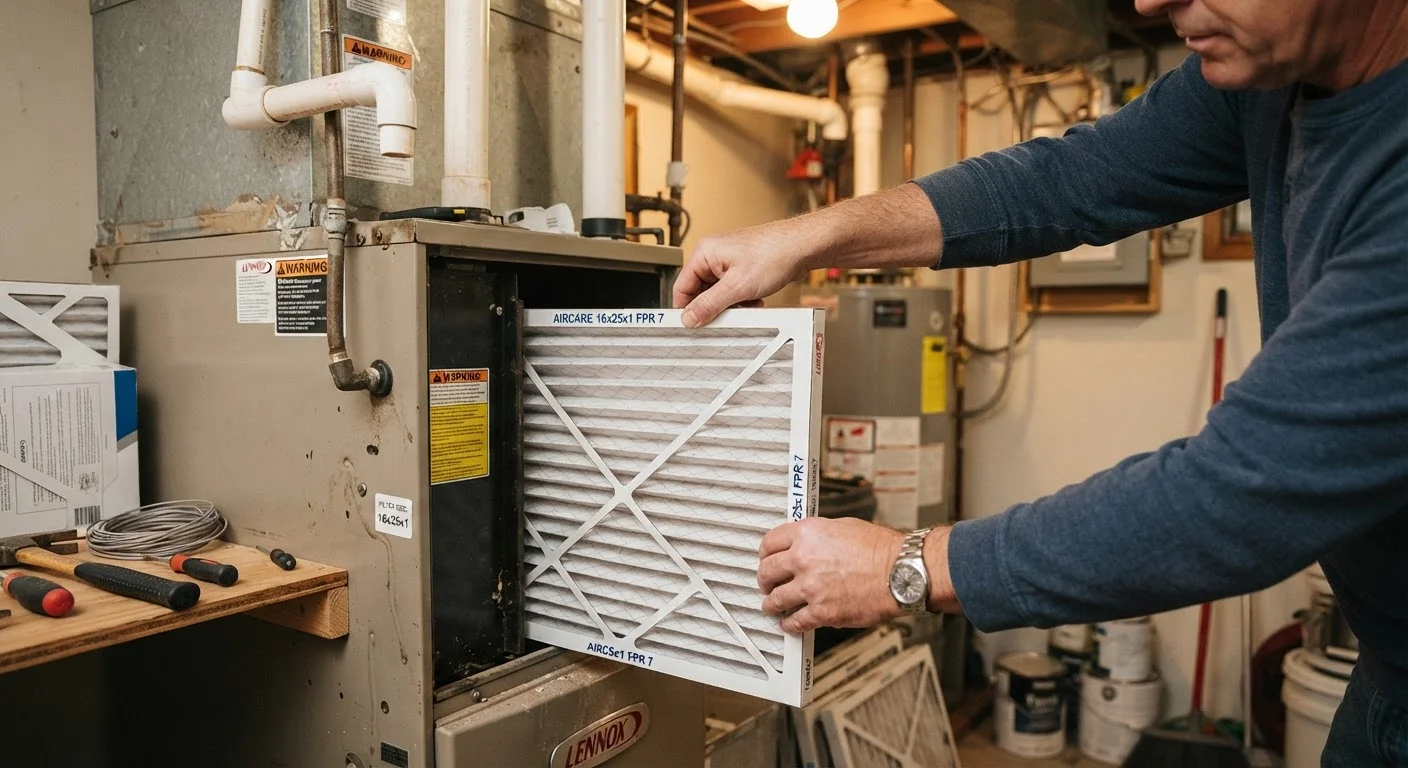
Common Mistakes with HVAC Filter Changes
Filter changes are the most frequent DIY HVAC task - and they carry more risk of error than most homeowners expect.
Installing the filter in the wrong direction.
Why it happens: Filters look similar on both sides, and the airflow direction arrow printed on the frame is easy to overlook in a dim utility room.
Choosing a filter with a MERV rating that's too high for the system.
Why it happens: Higher MERV ratings sound better, and marketing often equates higher filtration with better air quality - but very dense filters block more airflow than many residential systems are designed to handle.
Leaving a gap around the filter due to the wrong size.
Why it happens: Filter sizes are not always consistent between manufacturers, and nominal dimensions (e.g., 16x20x1) may differ slightly from actual dimensions. A filter that's slightly undersized leaves an unfiltered air path.
Failing to photograph existing thermostat wiring before disconnecting it.
Why it happens: It seems like an unnecessary step until the wires spring loose and you can't remember which terminal each one came from - a situation that causes significant troubleshooting time.
Assuming the new thermostat is compatible with the existing system and wiring.
Why it happens: Thermostat packaging lists broad compatibility, and homeowners often assume compatibility without verifying whether their system has a common wire (C-wire) or whether the system type - heat pump, multi-stage, conventional - matches.
Not turning off power to the HVAC system before working on the thermostat.
Why it happens: Low-voltage wiring feels less hazardous, and many people skip the power-off step because nothing seems to happen when wires touch briefly.
5-15%
Potential energy savings from regular filter changes
The U.S. Department of Energy notes that replacing a clogged filter with a clean one can lower an air conditioner's energy consumption by roughly 5-15%.
1-3 months
Typical filter replacement interval
Most HVAC manufacturers recommend checking filters monthly and replacing them every one to three months, depending on pets, occupants, and local air quality conditions.
If you notice your system running longer cycles or rooms feeling inconsistently conditioned after a filter change, revisit the filter first. Also consider whether air leaks in your ductwork or building envelope are compounding the problem - sealing air leaks often does more for comfort than any equipment upgrade.
Common Mistakes with Thermostat Wiring
Replacing a thermostat is a low-voltage task - typically 24 volts - but it still requires care. Wiring errors can cause a system to short-cycle, fail to heat or cool, or in some cases damage the control board, which is an expensive repair.
Control Board Damage Is a Costly Risk
A miswired thermostat can short-circuit the HVAC system's control board - a component that often costs several hundred dollars to replace, plus labor. If your system fails to respond after a thermostat swap, do not repeatedly cycle the power trying to force it to start. Turn the system off at the breaker and consult a licensed HVAC technician to diagnose the issue before further damage occurs.
Once your thermostat is working correctly, you can get significantly more out of it by programming it thoughtfully. Our guide to thermostat schedules that actually reduce energy use walks through practical scheduling strategies that cut consumption without sacrificing comfort.
For context on how HVAC maintenance fits into a broader home efficiency picture, it's worth comparing the considerations involved in DIY insulation installation - another task where skipped steps carry real consequences.
Any work involving your home's main electrical panel, gas lines, or refrigerant handling requires a licensed professional. Always verify local permit and code requirements before beginning any HVAC-related project.
The content on this site is for informational purposes only and is not a substitute for professional advice. Always consult a qualified professional for guidance specific to your situation.