

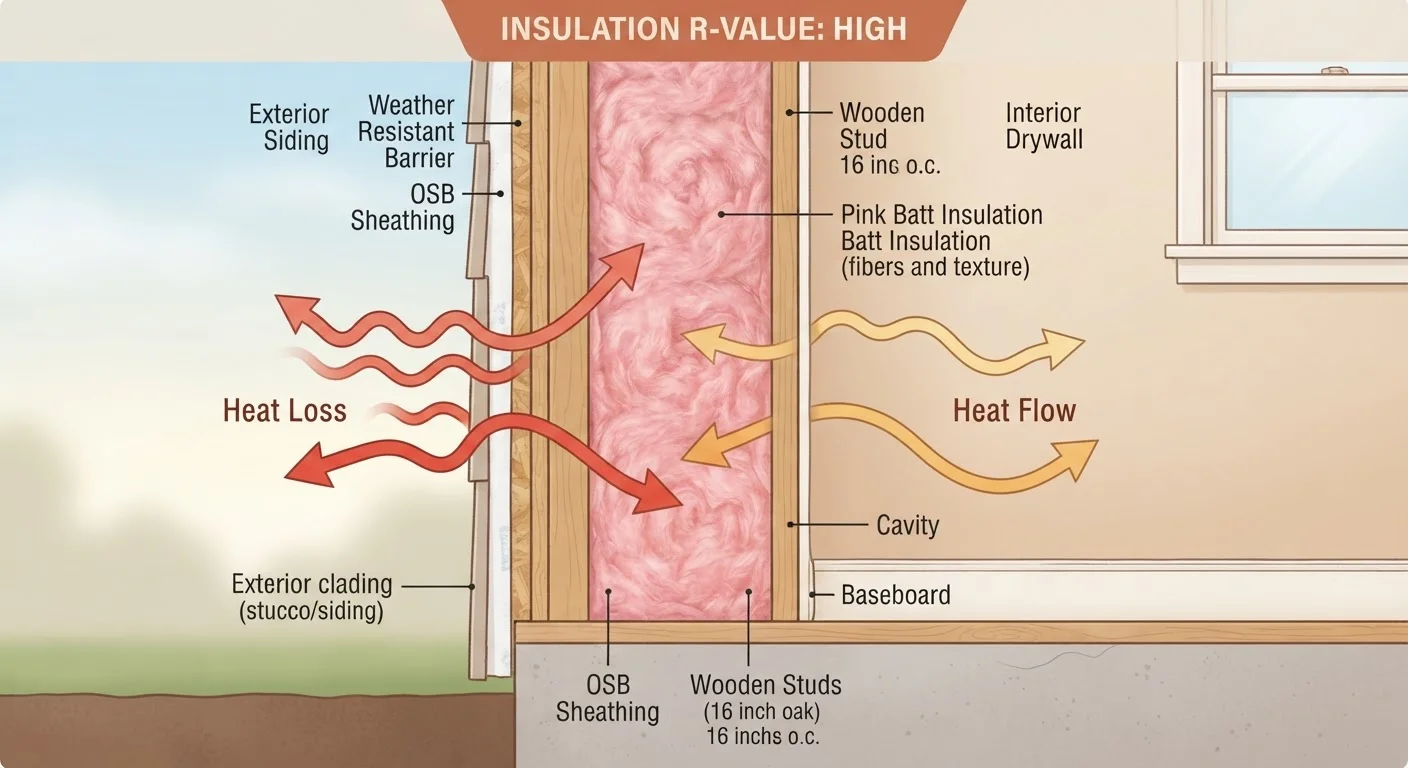
What R-Value Actually Measures
Think of R-value as a resistance score for heat. Heat naturally moves from warm areas to cool ones - out of your home in winter, into it in summer. R-value tells you how strongly a material fights that movement. A wall insulated to R-13 resists heat flow more than one with R-7; a ceiling at R-49 resists it far more than one at R-19.
Every material has some R-value, including drywall, wood studs, and concrete - but insulation products are specifically engineered to maximize it. Manufacturers must test and label their products to established standards, so when a bag of blown-in cellulose advertises R-3.7 per inch, that rating is based on standardized lab conditions.
For a deeper look at how insulation layers work together beyond just their R-values, see our guide to what each insulation layer does.
R-Value Applies to the Whole Assembly
When professionals talk about wall R-value, they often mean the total thermal resistance of the entire wall assembly - insulation plus drywall, sheathing, siding, and air films. The insulation product's labeled R-value is one part of that total. Understanding this distinction helps you read energy reports and contractor proposals accurately.
Why Climate Zone Changes Everything
The U.S. Department of Energy divides the country into eight climate zones, from the sweltering Gulf Coast (Zone 1) to the frigid northern tier and Alaska (Zones 6-8). Your zone directly determines the R-value targets recommended for your attic, walls, floors, and basement.
A home in Houston may only need attic insulation rated at R-30 to R-38, while a home in Minneapolis is recommended to reach R-49 to R-60 in the same location. Installing less than the recommended amount for your zone means your heating and cooling systems work harder than necessary - and your utility bills reflect it.
You can find your specific climate zone and associated R-value recommendations on the DOE's Energy Saver website or ask your local utility company, which often provides this guidance free of charge.
R-49 to R-60
Recommended attic R-value for coldest U.S. climates
According to U.S. Department of Energy recommendations for Climate Zones 6 through 8, covering areas like the upper Midwest and northern New England.
~15%
Estimated heating and cooling savings from air sealing and insulating
The U.S. EPA estimates that air sealing and adding insulation in key areas can save typical homeowners around 15% on their total heating and cooling costs.
R-3.2-3.8
Typical R-value per inch of cellulose insulation
Blown-in cellulose, made from recycled paper fiber, offers moderate R-value per inch and is a common choice for attic top-ups and dense-pack wall retrofits.
How to Gauge Whether Your Home Has Enough
The easiest place to check is your attic, because it's accessible and insulation is visible. Take a ruler or tape measure up there. Fiberglass batts compressed to 3.5 inches in a standard 2×4 wall deliver around R-11 to R-13. Loose-fill fiberglass at 10 inches is roughly R-30; cellulose at the same depth is closer to R-37. If your attic floor shows only a few inches of material - or worse, bare joists - you're almost certainly under-insulated.
Walls are harder to assess without an energy audit or thermal imaging. A professional energy auditor can use a blower door test combined with an infrared camera to reveal where heat is escaping. Many utility companies offer subsidized audits, so check before hiring privately.
For a material-by-material breakdown of R-values per inch and typical applications, the insulation quick-reference guide is a useful companion resource.
Common Pitfalls That Undermine Your R-Value
R-value ratings are determined under ideal lab conditions. In the real world, several factors erode actual performance:
- Compression: Squeezing a batt into a space thinner than its rated thickness reduces its R-value. A 6-inch R-19 batt jammed into a 3.5-inch cavity performs closer to R-13.
- Gaps and voids: Even small gaps around wiring, pipes, or at the edges of batts allow heat to bypass the insulation entirely through air movement - a phenomenon called convective looping.
- Moisture damage: Wet insulation loses thermal resistance. Fiberglass batts that have absorbed water from a roof leak or condensation problem can lose a significant portion of their rated value and may harbor mold.
- Missing air sealing: Insulation slows conductive heat transfer, but air leaks carry heat directly through gaps. Sealing penetrations before insulating dramatically improves real-world performance.
Our article on common insulation misconceptions addresses several of these pitfalls in more detail, including why more insulation doesn't always solve the underlying problem.
Putting R-Value to Work in Your Home
Once you understand your climate zone targets and know your existing R-values, you can prioritize improvements systematically. Attic upgrades typically offer the highest return because heat rises and attic bypasses are common. Sealing air leaks first - around light fixtures, plumbing chases, and top plates - then adding insulation on top is the recommended sequence.
For walls, blown-in insulation added through small exterior holes (dense-pack cellulose or fiberglass) is often the most practical retrofit option. Basement rim joists and crawl space floors are frequently overlooked but can account for meaningful heat loss in older homes.
Keep in mind that insulation work in walls, around electrical wiring, or involving spray foam in enclosed cavities may require permits or professional installation depending on your local building code. Always verify requirements with your local building department before starting work. For a comprehensive overview of insulation choices and installation zones, see everything you need to know about home insulation.
This article is for general informational and educational purposes only. R-value recommendations, local code requirements, and permit obligations vary by location. Consult your local building department and, where appropriate, a licensed insulation contractor before undertaking insulation projects.
Frequently Asked Questions
It depends on where in your home and where you live. The U.S. Department of Energy recommends attic insulation ranging from R-38 to R-60 in colder climates and R-30 to R-49 in milder ones. Walls and floors have lower targets. Check the DOE's zone map for your specific recommendations.
Higher R-value does mean greater thermal resistance, but there are diminishing returns. Going from R-11 to R-19 is a significant jump; going from R-49 to R-60 yields a much smaller efficiency gain. Installation quality matters just as much as the rating on the bag.
Yes, in most cases you can add new insulation over existing material, particularly in attics. The R-values are additive. Just make sure existing insulation is dry and undamaged before adding more.
Some insulation materials, particularly foam boards using blowing agents, can experience slight R-value drift over time as gases diffuse out of the foam cells. Fiberglass and cellulose are more stable but can lose effectiveness if they become compressed or moisture-damaged.
No. Air sealing, moisture control, and proper installation are equally important. An insulation material with a high R-value installed with gaps or compressed into a thinner space will underperform its rating significantly.
The content on this site is for informational purposes only and is not a substitute for professional advice. Always consult a qualified professional for guidance specific to your situation.