

Why Insulation Myths Are So Expensive
Insulation is one of the highest-leverage investments a homeowner can make - but persistent myths cause many people to either overspend in the wrong places or skip upgrades that would genuinely lower their bills. Understanding what insulation actually does, and where it commonly fails, is the first step toward smarter decisions.
For a thorough grounding in materials, R-values, and installation zones, see our complete home insulation guide. The myths below are among the most costly to believe.
Myth
Adding more insulation will always lower my energy bills significantly.
Fact
Above a certain R-value threshold for your climate zone, additional insulation yields diminishing returns - especially if air leaks are not sealed first.
Insulation slows the transfer of heat through solid materials, but it cannot stop air movement. If your attic has gaps around recessed lights, plumbing chases, or pull-down stair hatches, warm air will bypass even thick batts entirely. Studies by the DOE Building Technologies Office consistently show that air sealing combined with insulation outperforms insulation alone. Check your climate zone's recommended R-values - going from R-19 to R-60 in an already well-sealed attic may offer only marginal gains.
Myth
Every home needs a vapour barrier on all insulated walls.
Fact
Vapour barrier requirements depend on your climate zone, wall assembly, and the type of insulation used - installing one incorrectly can trap moisture and cause mould.
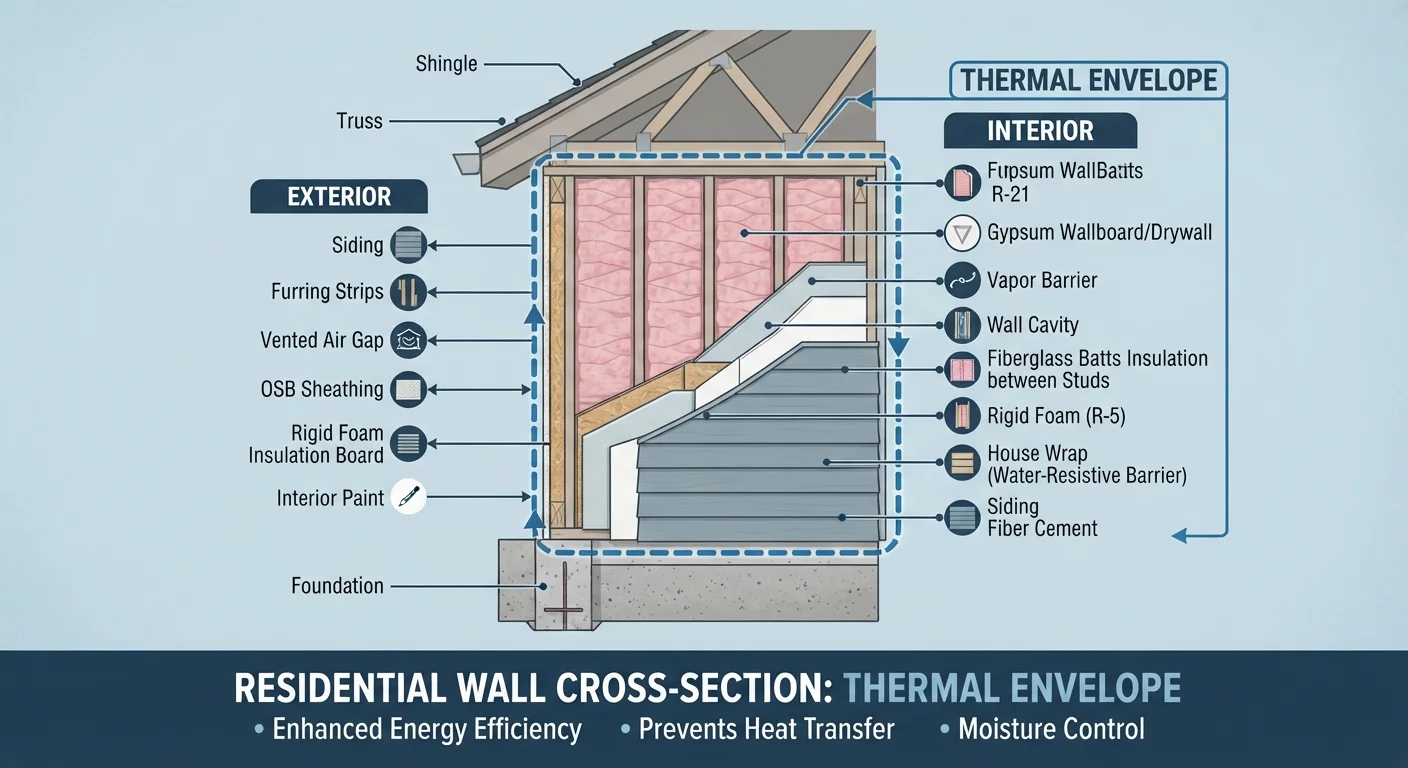
A vapour barrier (or vapour retarder) controls the diffusion of moisture through wall assemblies. In cold climates, it typically goes on the warm-in-winter side (interior). In hot-humid climates, the logic can reverse. In mixed or marine climates, a fully sealed vapour barrier on the interior can actually trap moisture driven inward by summer humidity, leading to rot and mould inside the wall cavity. Always consult your local building code and understand what each insulation layer does before adding a barrier.
Myth
R-value is all that matters when choosing insulation.
Fact
R-value measures resistance to conductive heat flow, not airtightness or moisture management - other factors are equally important for real-world performance.
A high-R-value batt that is poorly fitted around obstructions can perform far below its rated value. Gaps as small as 4% of a wall's area can reduce the effective thermal performance by up to 50%, according to building science research. Some insulation types - such as closed-cell spray foam - provide both thermal resistance and air sealing in one application, while others like fiberglass batts require a separate air barrier. Match the insulation type to the application, not just the R-value target.
Myth
Newly built homes are well-insulated and don't need improvement.
Fact
New construction meets minimum code requirements, which are not the same as optimal energy performance - and installation quality varies considerably.
Building codes set a floor, not a ceiling. Builders working within tight margins may install insulation that technically meets code while leaving rim joists uninsulated, compressing batts (which reduces effective R-value), or skipping air sealing around electrical boxes and plumbing. Homeowners in newer builds who notice cold floors, drafty rooms, or higher-than-expected bills should conduct or commission a home energy audit - a blower door test can reveal air leakage that is invisible to the eye. This is a common thread in broader energy-saving myths worth understanding.
Myth
Insulating the attic is enough to make the whole house comfortable.
Fact
Attic insulation addresses one part of the thermal envelope; uninsulated crawl spaces, basements, and rim joists can account for as much or more heat loss.
The thermal envelope is the full boundary between conditioned and unconditioned space - attic, walls, floors, foundation, and all penetrations through them. Concentrating solely on the attic while leaving a vented crawl space uninsulated beneath the living area means cold air continues to move through floor cavities, making floors uncomfortable and straining your heating system. Prioritize a whole-house assessment rather than addressing zones in isolation.
Where to Focus Your Insulation Dollars
Once the myths are out of the way, the priority list becomes clearer. Air sealing should almost always come before adding more insulation - caulking around penetrations, weatherstripping doors, and sealing the rim joist (the framing where your floor meets the foundation wall) can dramatically reduce heat loss at low cost.
Crawl spaces deserve special attention because they directly affect floor comfort and moisture control. Our crawl space insulation guide walks through the options and when to call a professional. Similarly, if your bills spike every winter despite adequate attic insulation, the real culprits are often hiding elsewhere.
Insulating Over Existing Moisture Problems
Adding insulation on top of damp materials or around active leaks will trap moisture, accelerating rot and mould growth inside your walls or floor assemblies. Always resolve any moisture source - roof leaks, plumbing drips, or ground moisture - before insulating. If you are unsure, a building inspector or energy auditor can assess the situation safely.
Before adding insulation to any area, inspect for signs of existing failure - cold spots, uneven room temperatures, or visible moisture. Learn more about warning signs of insulation failure before committing to a fix. Addressing root causes first saves you from insulating over a problem and sealing it in.
Up to 50%
Thermal performance lost from small insulation gaps
Building science research indicates gaps covering as little as 4% of a wall's area can cut effective thermal performance by roughly half.
~11%
Of US home heating energy lost through floors and foundations
The U.S. Department of Energy estimates that floors, walls, and ceilings together account for a significant portion of home heating and cooling losses.
If you still have doubts about whether your own assumptions about insulation hold up, this companion piece on common insulation assumptions covers additional misconceptions worth reviewing alongside this one.
The content on this site is for informational purposes only and is not a substitute for professional advice. Always consult a qualified professional for guidance specific to your situation.