

Our Verdict
Manual thermostats remain a practical choice for renters or very consistent households. Programmable models hit a strong middle ground for families with set daily routines who want savings without ongoing connectivity. Smart thermostats reward households that can use their full feature set - but they only outperform cheaper options if you actually engage with their scheduling and learning capabilities.
| Best for | Recommended |
|---|---|
| Budget-conscious households or renters who adjust temperature consistently | Manual thermostat |
| Families with predictable weekday and weekend routines | Programmable thermostat |
| Tech-comfortable homeowners who want remote control and automation | Smart thermostat |
| Households with irregular schedules or frequent travel | Smart thermostat |
What Each Thermostat Type Actually Does
At the most basic level, all three thermostat types do the same job: they signal your heating and cooling system to turn on or off based on a target temperature. The meaningful differences lie in how that target is set and maintained.
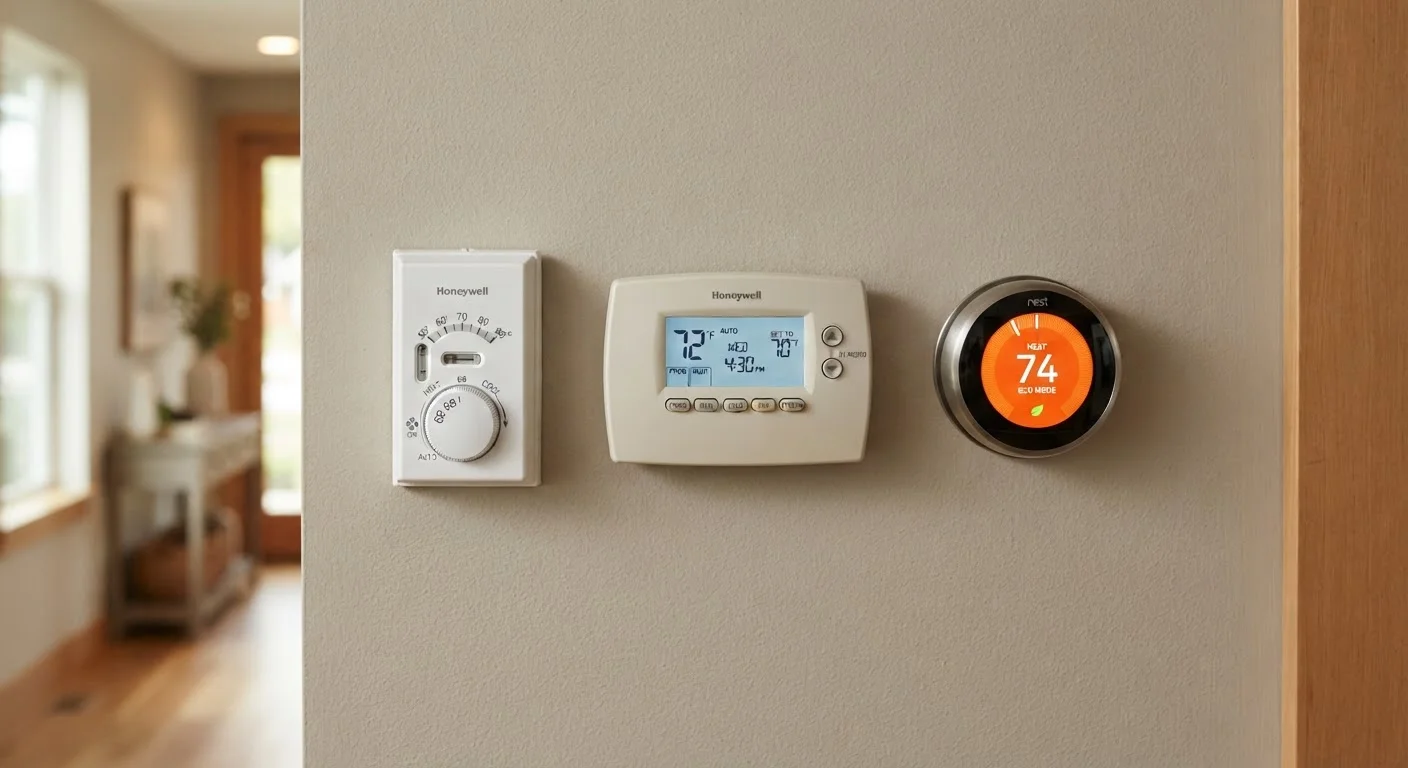
Manual thermostats - including classic dial and basic digital slide models - hold one temperature until you physically change it. There is no scheduling, no memory, and no connectivity. What you set is what runs.
Programmable thermostats let you pre-set different temperatures for different times of day and days of the week. A typical 7-day model can be configured to ease back on heating while you sleep or work, then return to a comfortable level before you arrive home. Once programmed correctly, it requires little daily attention.
Smart thermostats build on programmable functionality by adding Wi-Fi connectivity, app control, and - in many models - learning algorithms that adapt to your patterns over time. Some integrate with voice assistants or broader home automation platforms. For a deeper look at how these two categories actually differ under the hood, see how smart and programmable thermostats compare.
How the Three Options Stack Up
The comparison below covers the criteria that matter most for most households - cost, setup effort, potential energy impact, and practical day-to-day use.
| Manual | Programmable | Smart | |
|---|---|---|---|
| Typical upfront cost | Low ($15-$40) | Moderate ($25-$80) | Higher ($100-$250+) |
| Installation complexity | Very simple | Simple to moderate | Moderate; C-wire may be needed |
| Energy savings potential | Depends on user habits | Good with proper scheduling | High with full feature use |
| Daily effort required | High - manual changes only | Low once programmed | Minimal with automation |
| Wi-Fi / app required | No | No | Yes |
| Best schedule type | Consistent routine | Regular weekday pattern | Irregular or varied schedule |
| Learning / auto-adjust | None | None | Available on many models |
| Remote control | Not available | Not available | Yes, via smartphone app |
A few notes on reading this table: "Energy savings potential" assumes the thermostat is used as intended. A programmable thermostat that was set up once and never adjusted delivers little benefit. Conversely, a disciplined manual thermostat user can match a programmable model's efficiency. Also note that smart thermostat compatibility with older HVAC systems - particularly those without a common wire (C-wire) - can be a real barrier. Check your system's wiring before purchasing any replacement unit. If you're unsure about HVAC wiring, review common DIY thermostat wiring pitfalls before proceeding.
Matching Your Household to the Right Option
The right thermostat depends on three practical factors: your schedule consistency, your comfort with technology, and your HVAC system's compatibility.
Choose a manual thermostat if:
- You rent and cannot justify a significant upfront investment
- Your household keeps a genuinely consistent temperature preference throughout the day
- Your heating or cooling system is older and may not be compatible with modern programmable or smart units
Choose a programmable thermostat if:
- Your household follows a regular weekday/weekend pattern
- You want automatic setbacks without relying on an internet connection or smartphone
- You want meaningful energy savings with a one-time setup investment
Once you've set up a programmable thermostat, the gains come from the schedule itself - not from fiddling with it daily. See our guide on thermostat schedules that reduce energy use to build a schedule that works for your routine.
Choose a smart thermostat if:
- Your schedule varies week to week and you want flexibility without manual adjustments
- You travel or work irregular hours and want remote temperature control
- Your HVAC system is compatible and you're comfortable with app-based setup
One Habit That Affects All Three Types
Regardless of which thermostat you choose, one widespread habit undermines efficiency across all types: cranking the thermostat significantly higher hoping the home heats faster. Most forced-air and heat-pump systems deliver heat at the same rate regardless of how high the target is set - the only result is an overheated home and wasted energy. For a clear explanation of why this happens, read why turning up the thermostat doesn't heat your home faster.
Understanding this principle helps you get more out of any thermostat. Small, consistent setpoint changes - rather than dramatic swings - are where lasting energy savings come from.
This article provides general educational guidance on thermostat types. Compatibility, installation requirements, and energy savings will vary by home, HVAC system, and usage habits. Consult a licensed HVAC professional if you are unsure about wiring or system compatibility before installing any new thermostat.
The content on this site is for informational purposes only and is not a substitute for professional advice. Always consult a qualified professional for guidance specific to your situation.