

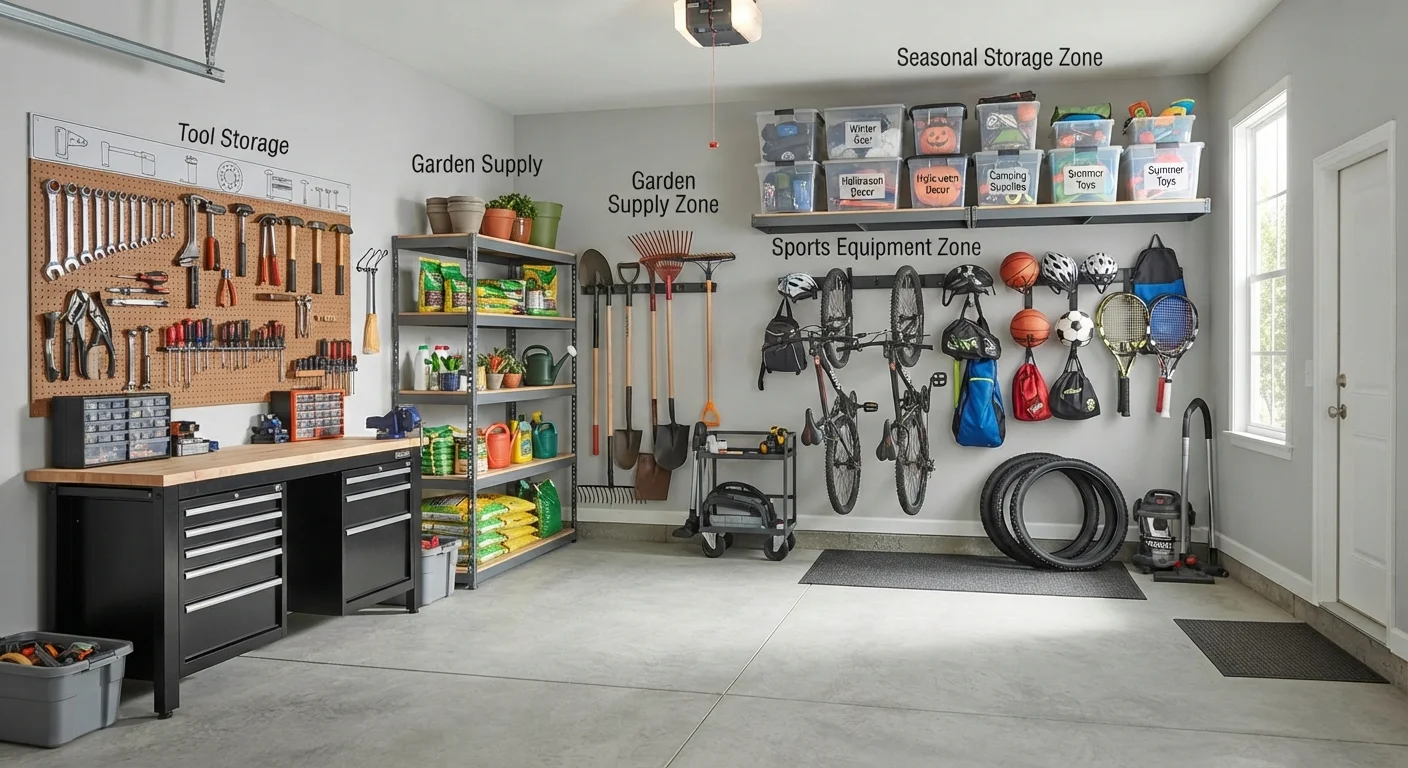
Why Zones Work Better Than General Tidying
Most garage chaos has the same root cause: items were put down wherever space existed at the moment, rather than returned to a defined location. Over time, this creates a layered jumble where finding a drill bit means moving bikes, garden hoses, and a box of holiday lights.
Zoning solves this at the structural level. When every category of item has a fixed home, the habit of returning things correctly becomes nearly automatic. You don't have to remember where you put the pruning shears - they live in the garden zone, always.
This same principle shapes how professionals organize any large mixed-use space. As part of a whole-home storage framework, the garage is treated as a room with distinct activity areas - not just an overflow bin for the house.
Start With a Zone Audit, Not a Shopping Trip
Before purchasing any storage products, spend 20 minutes grouping your existing garage items into piles by category - tools, sports, garden, seasonal, and miscellaneous. This audit reveals which zones are largest, where you actually have gaps, and which items belong elsewhere in the house entirely. Buying first and sorting second almost always results in the wrong products for your real needs.
The Four Core Garage Zones
1. Tools and Hardware
This zone covers hand tools, power tools, fasteners, adhesives, and general maintenance supplies. Place it near the garage's main entry from the house for fast grab-and-go access. Wall-mounted panels, magnetic strips, and drawer units work well here. For deeper guidance on mounting options and load limits, see the wall-mounted storage guide.
2. Sports and Recreation
Bikes, balls, helmets, rackets, and seasonal sports equipment belong in an open, accessible zone - often near the garage door for quick weekend loading. Freestanding racks, ceiling hoists for bikes, and mesh bins for loose balls help keep gear visible and ready.
3. Garden and Lawn Care
Long-handled tools (rakes, shovels, hoes) need vertical storage to avoid floor clutter. A dedicated wall panel or floor-mounted tool holder keeps them upright and separated. Store soil amendments, fertilizers, and pesticides in a locked or child-resistant cabinet within this zone.
4. Seasonal Storage
Holiday décor, off-season sports gear, and climate-sensitive items (like seeds or paint) need a stable-temperature spot, typically along an interior wall away from the garage door. Labeled, stackable bins are the backbone of this zone. Heavy items go on lower shelves; lightweight boxes go higher.
Mapping Your Space Before You Move Anything
Before rearranging a single shelf, sketch a rough floor plan of your garage on paper. Mark the location of doors, windows, utility panels, and the vehicle footprint if you park inside. These fixed points determine where each zone can realistically go.
Apply a use-frequency filter: items used weekly should sit at eye level and arm's reach. Items used monthly can go on higher or lower shelves. Anything pulled out just once or twice a year - holiday inflatables, camping gear - belongs on ceiling racks or in the back corners.
This spatial logic mirrors how room-by-room organization works throughout the home. The kitchen zone approach applies the same frequency-of-use principle to countertops and cabinets. The method transfers directly to the garage.
55%
Homeowners who can't fit a car in their garage
According to a survey by the US Department of Energy, roughly half of two-car garages in American homes are too cluttered to accommodate vehicles.
3-4x
More storage capacity unlocked with vertical systems
Home organization professionals generally estimate that using wall and ceiling space multiplies effective garage storage capacity several times over typical floor-only arrangements.
Maintaining Zones Without Constant Re-organizing
A zone system only works if everyone in the household understands it. Two practices that dramatically improve compliance: clear labeling on every bin and shelf, and a simple visual boundary for each zone (different colored shelf tape, a hanging sign, or even a painted floor stripe).
Schedule a brief seasonal reset - 30 to 45 minutes, four times a year - to catch items that have drifted and to swap seasonal gear in and out of the seasonal zone. This prevents the slow accumulation that makes garages feel unmanageable.
For readers interested in building custom organizers that fit specific zone layouts, the DIY organizers hub offers budget-friendly project ideas that complement any zone structure. And if you've encountered advice that contradicts what you've set up here, it's worth checking common garage storage myths against the facts before making changes.
This article is intended for general informational purposes. Storage needs vary by household. For any installation involving structural anchoring, electrical access, or heavy overhead mounting, consult a qualified professional and verify local building requirements before proceeding.
Frequently Asked Questions
Most households function well with four to six zones, covering tools, sports gear, garden supplies, seasonal items, and a dedicated workspace if needed. The right number depends on how you actually use the space - fewer, larger zones are better than many tiny ones that overlap.
Yes. Zoning is especially valuable in small garages because it prevents random pileups from blocking access. Vertical storage - shelves, wall panels, ceiling racks - lets you stack zones upward rather than outward, which is key when floor space is tight.
Not at all. Basic shelving units, labeled bins, and hook strips can establish a functional zone system at low cost. Start with what you own, assign locations, then invest in additional storage only where gaps are obvious.
Assign the item to the zone matching its primary use. A multi-tool used mainly for car maintenance belongs in the tool zone, even if it occasionally helps with garden work. Avoid duplicating items across zones unless they're inexpensive consumables.
A seasonal review - four times a year - keeps zones aligned with changing needs. Swap out summer sports gear for winter equipment, audit seasonal bins before storing, and reassign anything that has drifted out of its designated area.
The content on this site is for informational purposes only and is not a substitute for professional advice. Always consult a qualified professional for guidance specific to your situation.